Kleene.ai vs Supermetrics: what your AI can actually see
August 5, 2026
- min read
Henry Owen
Product Marketing Manager
Updated 20/10/2026
TLDR: Both platforms let you ask questions of your data in Claude or ChatGPT. Supermetrics is a marketing intelligence platform that connects ad platforms and analytics tools, standardizes the data, and sends it to a reporting destination or an AI chat. It is very good at that and 200,000 companies use it. What it does not do is model that marketing data against your revenue, margin and inventory, because those systems are not what it was built around. Kleene connects the whole business, models it, and runs predictive models on top. If your question is how campaigns performed, Supermetrics answers it faster and cheaper. If your question is what marketing contributed to the business, that answer needs data Supermetrics is not designed to reach.
Supermetrics leads its homepage with connecting your marketing platforms to Claude. We do something similar through MCP. So the interface is not the difference between us, and anyone selling you plain-English querying as a differentiator in 2026 is behind.
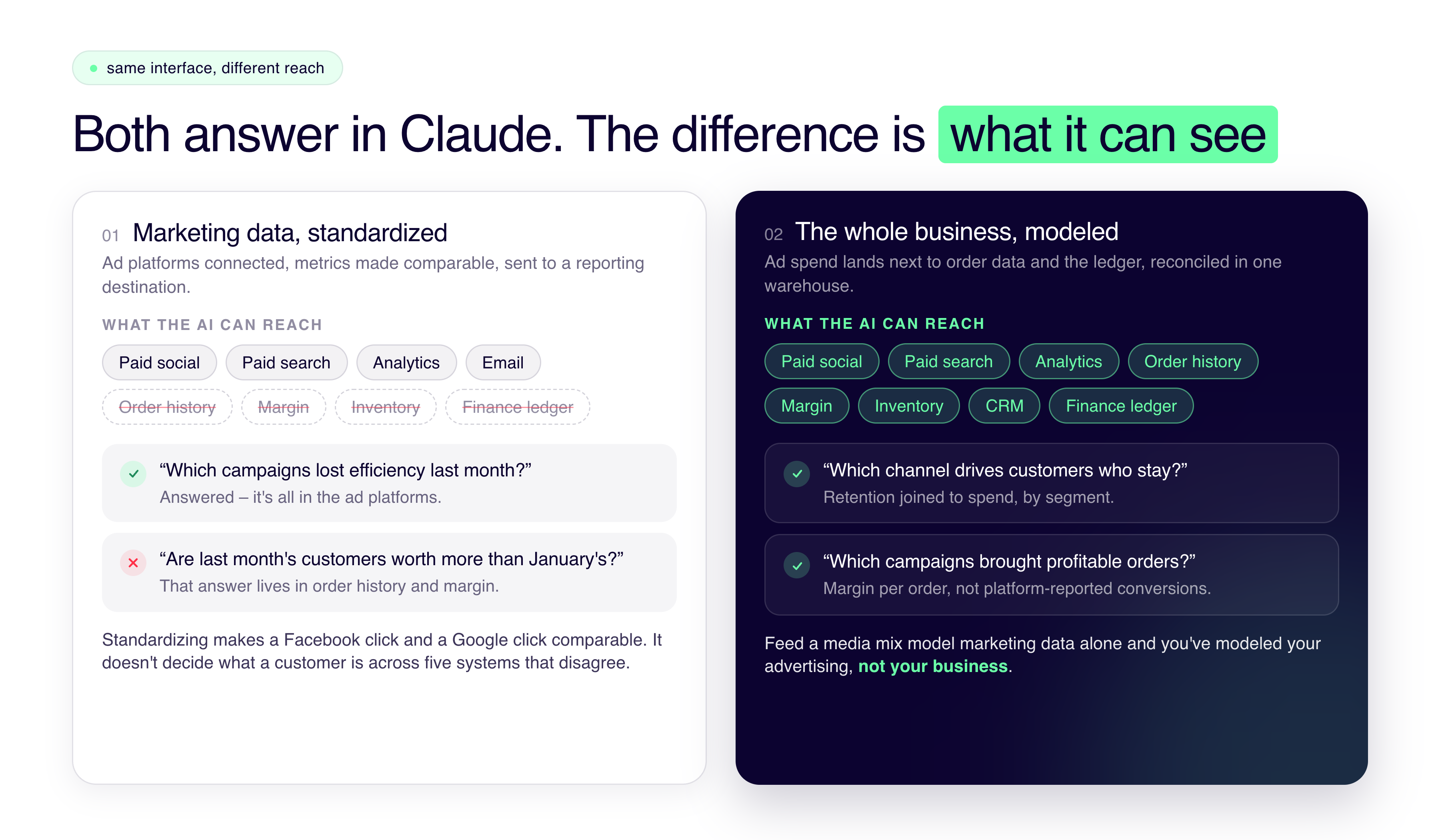
The difference is what the AI can see when you ask it something.
Ask Supermetrics-fed Claude why last month's ROAS dropped and it can tell you which campaigns lost efficiency, which creatives fatigued, which channels moved. Ask it whether the customers you acquired last month are worth more than the ones you acquired in January, and it cannot, because that answer lives in your order history and your margin data.
How Kleene.ai and Supermetrics both work in Claude (via MCP) but have differing capabilities
What Supermetrics does
Supermetrics is a marketing intelligence platform used by more than 200,000 companies across 120 countries, built around four jobs: connect marketing data, manage it, analyze it, and activate it.
Connect is the original business and still the strongest part. Ad platforms, analytics, social, with a large connector catalog covering the marketing stack in more depth than general-purpose ELT tools manage. If you run paid media across six platforms, this is a solved problem for them.
Manage cleans and standardizes what comes in, so the same metric means the same thing across Facebook and Google Ads, which is fiddly work and worth paying for.
Analyze sends the result wherever you report: Looker Studio, Google Sheets, Power BI, Excel, and now Claude and ChatGPT.
Activate pushes data back out to ad, email and engagement platforms, with unified profiles and audience segmentation, capability they added through the Relay42 acquisition. Their own framing is to say goodbye to your CDP.
They are SOC 2 Type II and ISO 27001 certified, GDPR and CCPA compliant, quote 99.9% uptime, and run 24/5 support. Accenture and Dentsu are among the customers on their homepage.
Three things they do better than we do:
Marketing connector depth. They have spent a decade on ad platform connectors specifically. For obscure ad networks and platform-specific metrics, they will cover things we would need to build.
Looker Studio and Sheets. If your team reports in Looker Studio or lives in spreadsheets, Supermetrics is purpose-built for that path and we are not.
The entry price. A small marketing team or a single-brand advertiser can start for tens of dollars a month. We are not competing at that price and should not pretend to.
What Kleene does
Kleene connects the whole business rather than one department. 200+ connectors reaching ad platforms, ecommerce, ERP, CRM and finance. A warehouse we run for you. Modeling in SQL and Python. On top of that, plain-English querying and seven predictive models, built and maintained by an analyst and engineering team assigned to your account.
1. Marketing data, or marketing data in context
Every meaningful marketing question resolves outside the marketing platforms.
Which channel drives customers who stay? That needs retention data. Which campaigns brought profitable orders rather than discounted ones? That needs margin. Should you spend more on the product that converts best? That depends whether it is in stock. Marketing platforms hold none of those, and no pipeline moving marketing data faithfully into a dashboard changes it.
This is what our CPO Ian Liddicoat means when he describes where a model gets its edge over platform reporting:
"The advantage we bring over something like GA4 or platform-level reporting is all the other transactional data we have access to."
To be accurate about Supermetrics, its catalog is not exclusively advertising. Shopify and HubSpot appear in it, and API access reaches further. But the platform is designed around marketing channels, its destinations are reporting surfaces, and the work of joining marketing spend to order-level margin and inventory position is not what it does. That work is the job.
2. Moving data, or modeling it
Supermetrics cleans and standardizes marketing data. That is a real and useful step, and it is not the same as modeling.
Standardizing means Facebook's version of a click and Google's version of a click become comparable. Modeling means deciding what a customer is across five systems that disagree, what revenue means when finance and marketing count it differently, and which of your customers belong in which segment.
Which is the layer that determines whether anything above it can be trusted. Clean marketing data in a dashboard alongside unreconciled revenue produces a report that looks authoritative and is not.
Segmentation shows this most clearly, because you cannot build it from marketing data at all. Grouping customers by what they are worth needs purchase history, order frequency and margin. Those live in your commerce and finance systems, not your ad accounts. Which means a marketing platform can tell you a campaign reached 40,000 people, and cannot tell you whether they were the 40,000 worth reaching.
3. Predictive models
Supermetrics does not have them, and does not claim to. Its role is to get data ready for analysis that happens elsewhere.
Their homepage makes this clearer than we could. A quote from Dentsu's Head of Data Technology describes marketing mix modeling as a process that can take up to a year, with Supermetrics' contribution being to automate the data transfer so the modeling takes less time and less manpower. Which is an accurate description of the product. They are the step that feeds someone else's model.
Kleene builds the model. Seven of them, covering forecasting, pricing, segmentation, media measurement, attribution, inventory and creative.
The marketing ones need the same thing the rest of this article is about. A media mix model weighs channels against each other over years of spend, and it can only do that if it knows what each channel produced in revenue and margin rather than in platform-reported conversions. Feed it marketing data alone and you have modeled your own advertising, not your business.
4. A destination, or a warehouse
Supermetrics sends data to a destination you already have. On the reported pricing, warehouse destinations like BigQuery and Snowflake sit on the enterprise tier, so the accessible plans point at Looker Studio, Sheets, Excel or Power BI.
That shapes what you can do later. Data landing in Looker Studio is available to Looker Studio. Data landing in a warehouse is available to everything, including the models that need to join it to finance and inventory.
Kleene runs the warehouse for you, on Snowflake, which is a Kleene technical partner. Marketing data lands next to order data and ledger data in the same place, which is the precondition for asking a question that spans them.
5. Who does the work
Supermetrics is self-serve by design, and that is part of why it works at its price. You connect the sources, pick the destination, and build the report.
Kleene comes with people. An analyst and an engineer assigned to your account, doing the joining, the modeling and the maintenance. Different product at a different price, for companies where nobody has spare time to own a reporting layer.
6. Pricing, briefly
Supermetrics prices per destination. Each tier covers a number of data sources and one destination, so sending the same data to two places means two subscriptions. Starter went up in 2026, from about $37 a month to $44 billed annually, or $55 if you pay monthly, still with three data sources and weekly refresh. Growth runs around 159 euros with daily refresh, Pro around 399 euros with hourly refresh, and warehouse destinations sit on enterprise pricing. Prices differ between the US and EU. Check their pricing page rather than these figures, which come from third parties, not Supermetrics.
Refresh frequency is the detail most likely to matter. Weekly on the entry tier is fine for a monthly report and not fine for managing spend.
Kleene is a flat monthly fee with unlimited rows and every connector included, and we publish it. Our pricing comparison prices a standardized configuration across several platforms if you want the workings.
Kleene.ai vs Supermetrics, head to head
Kleene.ai
Supermetrics
What it is
Business data platform with predictive models and an embedded analyst team
Marketing intelligence platform: connect, manage, analyze and activate marketing data
Data scope
Whole business: ad platforms plus ecommerce, ERP, CRM and finance
Designed around marketing channels. Some commerce and CRM sources available
Marketing connector depth
Broad, with custom builds available. Not as deep on niche ad networks
Deeper than ours on ad platforms specifically. A decade of specialist focus
What happens to the data
Modeled: entities resolved across systems, revenue definitions reconciled, segments built
Cleaned and standardized so metrics are comparable across channels
None. The product prepares data for modeling done elsewhere
Where data lands
A managed warehouse run for you on Snowflake, a Kleene technical partner
A destination you choose. Warehouse destinations reported as enterprise tier only
Plain-English querying
KAI in-platform, or from Claude and ChatGPT via MCP, across all business data
Yes, Claude and ChatGPT are destinations. Scoped to the marketing data connected
Activation
Reverse ETL from the platform that built the data, plus MCP to AI clients
Unified profiles, audience segmentation and journey orchestration, added via Relay42
Who does the work
Embedded analyst and engineering team, included
Self-serve by design, with onboarding and 24/5 support available
Pricing model
Flat monthly fee, unlimited rows, all connectors included, published
Per destination, tiered by data source count and refresh rate. Annual billing only
Entry price
Higher. Not competing at the low end
Far lower. Starter runs about $44 a month billed annually, up from about $37 earlier in 2026
Best for
Companies asking what marketing contributed to the business, without a data team to find out
Marketing teams and agencies reporting on channel performance across many accounts
Supermetrics pricing figures are reported by third parties, several of whom sell competing products, and it prices differently by region. Check supermetrics.com/pricing directly. Supermetrics has more than 200,000 customers and is SOC 2 Type II and ISO 27001 certified; the distinctions above concern scope of data rather than product quality.
Where Supermetrics is the right call
Choose Supermetrics if your question is campaign performance. How did paid social do against paid search, which creatives worked, where is spend leaking. It answers that faster and for less money than we will.
Choose Supermetrics if you are an agency reporting on many clients. Aggregating client accounts into per-client dashboards is what the product was built for, and it does it well.
Choose Supermetrics if you report in Looker Studio or Sheets. Purpose-built for those destinations in a way we are not.
Choose Supermetrics if your budget is a few hundred a month. At that level we are the wrong conversation, and a marketing team getting clean channel data into one dashboard is a good outcome.
And neither of us, if marketing reporting is not the actual problem. Plenty of teams buy a reporting tool when the underlying issue is that nobody agrees what a conversion is. Fix the definitions first, or you will automate an argument. Our five-step data stack audit covers how to test that in a day.
Bottom line
These are not really competing products. Supermetrics is a marketing data pipeline with reporting and activation on top. Kleene is a business data platform with predictive models and a team.
The overlap is that both will now let a marketer ask a question in plain English and get an answer. What separates them is the size of the question. Which campaign underperformed is a marketing question and Supermetrics is built for it. Whether marketing is making the business money, and which customers it should be chasing, needs order data, margin and inventory in the same place as the ad spend.
If you already have Supermetrics and the reporting is fine but the board question is still unanswered, that is the gap we fill, and it is a reasonable thing to run alongside rather than replace.
Book a call and we will tell you which of your questions your current setup can already answer, including the ones you do not need us for.


%201.svg)


%201.svg)
