
Orchestration
Runs your KAI Analytics models together so price, stock, media and customers are modeled as one system rather than seven separate answers


Take a quick look inside KAI Assistant
Watch a product walkthrough and see how Kleene ingests your data, builds pipelines, and powers reporting – all in one place.


Ask AI whether Kleene.ai is right for you



What is orchestration?

What it does
Each model answers its own question well. None of them know the others exist, so the answers never account for each other.

What is orchestration?
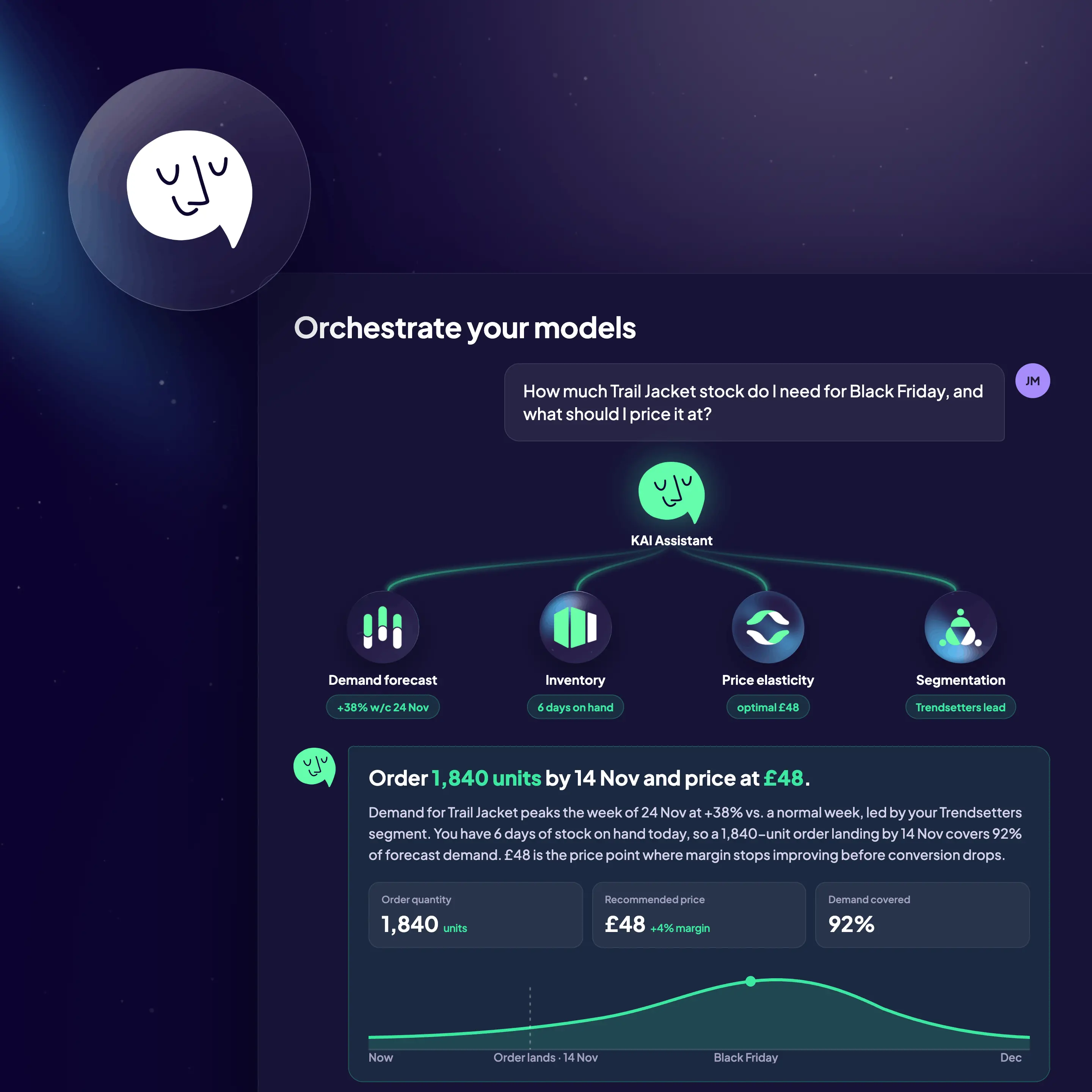
A layer that runs your KAI Analytics models together and works out how a change in one, like price, moves the others, like demand and stock.

What it does for your business
Gives you answers to questions like "what happens to margin if we raise prices and cut TV," instead of you having to reconcile three models' outputs yourself.

What can you ask?

What actually drove sales last quarter: price, media, seasonality or customer mix?
If we raise prices 5% on this segment, what happens to demand and to the media plan?
Which products are at risk next season once you account for both the forecast and how price sensitive their buyers are?
Where should the next £100k go: stock, media or discounting?
Which customer segments respond to TV, and are we forecasting enough stock for them?
how it works
How does orchestration work?

Connect the models
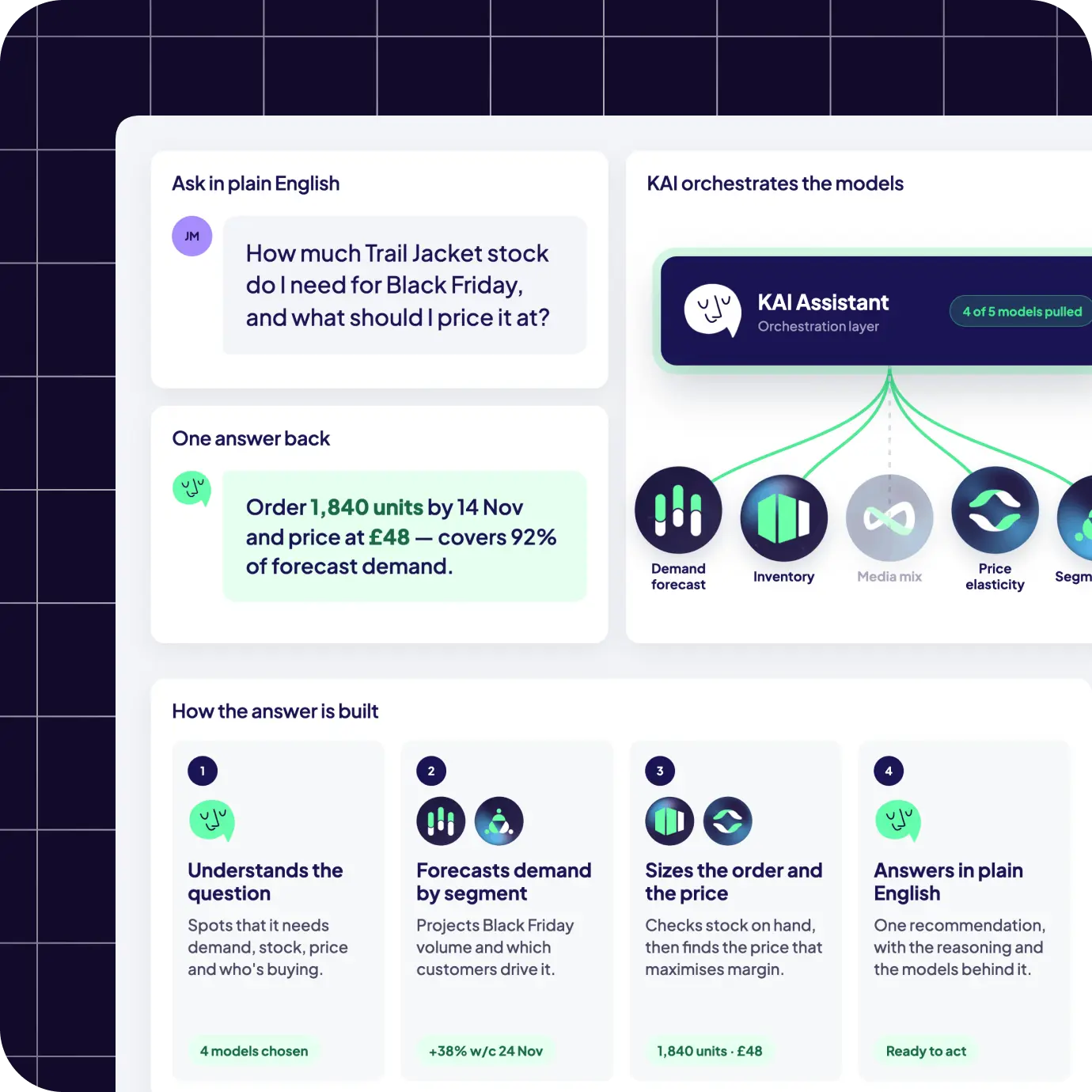
Each KAI Analytics model writes its outputs back to your warehouse as tables keyed to your IDs. Segment codes, forecast volumes, elasticity curves and channel contributions all land in one place.

Model the interactions
The orchestration layer sits across those outputs and estimates how they move together. How does a price change in one segment shift demand? How does a media cut change the forecast? Which segments are most sensitive to both?

Ask one question
With KAI Assistant on top, a CMO or CFO asks what drove sales last quarter, or what happens to margin if price goes up 3% and TV comes down 20%. The answer draws from every model at once, in plain English.
Connectiong models
Built on the KAI Analytics suite
Here are a few examples of how the models connect using orchestration. Any combination works, and most clients run three or more together. The more models in place, the more the layer can tell you.

Media Mix Modeling + Digital Attribution
MMM measures every channel in aggregate. Attribution resolves the digital journey to touchpoints. Fused, you get one view of media performance instead of two that disagree.

Demand Forecasting + Inventory Management
Built independently, they give an 18 month planning horizon together. Orchestration adds price elasticity and segmentation on top, so the plan accounts for who is buying and at what price.
Customer Segmentation + everything
Segment codes are available as variables across every other model, so channel contribution, forecasts and price response are all stratified by customer type rather than averaged across the base.

Lifetime Value + MMM
Most media mix models only see the first purchase. Segment based LTV multipliers feed into the MMM so channels that bring in valuable customers get proper credit, which is usually where brand activity finally gets its due.
Model Orchestration FAQ's
Do our teams need to do anything to keep it running?
No. Our consultants scope the interactions with you, review the first results before anything goes live and maintain the models on an ongoing basis. Your team works with the outputs.
How often does it update?
As often as the models feeding it. Most run on a weekly or monthly schedule, and orchestration recalculates whenever any of its inputs change.
Does it replace the individual models?
No. Each model still runs on its own and writes its own results to your warehouse. Orchestration sits on top and reads from them. If you only want the forecast, you still get the forecast.
How is this different from a dashboard with several charts on it?
A dashboard shows the outputs side by side and leaves you to work out how they relate. Orchestration models how a change in one moves the others and gives you one answer that accounts for it.
Is orchestration a separate product?
No. It's the layer that runs across the KAI Analytics models you already have. There's nothing extra to buy when you run two or more models with us.
Do we need every model for orchestration to work?
No. It starts adding value with two connected models and builds from there. Demand Forecasting with Inventory Management is the most common starting pair, since that's what gets you the 18 month planning horizon.
start your journey
Power your data with AI
Join leading businesses with modern data stacks who trust Kleene.ai
Ask AI whether Kleene.ai is right for you

Copyright © 2026 Kleene.ai All Rights Reserved