What happened to AI data platform pricing over the past couple of years? Almost everyone moved to usage-based billing. Fivetran switched from connector pricing to monthly active rows. Snowflake and Databricks were already metering compute. Matillion runs on credits. And now the new wave of AI features inside these platforms, the SQL copilots and chat assistants and automated modeling tools, are arriving with their own meters attached, usually priced per token, per credit, or per query.
The pitch for consumption pricing is that you only pay for what you use. The reality most finance teams discover is that "what you use" grows with your data, not your revenue, and the bill arrives from four or five different vendors at once. This guide breaks down what consumption pricing actually means in its different forms, and then prices out the full data stack for each major platform, because the cost of any single tool only makes sense in the context of everything else you need around it. If you're earlier in your evaluation and want the broader landscape first, our guide to the best AI data platforms in 2026 covers the full field.
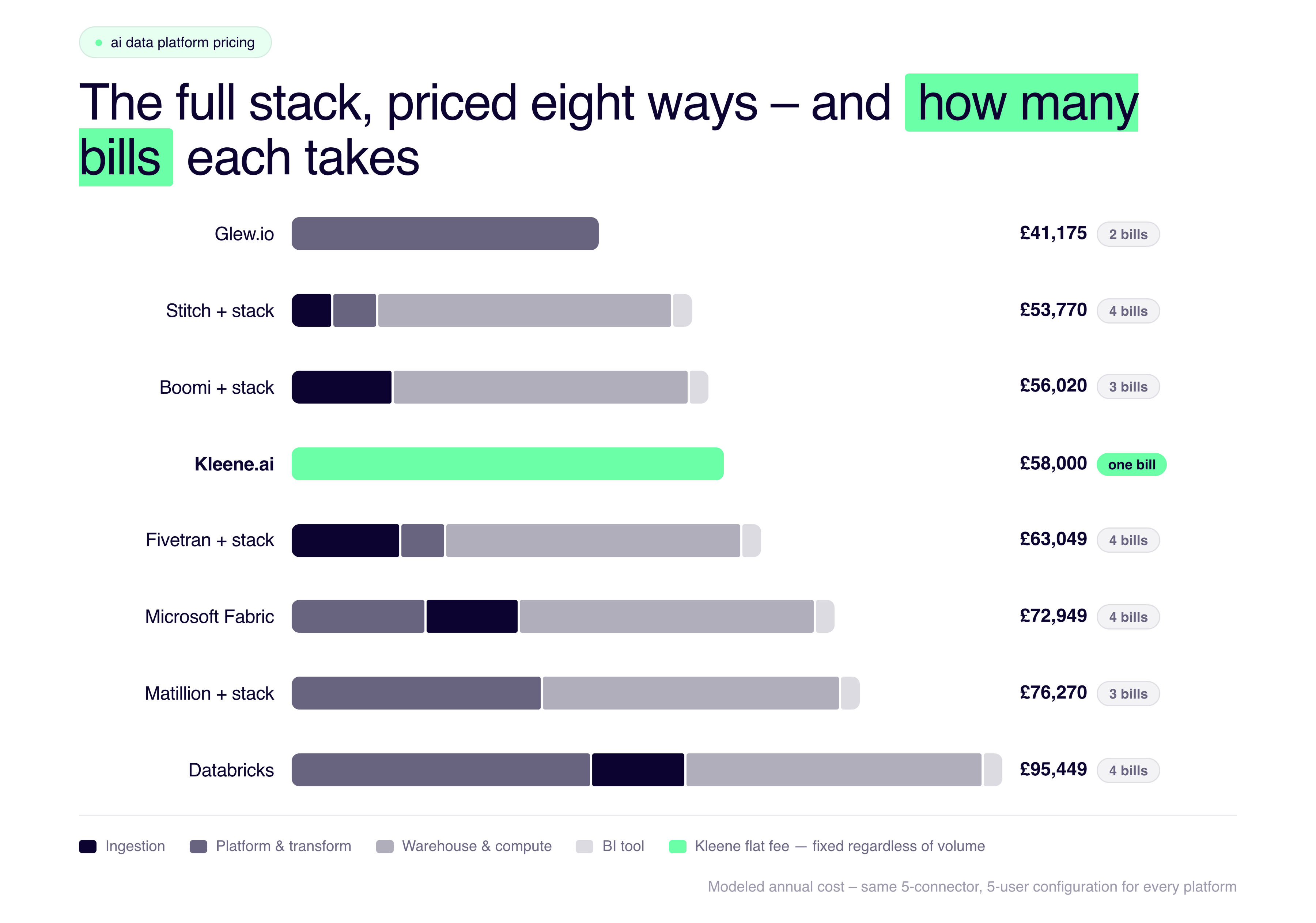
Total modeled annual stack cost on the same 5-connector, 5-user configuration. Most platforms assemble three or four separate bills, while Kleene.ai's flat fee is a single one.
What "consumption-based pricing" actually means, case by case
Consumption pricing isn't one model. It's at least four, and most companies running a modern data stack are exposed to several of them at the same time.
Row and event-based billing charges for the volume of data moved. Fivetran's monthly active rows model is the best-known example: you pay for each unique row synced in a month. Order tables, marketing events, and clickstream data inflate this quickly, and a single high-volume connector like GA4 or Klaviyo can dominate the bill. The cost driver here is how much your data changes, which is loosely related to business activity but only loosely.
Warehouse compute consumption is how Snowflake, BigQuery, and Redshift charge. Every query, every transformation, and every dashboard refresh burns compute credits. The subtlety is that other tools in your stack spend these credits on your behalf. A transformation tool that pushes work down into your warehouse, the way Matillion and dbt do, generates warehouse charges that appear on your cloud bill rather than the tool's invoice. You're paying two vendors for one piece of work.
Platform credits are the model used by Matillion, Databricks, and others. You buy a pool of credits, and pipeline runs, transformations, and platform features draw it down. Credit pricing makes the unit cost look small and the total cost hard to predict, because the relationship between "one credit" and "one useful business outcome" is rarely obvious until you've been running production workloads for a few months.
AI compute metering is the newest layer and the one to watch in 2026. SQL generation assistants, natural-language query tools, and AI-driven modeling features are mostly priced per token, per request, or through yet another credit pool. The compute behind large language models is expensive, so vendors are passing it through. The practical effect is that AI for analytics, the layer that makes these platforms accessible to non-technical users and where most of the business value sits, is often the most aggressively metered part of the product.
Stack these models together and you get the defining cost problem of the modern data stack: no single bill tells you what your data function costs, and several of the meters are running on the same underlying work.
Pricing the full stack, platform by platform
A data tool's sticker price is only meaningful alongside everything else you need to buy to get from raw data to a decision. So instead of comparing license fees, the tables below price the complete stack for each option: ingestion, transformation, warehouse, BI, and where it exists, the intelligence layer.
All figures come from our internal stack model: a standardized mid-market configuration with five users, five connectors (GA4, Shopify, Klaviyo, Meta Ads, Google Ads), and a five-million-row GA4 workload. Dollar-priced tools are converted at the rate used in the model, and your numbers will vary with volume and negotiation, but the relative picture holds.
Fivetran
Fivetran handles ingestion only, so the stack formula looks like this:
Fivetran: full stack cost
Stack component
Tool
Modeled annual cost
Platform fee
Fivetran
£2,250
Connectors (5, MAR billing)
Fivetran
£12,429
Transformation
dbt
£5,850
Warehouse
Snowflake
£40,000
BI tool (5 users)
Power BI / Looker
£2,520
AI / intelligence layer
Not included, separate tools
Additional
Total stack
£63,049 (£5,254/month)
The MAR meter on the ingestion line is the variable to watch. The GA4 and Klaviyo connectors alone account for most of the Fivetran line in this configuration, and both scale with traffic and email volume rather than with revenue. We've written a fuller breakdown of how the two approaches differ in our Kleene.ai vs Fivetran + dbt comparison.
Stitch
Stitch is the budget ingestion option, with simpler row-based pricing and fewer enterprise features:
Stitch: full stack cost
Stack component
Tool
Modeled annual cost
Connectors (5)
Stitch
£5,400
Transformation
dbt
£5,850
Warehouse
Snowflake
£40,000
BI tool (5 users)
Power BI / Looker
£2,520
AI / intelligence layer
Not included, separate tools
Additional
Total stack
£53,770 (£4,481/month)
Cheaper than Fivetran on the ingestion line, with the same warehouse cost dominating the total. Note the row limits on Stitch plans, which cap how far this configuration stretches before forcing an upgrade.
Databricks
Databricks bundles warehouse and transformation into one platform, but you still need ingestion and BI, and the DBU consumption model makes the platform line the most variable in this comparison:
Databricks: full stack cost
Stack component
Tool
Modeled annual cost
Platform (DBU consumption)
Databricks
£40,500
Ingestion (5 connectors, MAR billing)
Fivetran
£12,429
Warehouse / cloud compute
Cloud provider
£40,000
BI tool (5 users)
Power BI / Looker
£2,520
AI / intelligence layer
Build your own (ML tooling included)
Engineering time
Total stack
£95,449 (£7,954/month)
The highest total in the comparison, and the one with the largest hidden line: the data engineering capability required to run it. Databricks includes the ML tooling to build predictive models, but building them is your team's job. For a deeper look at when each platform makes sense, see our Kleene.ai vs Databricks comparison.
Microsoft Fabric
Microsoft Fabric bundles warehouse, transformation, and BI (Power BI is native), billed through capacity units:
Microsoft Fabric: full stack cost
Stack component
Tool
Modeled annual cost
Platform capacity (F-SKUs)
Microsoft Fabric
£18,000
Ingestion (5 connectors, MAR billing)
Fivetran
£12,429
Warehouse / cloud compute
Azure
£40,000
BI tool (5 users)
Power BI licenses
£2,520
AI / intelligence layer
Copilot features, metered
Additional
Total stack
£72,949 (£6,079/month)
The capacity model means you're committed to a tier regardless of utilization, and the Azure compute and storage underneath it is metered separately, which is why the platform line is only part of the total. Fabric's Copilot AI features are a good example of the new AI metering layer: they require higher capacity tiers, so the AI features effectively raise the floor of the whole platform.
Glew.io
Glew is self-contained, which makes the stack formula short:
Glew.io: full stack cost
Stack component
Tool
Modeled annual cost
Platform (5 connectors + dashboards)
Glew.io
£35,550
Transformation add-on
Glew.io
£5,625
Warehouse
Proprietary backend, included, no access
£0
BI tool
Built-in dashboards
£0
AI / intelligence layer
Insights only, no prediction
n/a
Total stack
£41,175 (£3,431/month)
The lowest total here, and the most constrained. The configuration behind this number carries fixed connector and row limits, and there's no path to custom modeling or forecasting inside the platform. The relevant question isn't the price, it's whether your requirements will still fit inside it in eighteen months.
Matillion
Matillion is a transformation platform on a credit model, running inside your warehouse:
Matillion: full stack cost
Stack component
Tool
Modeled annual cost
Platform (credits, 5 connectors included)
Matillion
£33,750
Warehouse (including pushdown compute)
Snowflake
£40,000
BI tool (5 users)
Power BI / Looker
£2,520
AI / intelligence layer
Maia assistant, credit-metered
Additional
Total stack
£76,270 (£6,356/month)
Matillion is the clearest example of the double meter. Its transformations execute in your warehouse, so heavy pipeline activity consumes Matillion credits and Snowflake credits at the same time, on the same work. That's why the warehouse line sits alongside a platform line that is already the second largest in this comparison.
Boomi
Boomi is an enterprise integration platform rather than an analytics tool, so using it as the backbone of a data stack still leaves the analytics layers to be assembled around it:
Boomi: full stack cost
Stack component
Tool
Modeled annual cost
Integration platform (5 connectors + data movement)
Boomi
£13,500
Transformation
Within Boomi processes / warehouse SQL
Included / compute
Warehouse
Snowflake
£40,000
BI tool (5 users)
Power BI / Looker
£2,520
AI / intelligence layer
Not included, separate tools
Additional
Total stack
£56,020 (£4,668/month)
Boomi handles the data movement credibly, and for organizations that already run it for system-to-system integration, extending it toward analytics can look efficient on paper. The catch is that it was never designed as an analytics pipeline, so the path from integrated data to a usable dashboard runs through more configuration and IT involvement than purpose-built tools require, and there's no reporting or modeling capability in the platform itself. We cover the distinction in more depth in our Kleene.ai vs Boomi comparison.
Kleene.ai
Kleene bundles the full stack into a flat monthly fee, which makes the formula a single line. Full details of what each tier includes are on our pricing page.
Kleene.ai: full stack cost
Stack component
Tool
Modeled annual cost
5 connectors + transformation + warehouse + BI + implementation
Kleene.ai (flat fee)
£58,000
AI / intelligence layer
KAI Analytics Models, fixed pricing add-ons
Optional, fixed
Total stack
£58,000 (£4,833/month)
The flat fee covers the same five-connector configuration used for every other platform in this comparison, plus the transformation layer, a managed Snowflake warehouse, the Sigma BI tool, and implementation, with no separate compute charges and no row or credit meters. The KAI Analytics Models for forecasting, price elasticity, segmentation, attribution, and inventory are add-ons at fixed annual pricing rather than consumption rates, which extends the predictability through the intelligence layer rather than stopping at the warehouse. This is what AI data deployment means in practice: the platform, the models, and the advisory team that gets them live arrive as one predictable line on the budget rather than a collection of meters.
One note on our own figure in these tables: it's an estimate for this modeled configuration, with implementation included, rather than a quote. Custom connectors can cost more or less depending on how straightforward they are for our deployment team to set up, so the number for your specific stack lands after we've looked at your sources. The difference from the consumption-priced platforms is that whatever your figure is, it's agreed upfront and stays flat, rather than moving with your data.
The totals, side by side
Total modeled annual stack cost, side by side (all platforms priced on the same 5-connector, 5-user configuration)
Platform approach
Annual stack cost
Per month
Glew.io
£41,175
£3,431
Stitch + full stack
£53,770
£4,481
Boomi + full stack
£56,020
£4,668
Kleene.ai (all-in)
£58,000
£4,833
Fivetran + full stack
£63,049
£5,254
Microsoft Fabric
£72,949
£6,079
Matillion + full stack
£76,270
£6,356
Databricks
£95,449
£7,954
Every row in this table is priced on the same five-connector, five-user configuration, so the comparison is like for like. Two caveats for reading this honestly. The cheapest rows carry the tightest constraints, and the comparison shifts quickly once data volumes or requirements outgrow their entry configurations. And the totals don't capture operational overhead, which is heaviest for Databricks, Fabric, and any multi-vendor stack, where someone in your business has to keep four tools and four meters working together.
The other thing the table shows is what each figure buys. (For a wider tool-by-tool view beyond the platforms here, see our guide to the best ETL tools in 2026.) For most rows, the number is an assembly of separate products and separate bills, several of them consumption-metered. The Kleene figure is one bill for the complete stack, and we'd argue the difference in predictability matters as much as the difference in price.
Kleene pricing FAQs
These are the questions that come up most often on sales calls, answered directly.
Is the cost itemized or all-in? Is it a one-off fee or recurring?
All-in and recurring. You pay one flat monthly fee for your tier, and that fee covers the connectors, transformation layer, managed warehouse, BI tool, and implementation. There is no separate implementation invoice, no setup fee, and no list of line items that grows over the contract. The only things priced separately are the optional KAI Analytics Models, and those are itemized deliberately so you can see exactly what each model costs before adding it.
What about contract length? Is it a 12-month commitment or month-to-month?
Our standard pricing is based on a 24-month agreement, which is how we keep the monthly fee where it is while including full implementation. Shorter terms are possible and priced accordingly, so if a 24-month commitment doesn't fit where your business is right now, raise it with the team and we'll work through the options.
What is the pricing actually based on? Connectors, data bands, number of users?
The tier you choose, and tiers are defined by connector count and platform capabilities. Scale covers up to three connectors, Accelerate up to eight, and Enterprise is unlimited, with each step up adding capabilities like real-time CDC extraction, the KAI Assistant, and multi-tenant instances. What pricing is not based on: data volume, rows processed, compute consumed, or per-seat fees for people who need access. We don't meter usage, so there's no band to outgrow and no incentive for us to hope your bill creeps up.
If my data volume grows 50x, do I pay more to cover the processing?
No. The fee is flat regardless of volume. If your row counts grow fifty times over, your invoice stays the same, and the processing cost is our problem rather than yours. This is the structural difference between flat-fee and consumption pricing: with usage-based platforms, that kind of growth would reprice your contract, and with us it doesn't. The only reason your fee changes is if you choose to move tiers for more connectors or capabilities, and that's a decision you make, not a meter that makes it for you.
Do I pay separately each time a model runs?
No. The KAI Analytics Models are priced as fixed annual add-ons, not per execution. Run a demand forecast daily or hourly and the price is the same. At the Enterprise tier, the full KAI Analytics Suite is available on performance-based pricing, which ties cost to the value the models deliver rather than to how often they run. Either way, there is no per-run meter.
Can we cut the price by doing the implementation ourselves?
Yes. If you have in-house data expertise and want direct access to the platform without our delivery team running the implementation, there's a lower-cost route for exactly that. You get the platform, setup guides, and an onboarding session, and your team builds at its own pace. It suits companies with data engineers who want the tooling without the services wrapper. Talk to the team about which route fits, because the right answer depends on how much internal capability you actually have, and we'd rather tell you honestly than sell you implementation you don't need.
Where this is heading
Consumption pricing isn't going away. If anything, the AI layer arriving across every AI data platform in 2026 deepens it, because AI compute is expensive and vendors will keep passing it through per token and per credit. The companies that come out of this well will be the ones that understand, before signing, which meters they're agreeing to run and what makes each one spin faster.
If you want a version of this stack model run against your own configuration, talk to our team and we'll price it out with you.


%201.svg)


%201.svg)
