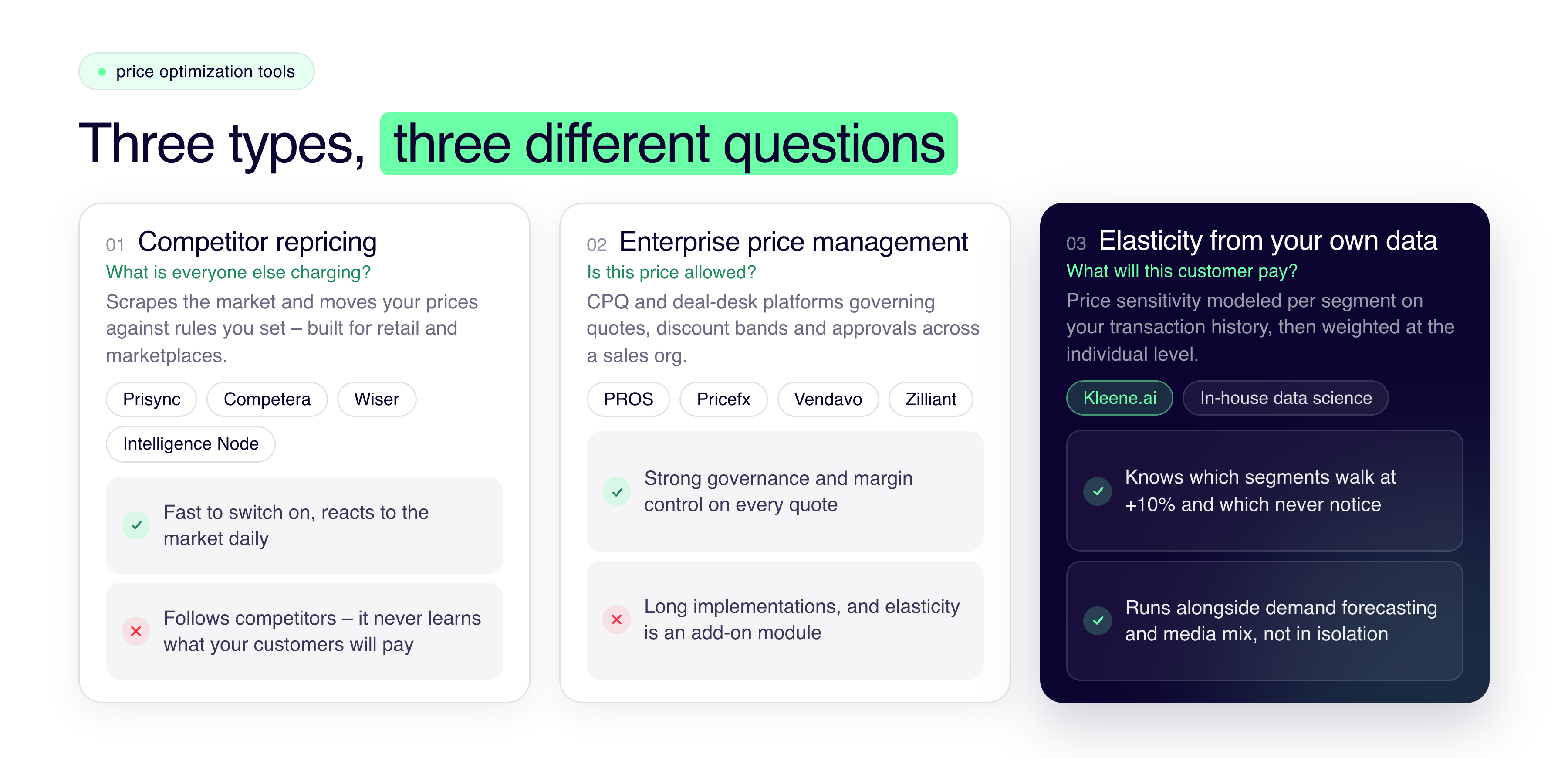
TLDR: The best price optimization tool depends on which job you actually have. Competitor repricers (Prisync, Omnia) adjust your prices against the market automatically, and suit high-SKU ecommerce. Enterprise pricing suites (Pricefx, Vendavo, PROS, Zilliant, Competera, Revionics, Flintfox) manage, quote and enforce prices across large B2B catalogs. Elasticity modeling (Kleene) answers the question the other two take as given: how much demand actually moves when price moves, per product and per customer segment. Most tools act on price. Fewer work out what the price should be, which is where a list like this is worth reading by category rather than by rank.
Search for price optimization software and you get long lists of tools that do quite different jobs, ranked as if they were interchangeable. They are not. A competitor repricer and an enterprise pricing suite and an elasticity model are three different products, and the "best" one is entirely a question of which problem you have.
So this list is grouped by the job, not just numbered. Repricers first, then the enterprise suites that dominate the category by revenue, then the elasticity layer that decides what the price should be in the first place. The number in front of each is a ranking within its group as much as overall, because ranking a retail repricer against a B2B pricing engine is comparing a spanner to a drill.
The top 10 price optimization tools in 2026, broken down into 3 categories
Competitor repricers
For retail and ecommerce sellers whose main problem is staying positioned against competitors across a large catalog.
1. Prisync
Competitor price tracking and dynamic repricing, aimed at ecommerce. It monitors competitor and marketplace prices and adjusts yours against rules you set: match the lowest, sit below a named rival, hold a margin floor. For a store running thousands of SKUs it automates something you cannot do by hand. It is one of the more affordable entries in the category and quick to deploy. What it does not do is tell you whether the rule you gave it is the profit-maximizing one, because it optimizes toward the market rather than toward your demand curve.
Price: published. Around $99/month for 100 products, $199 for 1,000, $399 for 5,000. API access adds roughly 20%.
Pros
Affordable
Fast to set up
Strong competitor and marketplace monitoring
Easy repricing rules
Cons
Optimizes against competitors rather than your own margin
No demand modeling
Ecommerce focus means limited fit for B2B or contract pricing
2. Omnia Retail
A step up in scope from a pure repricer, Omnia handles pricing, promotion and markdown decisions for grocery and larger retail, with dynamic rules driven by competitor and demand signals. Good for retailers who want pricing and promotions in one automated system. Like all repricers, the intelligence is in the rules, and the rules still have to come from somewhere.
Price: custom, with entry plans reported from around €399/month and enterprise deployments quoted individually.
Pros
Handles pricing plus promotion and markdown in one system
Built for grocery and larger retail
Dynamic rules driven by competitor and demand signals
Cons
Heavier and pricier than a basic repricer
Retail-shaped so less suited to B2B
Still rule-driven rather than elasticity-driven
Enterprise pricing suites
For mid-market to large B2B businesses managing prices, quotes and contracts at scale. These consistently rank at the top of the category by revenue and analyst coverage, and they are serious infrastructure rather than quick installs.
3. Pricefx
Cloud-native pricing platform covering price setting, optimization, analytics and CPQ, and one of the most frequently top-ranked tools in the category. Modular and quicker to deploy than legacy ERP pricing modules, which is its main pitch. Implementations run from roughly six weeks to several months depending on complexity. Strong for retailers, manufacturers and distributors that want to run pricing projects without a multi-year IT rollout.
Price: reported around $2,495 per module per month as a public reference point, though most deals are quoted. Third-party benchmarks put a full annual subscription around $50,000 to $150,000, with implementation often adding $100,000 or more in year one.
Pros
Broad and modular across price setting, optimization, analytics and CPQ
Cloud-native
Faster to deploy than legacy ERP pricing
Frequently top-ranked in the category
Cons
Per-module pricing adds up
Still an enterprise commitment in cost and change management
Needs clean historical data before recommendations are reliable
4. Vendavo
A B2B enterprise pricing and CPQ platform built around deal management, guided selling and profitability analysis, with deep CRM and ERP integration. It consistently ranks at or near the top of enterprise pricing lists, and its strength is complex negotiated and contract pricing where a sales team needs real-time guidance. Enterprise scope, enterprise cost, enterprise implementation.
Price: quote only. Not publicly disclosed, and benchmarked by third parties above $100,000 a year for large B2B deployments.
Pros
Deep CRM and ERP integration
Strong for complex negotiated and contract pricing
Guided selling and deal management for sales teams
Consistently top-ranked for B2B
Cons
Heavy implementation
Priced for large enterprises
And overkill for straightforward catalog pricing
5. PROS
AI-driven dynamic pricing and revenue management, strong in industries with complex, fast-moving pricing like travel, distribution and manufacturing. PROS is a category leader for real-time price optimization at scale, and it is built for organizations with the data maturity and the team to run it.
Price: quote only. Enterprise pricing scaled to your data and modules, in the same six-figure range as its peers.
Pros
Strong AI-driven dynamic pricing
Proven in fast-moving sectors like travel and distribution
Real-time optimization at scale
Cons
Assumes real data maturity and a team to run it
Enterprise pricing and timeline
More than a mid-market business usually needs
6. Zilliant
Precision pricing and sales guidance for B2B, using AI to tune prices to individual customer and buying context. Well suited to distributors and manufacturers with large customer bases and lots of SKUs, where small per-transaction pricing improvements compound.
Price: quote only. Third-party estimates put it around $60,000 to $150,000 a year, with a four to six month implementation.
Pros
Precise per-customer and per-transaction pricing
Strong sales guidance
Well suited to high-SKU B2B distribution
Cons
B2B distribution focus
Enterprise implementation
Limited relevance outside large transactional catalogs
7. Competera
AI pricing intelligence for retail and ecommerce enterprises, combining competitor monitoring with demand-based optimization. It sits between a pure repricer and a full enterprise suite, and its onboarding reflects the seriousness of the modeling: it asks for around two years of transactions, stock, price lists and promo calendars to run its full optimization.
Price: quote only, no public list price. Positioned as an enterprise retail platform with an onboarding project rather than a self-serve signup.
Pros
Combines competitor monitoring with demand-based optimization
Sits usefully between a repricer and a full suite
Genuine modeling depth for retail
Cons
Needs around two years of history to run fully
Retail and ecommerce focus
Heavier onboarding than a simple repricer
8. Revionics
Retail pricing optimization focused on assortment, promotion and markdown, aimed at maximizing margin across large retail operations. A strong fit for established retailers with the scale to justify it.
Price: quote only. Enterprise retail pricing, scoped to the size of the operation.
Pros
Strong on assortment and markdown optimization
Margin-focused
Proven at large retail scale
Cons
Built for established large retailers
Less suited to smaller operations or B2B
Enterprise scope and cost
9. Flintfox
Real-time pricing, billing and profitability management for complex environments, particularly CPG and manufacturing with intricate rebate and trade-promotion structures. Specialist rather than general, and excellent for the businesses whose pricing lives in that complexity.
Price: quote only. Enterprise pricing for complex trade and rebate environments.
Pros
Excellent for complex rebate and trade-promotion structures
For businesses that can already set and enforce prices, but cannot confidently say what the price should be.
10. Kleene
The other nine tools on this list act on price. Kleene models the thing underneath it: how demand responds when price changes, for each product and each customer cohort.
Its price elasticity model is an econometric one, a log-log regression across your historical pricing, sales volumes, competitor prices and demand curves, with scenario testing so you can model a price change and see the revenue effect before committing. The output is an elasticity coefficient per product or category, an optimal price, and revenue scenarios. That is the number a repricer's rules and a pricing suite's enforced price both assume someone has already worked out. The detail on how the model is built is here.
Two things make it different from a standalone pricing tool. The first is elasticity by cohort. The customers you acquired on a discount promotion are more price sensitive than your loyal base, so a single elasticity figure for a product is an average that hides the useful move. Modeling acquisition and retention cohorts separately lets you hold or raise price where it will hold and stay careful where it will not. That needs your customer data and pricing data in the same place, which is why it runs on a platform rather than as a point tool.
The second is that pricing does not run alone. Elasticity is one of several models on the same warehouse, and the orchestration layer is what makes them worth more together than apart. Your demand forecast tells the pricing model what volume to expect. Your customer segmentation defines the cohorts the elasticity model prices for. A price change that lifts margin but is expected to dent volume is a different decision once the forecasting model quantifies the dent, and the orchestration layer is what lets those models inform each other rather than produce three answers nobody reconciles. A pure pricing tool cannot do that, because pricing is all it has.
The trade is the obvious one. If all you need is to match competitors across a catalog, Kleene is more than that problem requires, and a repricer is the faster, cheaper fix. Kleene is for businesses where the pricing question is tangled up with demand, inventory and customer behavior, and where answering it in isolation would get it wrong.
Price: flat annual fee, quoted to your setup, with unlimited data rows rather than per-seat or per-transaction charges.
Pros
Models the demand response other tools assume
Elasticity by customer cohort
Runs alongside demand forecasting and segmentation through the orchestration layer
Managed platform with an analyst team
Cons
More than you need if you only want competitor repricing
Requires your pricing and customer data joined together first
Not a self-serve point tool
The decision layer, and the two execution layers that assume it
Layer
The question it answers
What it needs to work
Example tools
Elasticity modeling the decision layer, where Kleene sits
What should the price be? How much can it move before volume falls?
Joined pricing, sales and customer data to model demand response per product and cohort
Kleene, plus in-house data science
Competitor repricing execution
Given a rule, how do I stay positioned against competitors automatically?
Rules and floors to follow, which are themselves elasticity decisions
Prisync, Omnia, BQool, Repricer
Enterprise pricing suite execution
Given a price, how do I quote and enforce it consistently at scale?
A price to enforce, decided upstream
Pricefx, PROS, Competera, Zilliant
The two execution layers both take the price, or the rule that sets it, as an input. Elasticity modeling is where that input comes from. Example tools are illustrative of each layer, not endorsements; enterprise category share (Pricefx, PROS) is per 6sense, 2026.
How to choose
If you cannot keep prices current against competitors across a large catalog, you want a repricer. Prisync or Omnia, cheap and fast, and the analytical questions can wait.
If you are a large B2B managing quotes, contracts and thousands of prices with people who need to approve them, you want an enterprise suite. Pricefx, Vendavo, PROS, Zilliant and the rest, and you should budget for the implementation that comes with the power.
If you can already set prices but cannot say which ones are too low, which are one rise away from losing volume, or how to price different customer segments, you want elasticity modeling. That is the decision layer, and it is the one this whole category tends to assume you have already sorted out.
And plenty of businesses want more than one. The healthiest setup is usually the elasticity model deciding where prices and rules should sit, and a repricer or a suite executing them. Decision layer and execution layer, doing their own jobs.
FAQ
What is the best price optimization tool? It depends on the job. For competitor repricing across a large catalog, Prisync or Omnia. For enterprise B2B price management and CPQ, Pricefx, Vendavo, PROS or Zilliant. For working out what the price should be through elasticity modeling, Kleene. They are different categories, not a single ranking.
What is the difference between a repricer and price optimization software? A repricer adjusts your prices against competitors using rules you set. Fuller price optimization includes working out the profit-maximizing price in the first place, which is an elasticity question a repricer executes rather than answers.
Which price optimization tools are best for enterprise B2B? Pricefx, Vendavo, PROS and Zilliant consistently rank at the top for enterprise B2B pricing, CPQ and revenue management. They are powerful and require real implementation time and a team to run them.
What is price elasticity and why does it matter for pricing? Price elasticity measures how much demand changes when price changes. It matters because the answer differs by product and by customer segment, so a single pricing rule applied across a catalog holds margin on some products and loses volume on others.
Do I need a pricing tool or a data platform? If your problem is keeping prices current or enforcing them at scale, a pricing tool. If your problem is knowing what the right price is, especially across products and customer segments, you need elasticity modeling, which depends on your pricing and customer data being joined together first.


%201.svg)


%201.svg)
