How to implement an AI data stack in 2026: the 5 layers
July 29, 2026
- min read
Henry Owen
Product Marketing Manager
TLDR: An AI data stack has five jobs: getting data in and making the numbers reliable, storing it in one place, reporting on it, running predictive models, and getting answers out. Most guides assume you're starting from scratch and tell you to buy all five. Most businesses already have two or three, so the real question is which layer they're missing rather than which new tool is best. The proper decision is architectural: assemble specialist tools for each layer and own the integration work, or consolidate onto one platform and hand it over. Neither is always right. Roughly 60% of the effort in an AI project sits in the gap between a working demo and production, which is the phase almost nobody accounts for.
Most advice about building a data stack is written as if you're starting from square one.
It'll list five layers, recommend a tool for each, and send you off to the SaaS store with a shopping list. Which would be fine if you were greenfield. But you almost certainly aren't. You (hopefully!) have a CRM, some reporting, and a data warehouse.
This usual assumption of data stack advice causes a problem. Either you buy layers you already own, or you conclude the whole project is too big to start and do nothing for another year.
The 6 layers of an AI data stack, and how to implement them in the right order
The five jobs of an AI data stack
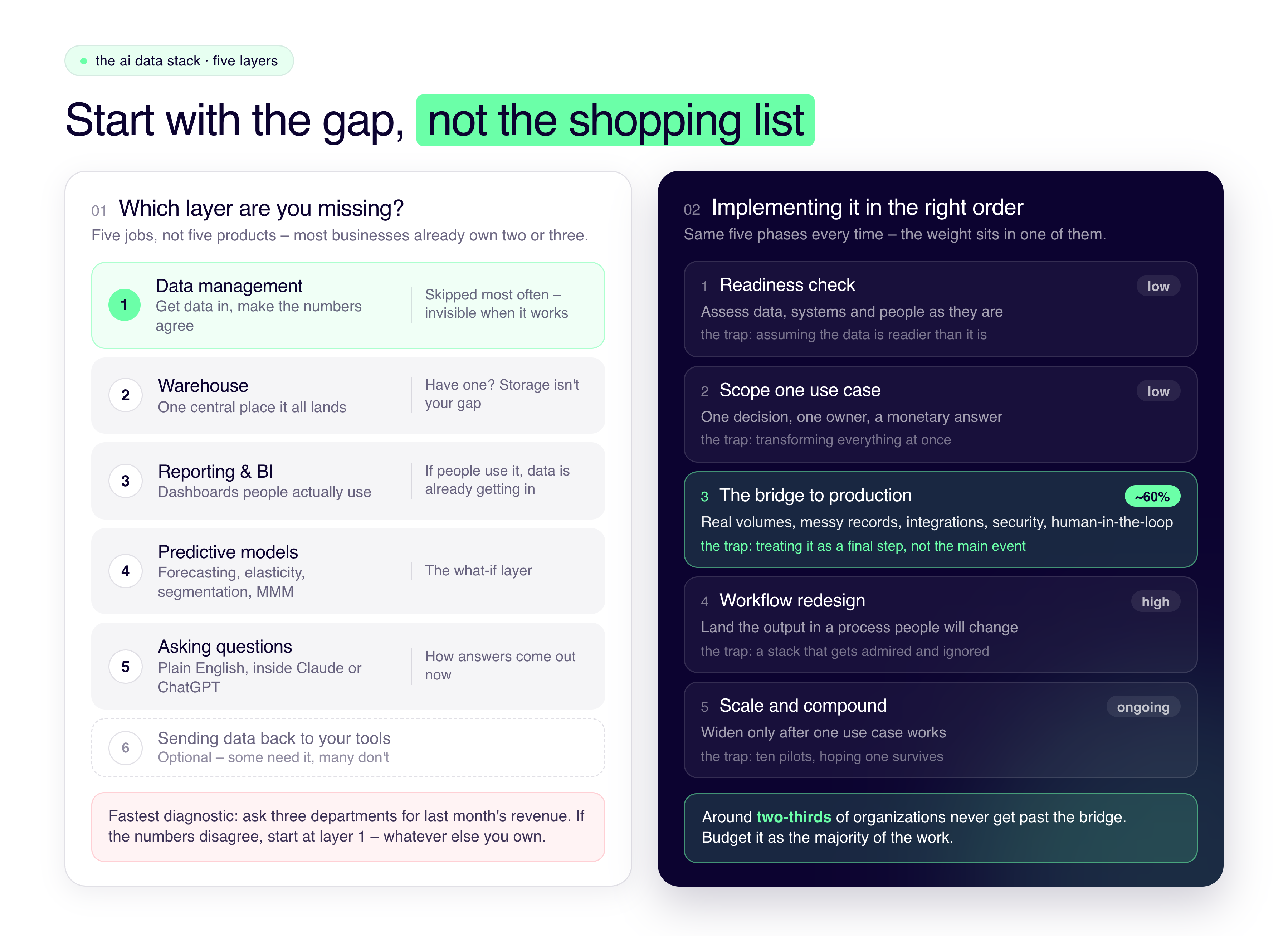
A modern data stack does five things. Historicallyl they would've been seen as five separate tools/products you need to procure, but in 2026 a vendor can do multiple, or in some cases the whole stack if that's what you're looking for.
Data management entails getting data out of your tools and then making the numbers reliable. Your Shopify orders, ad accounts, CRM data, all pulled in and cleaned. Then the data is joined so that finance and marketing report the same figure. This is the layer that decides whether anything above it is worth relying on, and a lot of organizations overlook it because it's assumed as done already.
A data warehouse is where all this ingested data is stored. This makes the management part from before much simpler than trying to manipulate and cross-check across multiple tools.
Reporting and BI is the dashboards and reports that the typical end user will be interacting with most.
Asking questions of your data is the newest job, and it's how end users prefer to get their answers these days. Plain English rather than a ticket to an analyst, increasingly from inside Claude or ChatGPT (using an MCP function) rather than a separate BI tool.
There's a sixth that some businesses need but many don't: sending data back to your tools (historically called reverse ETL), pushing clean segments into your CRM or ad platforms rather than exporting a CSV.
Tom Fordyce, our Principal Analytics Consultant, audits data stacks for a living, and thinks technology is rarely where things go wrong. The tools are usually fine, but what's missing is a layer, or more often the connection between two layers that each work on their own.
The fastest diagnostic he runs with a new client takes a day:
"Go around different departments and ask each one what their revenue number is. In an organization that is siloed and has not been through this process, everyone is going to come back with a different number."
This tells you which layer you're missing. If every department returns the same figure, your foundation is sound and your gap is higher up the stack. If they differ but everyone can explain why, you have a definition problem, which is solvable and cheaper than it sounds. If they differ and nobody can explain why, that's the thing to fix before spending anything on an analytics or AI layer.
Underneath a lot of those disagreements is what data teams call mastering, and it's Tom's most common technical finding:
"You ideally want to know that customer A in Salesforce is the same customer in NetSuite. Often you find there are a million customers in one system, half a million in another, some that are just in one side, some that are just in the other, and there is no proper mapping between them. Then any kind of in-depth customer segmentation or revenue modeling just becomes a bit pointless."
If your customers aren't mapped across systems, another warehouse or BI tools won't help you out much, or at all. His full five-step audit covers the rest.
Seven questions, no email required. It asks what you want the stack to do and what you already have working, then recommends only the layers you are missing, with named tools for each. It also has its own page if you want to send it to someone.
If your budget is small it does not recommend us. It points at free and low-cost tools, including doing light data prep in Claude or ChatGPT.
Assemble or consolidate
This decision matters more than any individual tool, and most tool comparisons never raise it. You can assemble a best-of-breed stack with a specialist tool per layer, or buy a platform that covers several layers at once. It sets your cost, your risk and how long implementation takes.
An assembled stack means Fivetran or Airbyte for ingestion, a warehouse, dbt for modeling, a BI tool, and a separate AI layer. You get the strongest tool at each layer and full control. You also get five vendors, five bills, five renewals, and responsibility for the integration work between them. This suits companies with a data engineering team that wants that control and has capacity to maintain it. Our pricing comparison breaks down what the assembled route costs.
A consolidated platform covers most layers in one system with one vendor responsible for the joins. You give up some flexibility at each layer in exchange for less integration work and a faster route to production. This suits the more common mid-market case, where the data engineering team the assembled version needs does not exist.
Neither is right for everyone, which is why a recommender is more useful than a ranking.
Why projects stall after the pilot
Implementation is where most projects are lost, and it happens in a predictable place.
A stack gets built in a pilot, on clean sample data, with one sponsor and nobody depending on it. It works. Then it meets production: real data volumes, messy records, security requirements, and integrations into the systems people use. The version that worked on curated data does not survive the real thing. Around two-thirds of organizations never get past this stage.
Industry estimates put roughly 60% of the total work of an AI project in this phase, the integration and reliability work between a demo and something that runs every day. Almost none of it shows up in a pilot, which is why teams underestimate it.
The order to implement in
Implementing the stack: the order that survives production
Phase
What it covers
Share of effort
The trap
1. Readiness check
Assess data, systems, and people as they are
Low
Assuming the data is readier than it is
2. Scope one use case
One decision, one owner, a monetary answer
Low
Trying to transform everything at once
3. The bridge to production
Real data volumes, integrations, security, human-in-the-loop
~60% of total effort
Treating it as a final step, not the main event
4. Workflow redesign
Land the output in a process people will change
High
A stack that gets admired and ignored
5. Scale and compound
Widen only after one use case works
Ongoing
Launching ten pilots, hoping one survives
Start with a readiness check on your data, your systems and whoever would run it. Most companies find their data is in worse shape than they assumed, and it costs less to learn that now. Our AI readiness assessment covers this.
Next, scope one use case small enough to finish, tied to a decision with a number attached to it.
Then do the integration work properly: real data volumes, the connections into other systems, the security work, plus a decision about where a person stays in the loop.
Then change the workflow so the output arrives somewhere it gets used. Research this year found workflow redesign to be the largest single factor in whether AI produces measurable returns, ahead of model quality.
Scale after that, funded by the first result rather than by launching several pilots at once.
Build or buy
Purchased solutions reach production more often than internal builds, roughly two-thirds against about a third in this year's research. Vendors who have done the integration work before bring architecture that a first build has to learn.
That is not an argument against building. It is an argument for making the decision with the pilot-to-production failure rate in mind rather than the demo.
For disclosure, this is where we sit. Kleene is the consolidated option with the implementation included. The platform covers the layers, and the embedded analyst team does the integration and workflow work as part of the engagement. That is why the timeline from kickoff to production is usually weeks rather than the six to eighteen months an assembled build takes. It is the same order as above, run by people who have done it before.
FAQ
What is an AI data stack?The layers that take data from source systems to AI you can use: getting data in and making it reliable, storing it centrally, reporting, predictive models, and asking questions of the data.
Do I need all five layers?No. Most companies already have two or three. Work out which are missing rather than buying a tool for each one.
How long does it take to implement an AI data stack?An assembled build from scratch usually takes six to eighteen months. A consolidated platform with implementation support takes weeks. The variable is how much of the integration work you take on.
Why do most AI projects fail to reach production?Because roughly 60% of the work is in the integration and reliability phase between a demo and production, and that phase barely exists in a pilot. About two-thirds of organizations do not get past it.
Should I build or buy?Purchased solutions reach production about twice as often as internal builds. Build if you have the engineering capacity and want control at each layer. Buy if getting to production matters more.
What should I fix first?Whether your numbers reconcile. Ask three departments for last month's revenue figure and compare the answers.
Where to start
If you want to know which layers you are missing, take the quiz. It takes two minutes and does not ask for your email.
If you would rather talk it through, send us your setup and we will tell you which layers you can assemble yourself and which are worth buying.


%201.svg)


%201.svg)
