Your TikTok Analytics Are Answering The Wrong Question
October 31, 2024
- min read
Henry Owen
Product Marketing Manager
TikTok's own analytics dashboard was built to keep you posting, not to tell you if any of it is making money.
That's not an insult to the product. Watch rate, retention curves, and the "More Data" panel under every video are genuinely good at what they measure: whether a piece of content holds attention. What they were never built to answer is the question sitting on your CFO's desk: did the money we spent on TikTok bring back a customer who's actually worth something?
In 2026, that gap has gotten expensive. Brands are on track to spend $34.8 billion globally on TikTok advertising this year, up 22% year over year. And yet only 51% of advertisers report positive ROI, with 45% merely breaking even. Half the market is pouring money into the platform without a confident answer on whether it's working.
The dashboard isn't broken. It's just answering for TikTok, not for you
Give TikTok's native analytics their due. If you want to know whether your hook lands in the first three seconds, or whether your retention curve falls off a cliff at second four, the in-app data is genuinely useful, and it always will be.
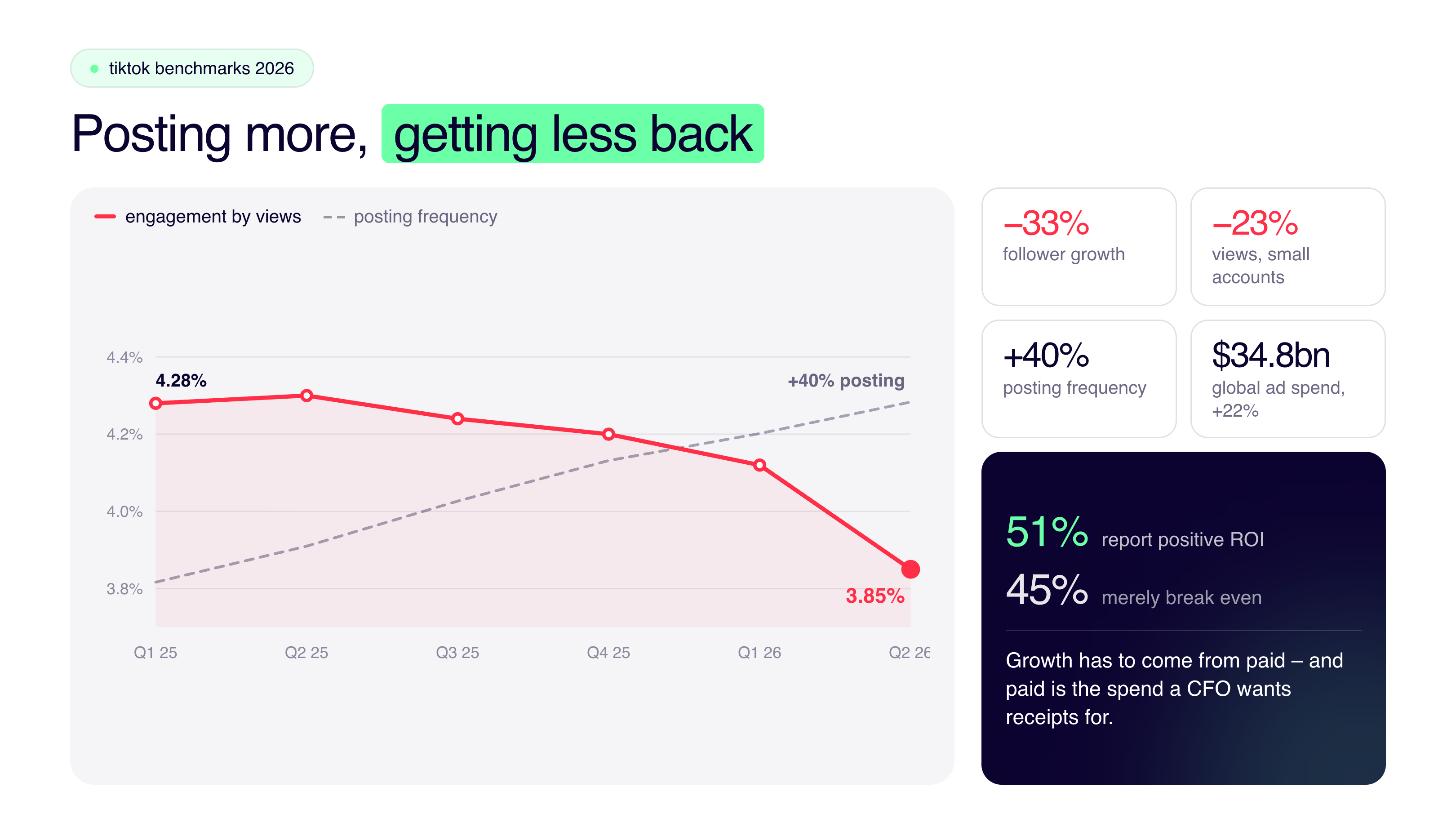
Socialinsider's 2026 TikTok Benchmarks, based on more than 2 million posts across 214,000+ profiles, shows engagement by views sliding to 3.85% in Q2 2026 after holding steady between 4.20% and 4.30% for five straight quarters. Posting frequency is up 40% year over year across every account size. Follower growth is down 33% on average. Views for smaller accounts fell 23%.
[IMAGE: chart showing TikTok engagement rate by views declining from 4.20-4.30% to 3.85% across Q1 2025-Q2 2026, alongside posting frequency rising 40%]
Read those numbers together and the picture is blunt: brands are working harder on TikTok and getting less back organically for the effort. Which means more of the growth story now has to come from paid media (that $34.8 billion), and paid media is exactly the spend a CFO wants receipts for.
Here's where TikTok's own dashboard stops helping. It can tell you a video got a 70% retention rate at the three-second mark. It cannot tell you whether the person who watched, clicked, and eventually bought something is a customer worth £40 in lifetime value or £400. It cannot tell you whether TikTok-driven customers churn faster than the ones from search. It cannot put a TikTok ad next to a CRM record and tell you which one actually closed. That's not a TikTok failure. It's the same limitation every single-platform analytics panel has: it only knows what happens inside its own walls.
Performance theater vs. performance
Call it performance theater: the retention chart goes up, the team feels good, the meeting ends on a high note, and nobody has actually checked whether that performance shows up in revenue. It's an easy trap, because TikTok's metrics are immediate and visual, while your actual CAC and LTV numbers live in a CRM, a payments processor, and a spreadsheet somewhere, updated a week late by someone who'd rather be doing something else.
The fix isn't to distrust TikTok's data. It's to stop treating it as the finish line. Watch time and retention are leading indicators of whether content works. Revenue, repeat purchase rate, and CAC by channel are the only indicators of whether the channel works. Confusing the two is how a brand ends up increasing TikTok spend nine months running because the retention charts look great, right up until finance asks why blended CAC has crept up 30% and marketing has no channel-level answer.
What "real" TikTok ROI actually requires
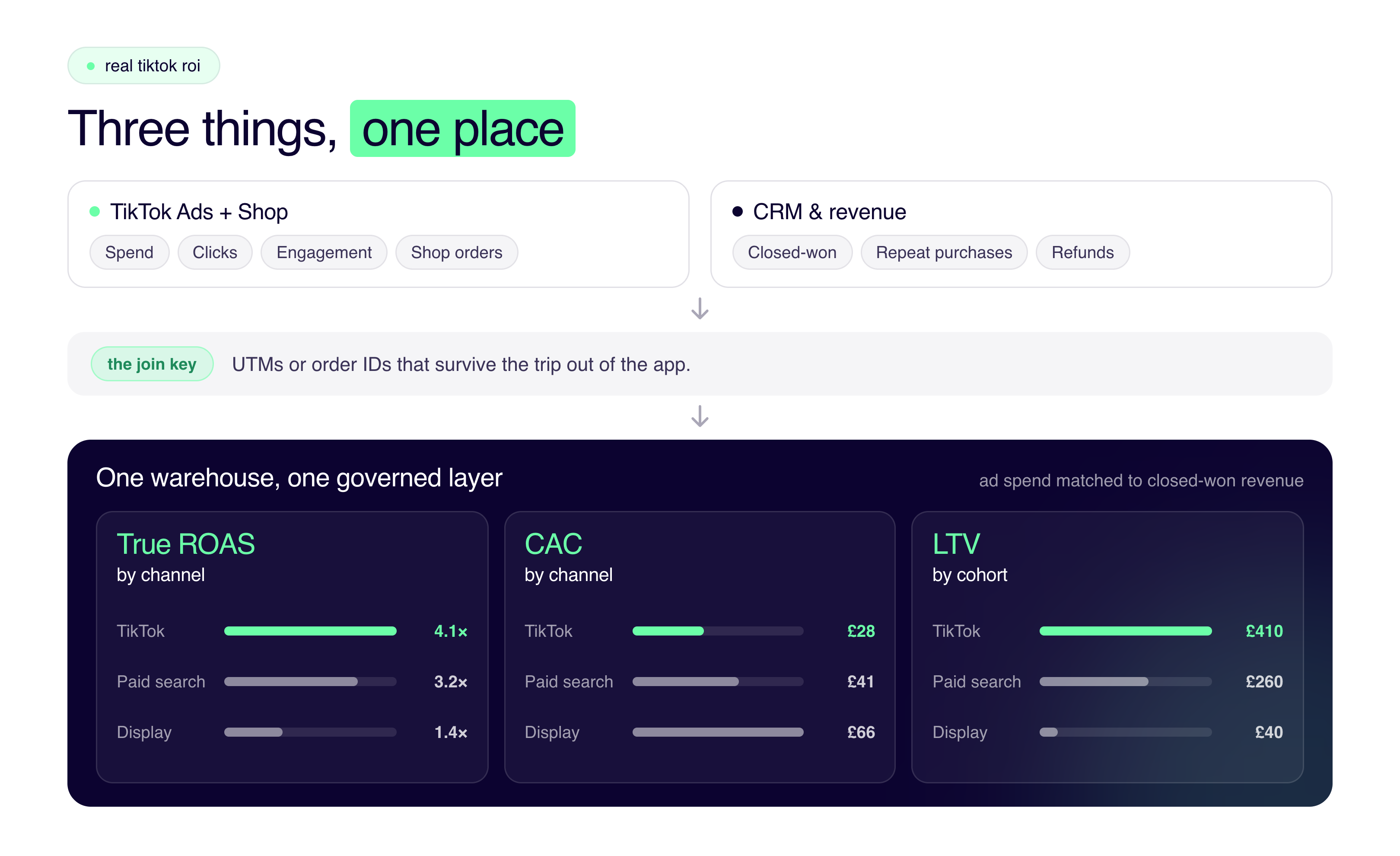
Getting from watch-time theater to an honest ROAS number means putting three things in the same place, not three different dashboards.
TikTok's own performance data. Spend, impressions, clicks, video-level engagement, pulled straight from Ads Manager or TikTok Shop.
Your CRM or revenue system. Closed-won deals, repeat purchases, refunds: the stuff that actually pays the bills.
A join key that survives the trip between them. UTM parameters, order IDs, or a customer identifier that doesn't get lost the moment someone leaves TikTok's app and lands on your site.
There's a fourth piece people skip: how you count the win in the first place. Last-click attribution (the default in most GA4 setups) systematically undercounts a discovery platform like TikTok, because a lot of its influence happens two or three touches before the sale, not on the touch that gets the credit. Get the data unified first. Fix the attribution model second. Doing it in the other order just means you're arguing about credit with bad plumbing underneath.
None of this is exotic. It's the same problem customer data integration solves for every other channel, and TikTok is just the newest, loudest one asking for the same treatment. Kleene's marketing use cases are built around exactly this: connect TikTok, Meta, Google Ads, GA4, and CRM data into one warehouse, match ad spend to closed-won revenue, and calculate CAC and LTV by channel and cohort, so budget moves toward what's actually profitable instead of what has the best retention chart. KAI Analytics then lets a marketing lead ask, in plain English, which TikTok campaigns are driving customers worth keeping, not just customers worth a like.
We'd love to drop a specific customer number here (we prefer named receipts over adjectives), but we don't have a published TikTok-specific case study to point to yet. [Customer name and metric to come once we've got one we can verify.] Better an honest gap than a made-up one.
The part where we admit the limits
TikTok's in-app analytics aren't going away, and they shouldn't. If you're a creator-led brand still figuring out format and hook, watch time and retention are exactly the right things to obsess over first, before you've got enough spend or volume to justify a warehouse. Everything in this post starts mattering once TikTok becomes a real line item in your paid media budget, not while you're posting three times a week hoping something lands.
[IMAGE: side-by-side comparison of "what TikTok's dashboard measures" (watch time, retention, hook performance) vs. "what it can't measure" (CAC, LTV, closed-won revenue)]
But if TikTok is already a five, six, or seven-figure spend, the question isn't whether your content is engaging. Engagement is table stakes now, not a differentiator. The question is whether that engagement is buying customers worth keeping, and most brands can't answer that from inside TikTok's own dashboard. Half the market is spending $34.8 billion this year without a confident answer on ROI. We'd like Kleene customers to not be in that half.
If you want to see what it looks like to put TikTok, your other paid channels, and your revenue data in one place: bring your last three months of TikTok spend and your CRM export to a call. Worst case, you leave with a clearer number than you walked in with. Best case, you find the budget that's been quietly funding views instead of customers. Book a look at how Kleene connects it.
And if you're still comparing platforms before committing to anyone, our breakdowns of the best ETL tools and the best AI data platforms in 2026 are genuinely useful starting points, not just a detour back to our own pricing page.


%201.svg)


%201.svg)
