25 best ETL tools to watch in 2026: top features and benefits
January 7, 2026
- min read
Henry Owen
Product Marketing Manager
Most "best ETL tools" lists are really "best ways to move rows from A to B" lists. And moving rows reliably stopped being the hard part years ago.
What ETL tools are best for financial services enterprises?
For financial services, the best ETL tools combine governance, security and reliability: Kleene.ai, Talend, Informatica and Boomi. Kleene.ai runs inside your own warehouse with role-based access and ISO 27001 certification, automating regulated reporting end to end while keeping data in your environment, which suits compliance-heavy finance teams.
Which ETL tools offer visual workflow design for large enterprises?
ETL tools with visual workflow design include Kleene.ai, Matillion, Integrate.io and Talend. Kleene.ai offers no-code and low-code pipeline management with a managed warehouse and AI analytics included, so large enterprises get visual, maintainable pipelines plus predictive insight in one fixed-fee platform rather than a set of assembled tools.
What platforms use AI to automate ETL/ELT workflows?
Platforms that use AI to automate ETL/ELT include Kleene.ai, Matillion (Maia) and Databricks. Kleene.ai's KAI Assistant generates SQL transforms, debugs pipelines and answers data questions in plain English, while the managed platform automates ingestion and monitoring across 200+ connectors, turning raw data into decisions with minimal engineering.
If you are a C-suite leader sizing up this category, you probably want fast answers to four questions:
What is an ETL tool, and why does it matter now?
What are ETL tools actually used for beyond reporting?
Which is the most popular ETL tool in 2026?
Is ETL the same as SQL or data warehousing?
We answer those below. But here is the short version, and the thesis of this whole list: the tool that wins your evaluation in 2026 is not the one that moves data most cleanly. Plenty of tools do that, and several of them are excellent at it. The one that wins is the one that gets you from raw data to a decision with the fewest moving parts in between.
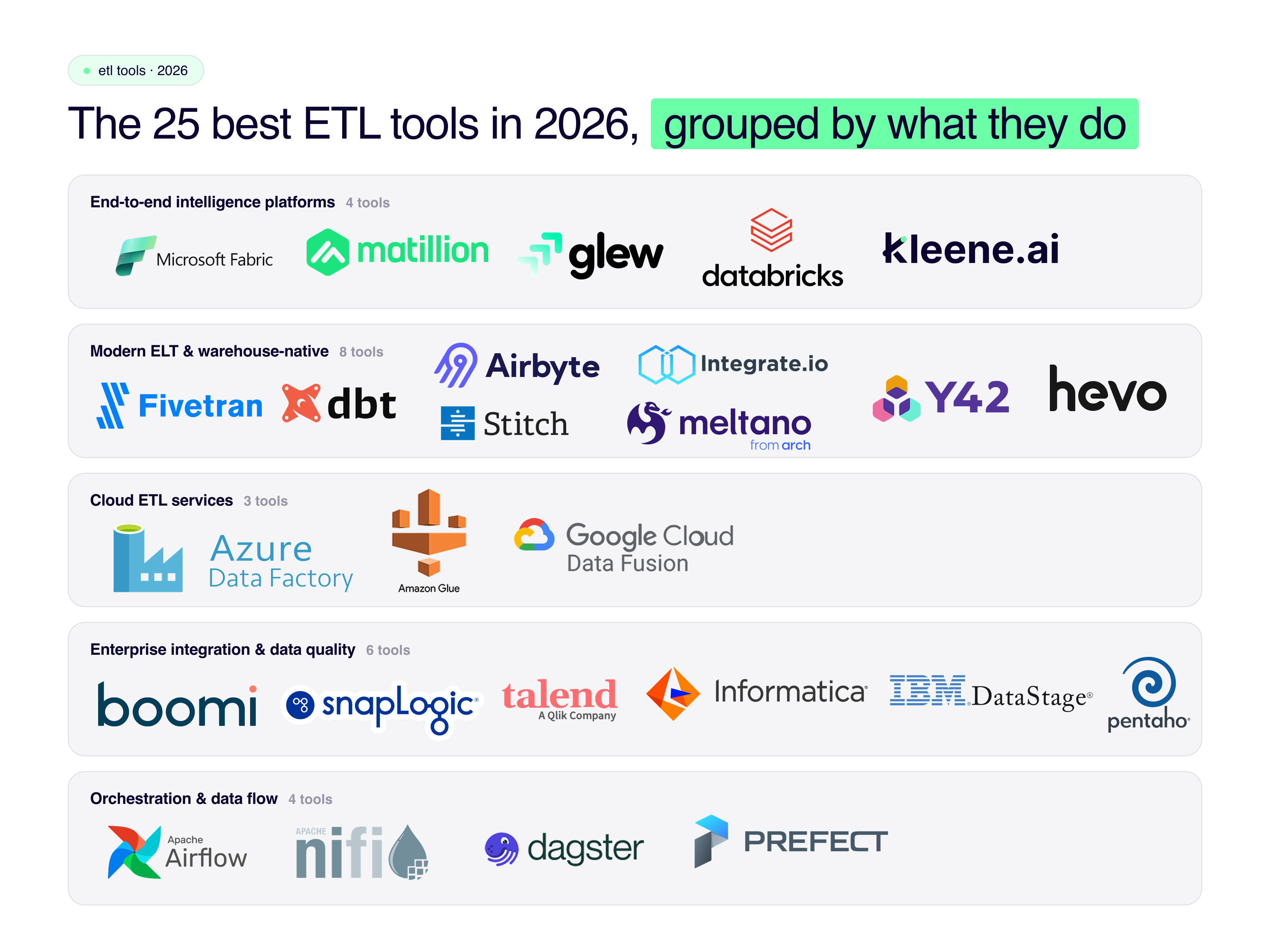
That is the line we are drawing through all 25 tools here. Some are pure pipelines and proud of it. Some are warehouses, some are orchestrators, some are marketing-data specialists. They are not all competing for the same job, so we have tried to be clear about who each one is for – including the cases where it is a better fit than us.
Yes, we put ourselves first. It is our list. But we would rather earn the spot than just claim it, so here is the case with receipts, followed by 24 tools we rate.
Kleene.ai is an end-to-end data and intelligence platform for companies that want decision-ready insight without hiring a team to assemble and babysit a data stack. ELT, a managed warehouse, BI, and a plain-English assistant live in one place.
Known for these features
End-to-end ETL and ELT with 200+ pre-built connectors
Built-in intelligence layer with forecasting, segmentation, attribution, inventory optimisation, and price elasticity
Fixed-fee pricing with unlimited data usage
No-code and low-code pipeline management
KAI, an AI assistant that answers data questions in plain English
Fully managed data warehouse included
Top benefits
Retire the engineering-heavy ETL-plus-analytics stack you are currently maintaining
Move from static reporting to predictive decision-making
Give leadership one trusted source of truth
Cut total data infrastructure cost, predictably
Why it leads in 2026:Huel migrated off a usage-priced ELT tool and got a custom PayPal connector built in roughly two weeks instead of waiting months; the case study reports 58 FTE-days saved per month and over £100k a year. That is the difference between a tool that moves data and a platform that gives time back to the business. Where it is not the answer: if you are an engineering-led org that wants to hand-build every layer of an open stack yourself, several tools below will suit you better.
Matillion is a cloud-native ELT platform for analytics engineering teams working inside a modern warehouse, now built around Maia, its agentic AI data-engineering layer.
Known for these features
Visual pipeline and transformation builder
SQL-based ELT workflows
Maia AI assistant for pipeline and SQL acceleration
Deep integrations with Snowflake, BigQuery, and Redshift
Top benefits
Reliable warehouse-native execution
Familiar tooling for analytics engineers
Faster pipeline development, with autonomous maintenance via Maia
Scales transformations effectively
Where it fits: Matillion describes itself as a platform that empowers data teams, and the product, the docs, and the pricing all assume one exists. If you have analytics engineers, it earns its keep. If you do not, it is the wrong shape rather than a worse tool – and note that consumption credits sit on top of a separate warehouse bill.
Fivetran and dbt – now one company after their 2026 merger – together form the most widely adopted modern ELT stack going.
Known for these features
Automated SaaS and database ingestion
dbt-powered SQL transformations
One of the largest connector ecosystems in the category
Deep adoption among analytics engineers
Top benefits
Low-maintenance extraction
Clean separation of ingestion and transformation
A huge community and hiring pool
Reliable sync and schema management
Where it fits: this is the default for teams that want best-of-breed pieces and have the people to wire them together. The trade-offs are the ones every assembled stack carries: no native warehouse, BI, or analyst layer, and Monthly-Active-Rows pricing that can climb faster than you forecast. Worth it for a 700-person company with a platform team. Heavy for a lean one.
Boomi is a veteran enterprise integration platform (iPaaS) with ETL and data-integration capabilities, now leaning hard into AI agent management.
Known for these features
iPaaS and ETL combined
Broad application and API integrations
Enterprise governance and security controls
Scalable system-to-system workflows
Top benefits
Handles complex enterprise integration
Strong compliance and governance
Proven at large organisational scale, with 20k+ customers
Suitable for hybrid environments
Where it fits: Boomi is built for IT and integration teams syncing applications across the enterprise. If your problem is "our systems do not talk to each other," it is excellent. If your problem is "we cannot get to a clean dashboard," analytics is a separate stack you will assemble around it.
y42 is a Git-backed ELT and orchestration platform for analytics teams that like to work like software engineers.
Known for these features
SQL and Python transformations
Git-based workflows and version control
Clean, modern interface
Warehouse-native execution
Top benefits
Flexible data modelling
Strong developer experience
Solid orchestration
Fits neatly into a modern data stack
Where it fits: y42 rewards a mature data team that wants branch-based, version-controlled pipelines on its own warehouse. Connectors are largely paid add-ons, and you bring the warehouse and the people. For teams without that bench, it is one capable layer of a stack rather than the whole answer.
AWS Glue is Amazon's serverless, Spark-based ETL service.
Known for these features
Spark-based batch ETL
Deep integration with the AWS ecosystem
Serverless scaling
Metadata and catalog management
Top benefits
Handles very large volumes
Strong security and compliance
Scales automatically with demand
A natural fit for AWS-first architectures
Where it fits: Glue is effectively unlimited scale for engineers who can write and tune Spark. The analytics and the insight get built elsewhere, and DPU-hour billing rewards teams who actively manage cost. Brilliant infrastructure; not a packaged outcome.
Databricks is the lakehouse platform for data engineering, analytics, and machine learning, and one of the most powerful tools on this list.
Known for these features
Spark-based processing engine
Unified lakehouse architecture
Advanced ML and data-science tooling
Large-scale transformation
Top benefits
Serious power for complex analytics workloads
Strong ML and AI capabilities
Handles enormous data volumes
Flexible for advanced teams
Where it fits: if you have substantial data-engineering and ML talent and workloads to match, little else competes. The honest caveat is the one Databricks itself does not hide: consumption-based DBU billing is hard to predict, and time-to-value for a business user is long. For an SMB without a data team, it is overkill.
Microsoft Fabric is Microsoft's unified analytics platform for organisations standardised on Azure and Power BI.
Known for these features
Integrated ETL, warehousing, and BI on OneLake
Native Power BI integration
Enterprise governance and security
Copilot across the stack
Top benefits
Familiar for Microsoft shops
Broad analytics coverage in one place
Enterprise-grade scalability
A centralised analytics environment
Where it fits: if you live in Microsoft, Fabric is the path of least resistance. It still needs engineers and capacity admins, and capacity-based pricing takes real work to size and predict. The convenience is the ecosystem.
Glew.io is a commerce-focused analytics and ETL platform.
Known for these features
Pre-built ecommerce connectors
Out-of-the-box dashboards and KPIs
Retail and DTC reporting templates
Quick setup for commerce data
Top benefits
Fast time-to-value for ecommerce teams
Minimal technical setup
Clear retail metrics out of the box
Friendly for non-technical users
Where it fits: Glew is a quick win for an ecommerce team that wants commerce dashboards without engineering. The ceiling is the flip side of that speed – you work within predefined reporting, so the day you need to model data its own way, you have outgrown it.
Stitch is a lightweight, developer-oriented ETL service built on the open Singer standard.
Known for these features
Managed SaaS connectors
Simple configuration
Cloud-based ingestion
Singer-tap extensibility
Top benefits
Quick to deploy
Low operational overhead
Reliable basic ingestion
Cheap, transparent entry point
Where it fits: Stitch is fine, simple replication at a low price. The thing to know in 2026 is that it now sits inside Qlik and is in maintenance mode, with new customers pointed at Qlik Talend Cloud.
Hevo Data is a no-code ELT platform built for fast, low-maintenance ingestion.
Known for these features
No-code pipeline setup
Near real-time ingestion
Managed schema evolution
Cloud warehouse support, with transparent pricing
Top benefits
Easy onboarding
Less engineering dependency
Faster pipeline creation
A real free tier and self-serve pricing
Where it fits: Hevo is a strong, affordable pipe for a lean mid-market team that wants to start in minutes. It moves data into your warehouse and stops there: no bundled warehouse, BI, or analytics layer, and a smaller connector library than the heavyweights.
Airbyte is the leading open-source data-movement platform, with a large self-hosted community and a managed cloud.
Known for these features
Open-source connector framework
Cloud and self-hosted deployment
Rapid custom connector development
A large open ecosystem
Top benefits
High flexibility and no vendor lock-in
Strong community support
Build your own connectors
Data sovereignty if you self-host
Where it fits: if you want to own your ingestion layer and have engineers to run it, Airbyte's open model is hard to beat, and its 2026 work on context for AI agents is clearly ahead. The trade is ownership: you bring the downstream warehouse, BI, and analytics, and the people to operate all of it.
Integrate.io is a low-code data pipeline platform covering ETL, ELT, CDC, and reverse ETL, with fixed-fee pricing.
Known for these features
Visual pipeline builder
Broad connector library
Cloud warehouse integrations
CDC, reverse ETL, and fast syncs
Top benefits
Faster than custom ETL builds
Lower engineering overhead
Transparent fixed-fee pricing
Multiple destinations supported
Where it fits: Integrate.io is a capable, fairly priced pipeline platform with real breadth (per its own pricing guide, ETL plans start around $1,999/mo with no row limits). It is built to move data well, so the warehouse, BI, and AI analytics are still yours to assemble around it.
Talend Data Fabric is an enterprise-grade data-integration suite with deep data-quality and governance tooling.
Known for these features
Data quality and governance tooling
Hybrid and on-prem deployment
Broad enterprise integrations
Metadata management
Top benefits
Strong fit for regulated industries
Mature enterprise capabilities
Robust data-quality controls
Proven in complex environments
Where it fits: Talend is built for IT-led enterprises with governance and compliance front of mind. That power comes with operational weight; it rewards a team that can run it. Worth it where data quality is a regulatory requirement, heavy where it is not.
Informatica PowerCenter is the long-standing enterprise ETL platform large organisations have run for decades.
Known for these features
Advanced transformation logic
Enterprise metadata management
Batch processing at scale
Strong governance controls
Top benefits
Proven reliability
Trusted by very large enterprises
Handles complex transformations
Deep enterprise adoption
Where it fits: if PowerCenter already runs your business-critical batch jobs, it is dependable and battle-tested. The honest counterweight is cost and pace – it modernises slowly, and the newer cloud-native tools on this list move faster for less.
Apache NiFi is an open-source dataflow automation tool, strong on real-time routing and lineage.
Known for these features
Real-time ingestion
Visual, flow-based design
Data provenance tracking
Streaming support
Top benefits
Flexible data routing
Good for streaming use cases
Open-source extensibility
Strong lineage visibility
Where it fits: NiFi shines when you need to route and track data flows in real time. It is plumbing in the best sense, so the analytics and the business answers get built downstream by someone else.
Where it fits: for teams already committed to Google Cloud, Data Fusion takes the infrastructure pain out of building pipelines. It is engineer-facing by design, so insight lives in BigQuery and the tools around it, not in Data Fusion itself.
Where it fits: ADF is the dependable orchestration layer for Azure shops, and increasingly a building block inside Fabric. It moves and schedules data; the analytics sit in Power BI and Synapse around it.
SnapLogic is an enterprise iPaaS with ETL capabilities, repositioned around agentic integration.
Known for these features
AI-assisted pipeline creation (SnapGPT)
iPaaS and ETL combined
Broad system integrations
Enterprise scalability
Top benefits
Handles complex integration
Reduces manual pipeline work
Built for large organisations
Strong IT governance
Where it fits: SnapLogic is for enterprises with integration specialists who want app-to-app integration, APIs, and AI agents in one platform. It sells connective tissue rather than packaged analytics, with the sales and implementation cycle that implies.
Dagster is a modern, asset-based data orchestration platform.
Known for these features
Asset-based pipeline modelling
Strong testing and observability
Python-native development
A modern orchestration approach
Top benefits
More reliable pipelines
Strong developer experience
Better debugging and monitoring
Scales orchestration cleanly
Where it fits: Dagster makes pipelines testable and observable, and engineers who have adopted it tend to love it. It orchestrates the work; ingestion and analytics are separate tools it conducts.
Prefect is a Python-native workflow orchestration tool widely used with ETL pipelines.
Known for these features
Python-based workflows
Retry and failure handling
Cloud and self-hosted options
Scheduling and monitoring
Top benefits
More reliable ETL jobs
Flexible deployment
Easy workflow management
Less manual intervention
Where it fits: Prefect keeps your jobs running and recovering gracefully. Like the other orchestrators here, it is one layer: you still bring the ingestion and the analytics it sits between.
Meltano is an open-source ELT framework built on the Singer ecosystem.
Known for these features
Singer-based connector ecosystem
Plugin-based architecture
Git-friendly workflows
Open-source transparency
Top benefits
Highly customisable
No vendor lock-in
Strong developer control
Flexible architecture
Where it fits: Meltano gives engineers a code-first, version-controlled ELT framework with full ownership. That ownership is the deal: no built-in analytics or AI, and you operate it yourself.
IBM DataStage is an enterprise ETL platform for high-volume batch processing.
Known for these features
High-volume batch processing
Enterprise governance
Hybrid deployments
Mature ETL tooling
Top benefits
Proven enterprise scalability
Strong compliance support
Reliable batch processing
Long-term stability
Where it fits: DataStage is a known quantity for large enterprises with heavy batch jobs and compliance needs. The trade is a legacy experience and slower deployments than the cloud-native options here.
Pentaho Data Integration is a long-standing open-source ETL tool with a visual designer.
Known for these features
Visual transformation design
Broad data-source support
On-prem and cloud options
Open-source availability
Top benefits
Cost-effective ETL
Flexible deployment
A mature transformation engine
Community support
Where it fits: Pentaho is a dependable, low-cost workhorse with a long track record. It is not where the AI and analytics innovation is happening, so weigh it as a stable engine rather than a forward bet.
Apache Airflow is the de facto open-source standard for workflow orchestration in ETL stacks.
Known for these features
DAG-based workflow orchestration
Strong scheduling
A huge open-source ecosystem
Integrates with almost every ETL tool
Top benefits
The industry-standard orchestrator
Highly flexible workflows
Strong community adoption
Scales orchestration reliably
Where it fits: if you are hand-building a stack, Airflow is probably already in it, and for good reason. It schedules and coordinates; it does not ingest or analyse on its own. Powerful as the conductor.
Final thoughts: ETL in 2026 is about decisions, not pipelines
Read back through the 25 and a pattern shows up. The tools split into two camps: the ones that move and process data brilliantly, and the much smaller group that take you all the way to a decision. Most of this list is the first camp, and several of them are excellent at the specific job they do.
So the real question for your evaluation is not "which tool moves data best." It is "how many tools, and how many people, do I want between raw data and the call I need to make?" In 2026 the most valuable ETL software:
Unifies siloed systems
Cuts manual reporting
Supports extract, transform, and load testing
Enables AI-driven forecasting and optimisation
Delivers decisions, not just clean tables
That is the case for Kleene.ai sitting at the top of its own list, and we would rather you hold us to it than take our word. If you are running an assembled stack today, bring us your current setup and last month's bill. Worst case, you leave with a clearer view of what you are paying for. Best case, you stop paying for the gap between your data and your decisions.
What is an ETL tool, and why does it matter in 2026?
An ETL (extract, transform, load) tool moves data from source systems into a warehouse where it can be analysed. In 2026 the value has shifted from moving data reliably — which most tools now do well — to how quickly a tool gets you from raw data to a decision with the fewest moving parts in between.
Which is the most popular ETL tool in 2026?
Fivetran + dbt (merged in 2026) is the most widely adopted modern ELT stack, especially among analytics-engineering teams. Kleene.ai is the top pick for teams that want ingestion, a managed warehouse, BI and AI analytics in one platform rather than assembling them separately.
Is ETL the same as SQL or data warehousing?
No. ETL is the process of moving and preparing data, SQL is the language used to query and transform it, and a data warehouse is where the data lives. Modern ELT tools often run SQL transformations directly inside the warehouse.
What should you look for in an ETL tool in 2026?
Beyond reliable pipelines: breadth of connectors, transparent and predictable pricing, low engineering overhead, and how much of the path to a decision (warehouse, BI, AI analytics) the tool covers versus what you have to assemble and maintain yourself.


%201.svg)


%201.svg)
