What is the difference between an AI data platform and a traditional ELT stack?
A traditional ELT stack is built from separate tools: an ingestion layer (Fivetran, Airbyte), a transformation layer (dbt), a cloud data warehouse (Snowflake, BigQuery, Redshift), and a BI tool on top. Each piece handles one job well. The stack is flexible, powerful, and well-loved by analytics engineering teams. It also requires you to integrate, maintain, and monitor all of it — and AI capabilities sit outside the stack entirely.
An AI data platform unifies all those layers into one managed product and adds an AI layer that runs directly on the warehoused data. Kleene.ai sits in this category. Following the Fivetran + dbt merger announcement in October 2025, the choice for mid-market teams is not really product-versus-product — it is whether you want to build and maintain a composable ELT stack or buy a unified AI data platform with the engineering team included. The rest of this guide compares both paths in detail.
In 2026, Kleene.ai vs Fivetran + dbt is an increasingly common question for growing organizations, especially following Fivetran + dbt’s 2025 partnership announcement. Kleene.ai delivers decision-ready insights, AI data apps, and predictable pricing in a single platform, while Fivetran + dbt power a traditional ELT stack optimized for analytics engineering teams.
Introduction
As companies modernize their data stacks in 2026, one architectural decision shows up repeatedly across industries: should you assemble a best-of-breed ELT stack, or adopt a unified data and AI platform?
This is where many teams end up comparing Kleene.ai with Fivetran + dbt.
On the surface, all three products operate in data integration and transformation. In practice, they serve different organizational goals. Fivetran and dbt are excellent at moving and modeling data. Kleene.ai is designed to turn that data into decisions, forecasts, and operational actions.
For organizations dealing with siloed data, legacy systems, and growing pressure to use AI effectively, the distinction matters. This guide is written for CTOs, Heads of Data, operators, and finance leaders deciding whether their biggest bottleneck is data preparation or decision velocity.
Side-by-side comparison table
Feature
Kleene.ai
Fivetran + dbt
Primary purpose
Data consolidation for decision-ready insights and AI apps
ELT pipelines and analytics engineering
Core user
Data analyst or Data Manager
Data and analytics teams
Connector coverage
200+ managed connectors + custom builds
Core SaaS connectors via Fivetran
Transformation capabilities
No-code, low-code, and SQL
SQL-first modeling (dbt)
Pricing model
Fixed-fee, predictable pricing
Usage-based, volume-driven
Ease of use
Business-friendly, guided setup
Engineer-led workflows
Support
Dedicated CSM and consulting
Product-led support
Automation and orchestration
Fully managed
Customer-managed
Intelligence layer
Built-in AI for forecasting and optimization
No native business AI
Time to value
Weeks
Months
Best for
Teams wanting speed and prediction
Teams optimizing composable data stacks
This table highlights the core difference: Kleene.ai is outcome-oriented, while Fivetran + dbt are infrastructure-oriented.
Platform overview
Kleene.ai overview
Kleene.ai is an end-to-end data and intelligence platform designed to deliver usable business insight, not just clean tables. It combines what are traditionally separate layers into a single managed system: Because these components are designed together, teams spend less time stitching tools together and more time applying data to real decisions.
Kleene.ai is typically adopted by organizations that want to reduce operational overhead, shorten time-to-value, and make advanced analytics accessible beyond the data team.
Fivetran + dbt overview
Fivetran and dbt together form one of the most common modern ELT stacks. This approach is flexible and powerful, especially for analytics engineering teams. However, value depends heavily on internal expertise, ongoing maintenance, and the ability to translate models into business action. For many organizations, the stack grows organically, increasing complexity over time.
Use cases and ideal customer profiles
Kleene.ai
Fivetran + dbt
Ideal for mid-market and enterprise teams needing fast, low-maintenance data foundations
Ideal for organizations with established analytics engineering teams
Best for unified insight across finance, marketing, operations, and supply chain
Best for analytics and transformation workflows
Predictive analytics and AI apps included out of the box (with Enterprise package or on demand for Scale + Accelerate)
Predictive use cases require custom ML or external tools
Designed for executives, operators, and analysts
Designed for data engineers and analytics engineers
A useful rule of thumb: if insight needs to flow to leadership and operators, Kleene.ai fits naturally. If the priority is modeling and transformation depth, Fivetran + dbt may be sufficient.
Kleene.ai vs Fivetran + dbt: key differences
Data ingestion and connector coverage
Kleene.ai provides over 200 managed connectors and supports custom builds as part of the platform. Ingestion, schema evolution, and reliability are handled centrally. Fivetran offers strong SaaS connector coverage, but pricing scales with data volume. As usage grows, teams often need to actively manage sync frequency, exclusions, and cost trade-offs.
In practice, Kleene.ai optimizes for simplicity and predictability, while Fivetran optimizes for granular control.
Transformation and ETL design
Kleene.ai supports no-code, low-code, and SQL transformations. This allows both technical and non-technical users to contribute to data modeling and logic. dbt is SQL-first and excels at version-controlled transformations. However, it assumes analytics engineers will own and maintain transformation logic over time.
For organizations without dedicated analytics engineering capacity, this difference often becomes a constraint.
Pricing and total cost of ownership
Kleene.ai uses a fixed-fee pricing model designed to remain stable as data volume, users, and use cases grow. Fivetran pricing scales with rows processed, while dbt introduces separate licensing and infrastructure costs. Warehousing, orchestration, BI, and AI tools further increase total cost of ownership.
As stacks mature, forecasting long-term cost becomes harder with a composable approach.
Orchestration, reliability, and operations
Kleene.ai manages orchestration, monitoring, schema changes, and pipeline reliability as part of the platform. With Fivetran + dbt, these responsibilities typically fall to the customer. Many teams add additional tools for testing, alerting, and orchestration as complexity increases.
This operational overhead is often underestimated early on.
Intelligence layer and AI readiness
Fivetran + dbt stop at analytics-ready tables. Advanced use cases such as forecasting, optimization, and scenario modeling require separate ML pipelines or platforms. Kleene.ai includes a native intelligence layer with AI data apps for:
These applications run directly on Kleene’s unified data layer, removing the need for custom feature engineering and ML infrastructure.
Business access and decision velocity
With Fivetran + dbt, insight typically flows through BI tools and analysts.
Kleene.ai adds natural language querying through KAI, allowing business users to ask questions directly and receive answers grounded in governed data models. This reduces dependency on ad hoc SQL and accelerates decision-making across teams.
User feedback and market position
Kleene.ai is positioned as an outcome-driven data and AI platform, often chosen by teams that want insight and prediction without scaling a large data organization. Fivetran + dbt are widely respected for analytics engineering and data preparation, but are rarely positioned as decision or AI platforms on their own. In the market, Kleene.ai is seen as executive-friendly and business-focused, while Fivetran + dbt are seen as powerful, flexible, and engineering-centric.
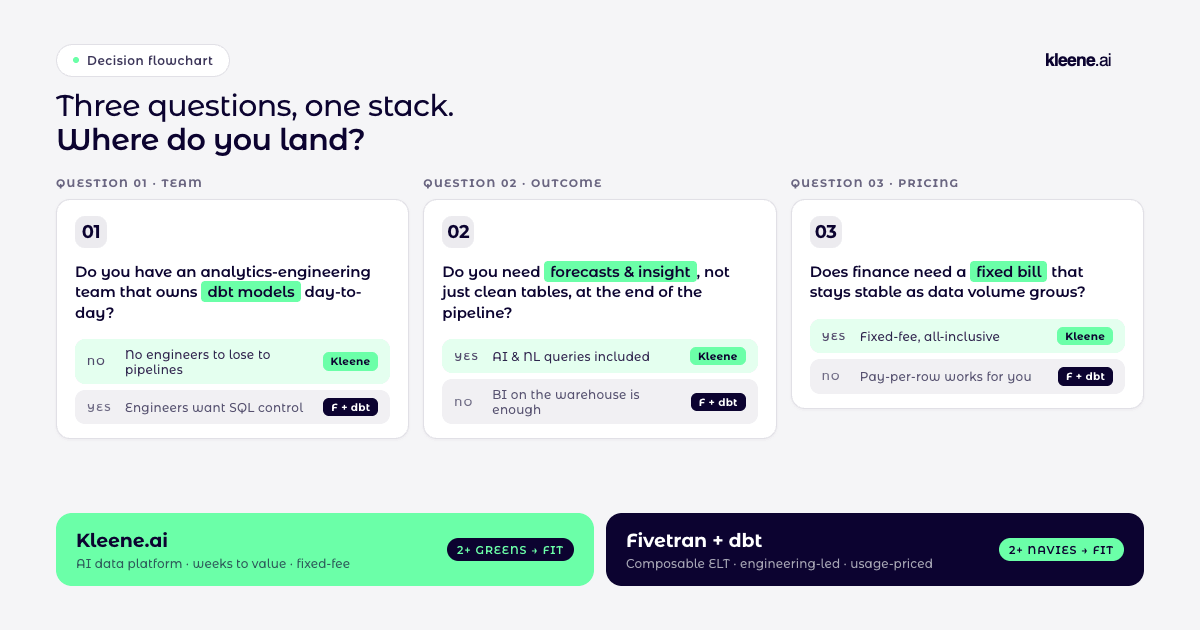
Kleene.ai vs Fivetran decision flowchart
The 2026 takeaway
Fivetran + dbt help teams build reliable data foundations.
Kleene.ai helps businesses turn those foundations into decisions, predictions, and action.
In 2026, competitive advantage does not come from moving data alone. It comes from using clean, trusted data to anticipate outcomes and act with confidence. That is the gap Kleene.ai was built to close.



%201.svg)
