B2B contact data decays at roughly 22.5% a year, which means a quarter of the records in your CRM will be wrong twelve months from now no matter which tool on this list you buy. Gartner puts the cost of poor data quality at an average of $12.9 million per organisation per year, so enrichment isn't optional, but buying an enrichment tool and calling the job done is how most companies end up with what we'd call enrichment sprawl: five tools appending data into five systems that never agree with each other.
This guide covers 18 tools worth knowing, what they cost, and where each one fits. We'll also explain where data platform sits in this picture.
The 18 best data enrichment tools in 2026, sorted by category
The B2B contact databases
1. ZoomInfo is still the reference point for North American B2B data, and its direct-dial accuracy is the reason: Cleanlist's 2026 head-to-head test measured an 88% phone connect rate, the best of the platforms tested. Meanwhile, contracts typically start around $15k and climb fast, and the same test found 85% email deliverability, which is weaker than cheaper rivals.
2. Apollo.io is the volume play: 275M+ contacts, a built-in sequencer and dialer, and a free tier that explains why over 500,000 companies use it. In the Cleanlist test it posted the strongest email deliverability at 94%. Phone data is thinner than ZoomInfo's, and power users will hit credit limits sooner than they'd like.
3. Cognism is the European option. Phone-verified mobiles ("Diamond Data") and proper GDPR handling make it the default pick if your market is the UK or EU rather than the US. You pay mid-market money for it, typically in the $10k–$30k band.
4. Lusha is the lightweight option: a browser extension, credits, contact details on demand. Good for a small SDR team. It is not built for bulk enrichment or enterprise governance, and it doesn't pretend to be.
5. Kaspr (owned by Cognism) does a similar job one notch cheaper, pulling contact details from LinkedIn profiles into your CRM. Same caveat as Lusha: handy at the individual-rep level, not a data strategy.
6. Hunter.io finds and verifies email addresses by domain, and does that one job well at a fair price. If "we need emails" is the whole requirement, you may not need anything else on this list.
The AI and workflow layer
7. Clay is the tool everyone in RevOps is talking about, and for once the hype is earned. It runs waterfall enrichment across 100+ data providers, so one missing field gets tried against ZoomInfo, then Apollo, then People Data Labs, until something hits. Its AI agent (Claygent) handles research no database holds. The catch: someone on your team has to enjoy building spreadsheet-style workflows, because Clay is a power tool, not a button.
8. Amplemarket combines enrichment with AI-driven outbound: contact data, intent signals, sequencing and a copywriting layer in one product. Disclosure: we use Amplemarket for our own outbound at Kleene, so discount this entry however you see fit. We keep paying for it, which is the only endorsement that means anything.
9. 6sense is less about appending fields and more about telling you which accounts are in-market, using intent data and predictive scoring. Powerful for enterprise ABM. Overkill (and over-budget) below roughly 50 employees.
10. Leadspace does AI-driven profile unification for enterprises that have leads scattered across systems and need one scored, deduplicated view. It assumes a serious ops function on your side.
11. Openprise is the workflow engine of the group: it orchestrates enrichment, dedupe, normalisation and routing across whatever data vendors you already use. Less glamorous than Clay, more governable at enterprise scale.
Customer and identity enrichment
12. Clearbit deserves an asterisk in 2026: HubSpot acquired it in 2023 and it now lives on as Breeze Intelligence. If you're a HubSpot shop, it's the path of least resistance and the real-time API enrichment is still excellent. If you're not on HubSpot, the standalone case has weakened, and most lists (including, we'll admit, the previous version of this one) haven't caught up.
13. FullContact specialises in consumer identity resolution: matching a person across email addresses, devices and social handles. More relevant to B2C marketers than to sales teams.
14. People Data Labs is the developer option: a raw API over billions of person and company records, priced per match. No interface to speak of. If your engineers are building enrichment into a product or pipeline, this is the shape you want; if not, look elsewhere.
Corporate and enterprise data quality
15. Dun & Bradstreet has been scoring companies since 1841, and the D-U-N-S number is still the backbone of firmographic data, credit risk and entity matching. Nobody matches its depth on company hierarchies. The interfaces feel their age and the contracts are enterprise-sized.
16. Experian Data Quality focuses on validation and cleansing (addresses, emails, phones) more than appending new fields. Unfashionable, useful, and often the missing step before enrichment spend pays off.
17. Demandbase is the account-based marketing platform: account identification, intent, advertising and enrichment in one. Worth knowing before you compare entries on lists like this one.
18. InsideView is why. InsideView was a respected corporate-data tool, but Demandbase acquired it in 2021, so entries 17 and 18 on most "18 best tools" lists are the same company. We've kept it here because people still search for it, but what you'd buy today is Demandbase.
What this costs
Knock AI's comparison guide puts most mid-market enrichment spend between $5,000 and $25,000 a year, with enterprise platforms like ZoomInfo, 6sense and Demandbase starting around $15,000 and running into six figures. API pricing tends to land between $0.05 and $0.50 per enriched record depending on the fields you want. Budget for the decay, too: whatever you enrich today degrades at about 2% a month, so one-off appends are a treadmill dressed up as a project.
Where Kleene fits (and where we don't)
Kleene is not a data enrichment tool, and if enrichment is your only problem, you don't need us.
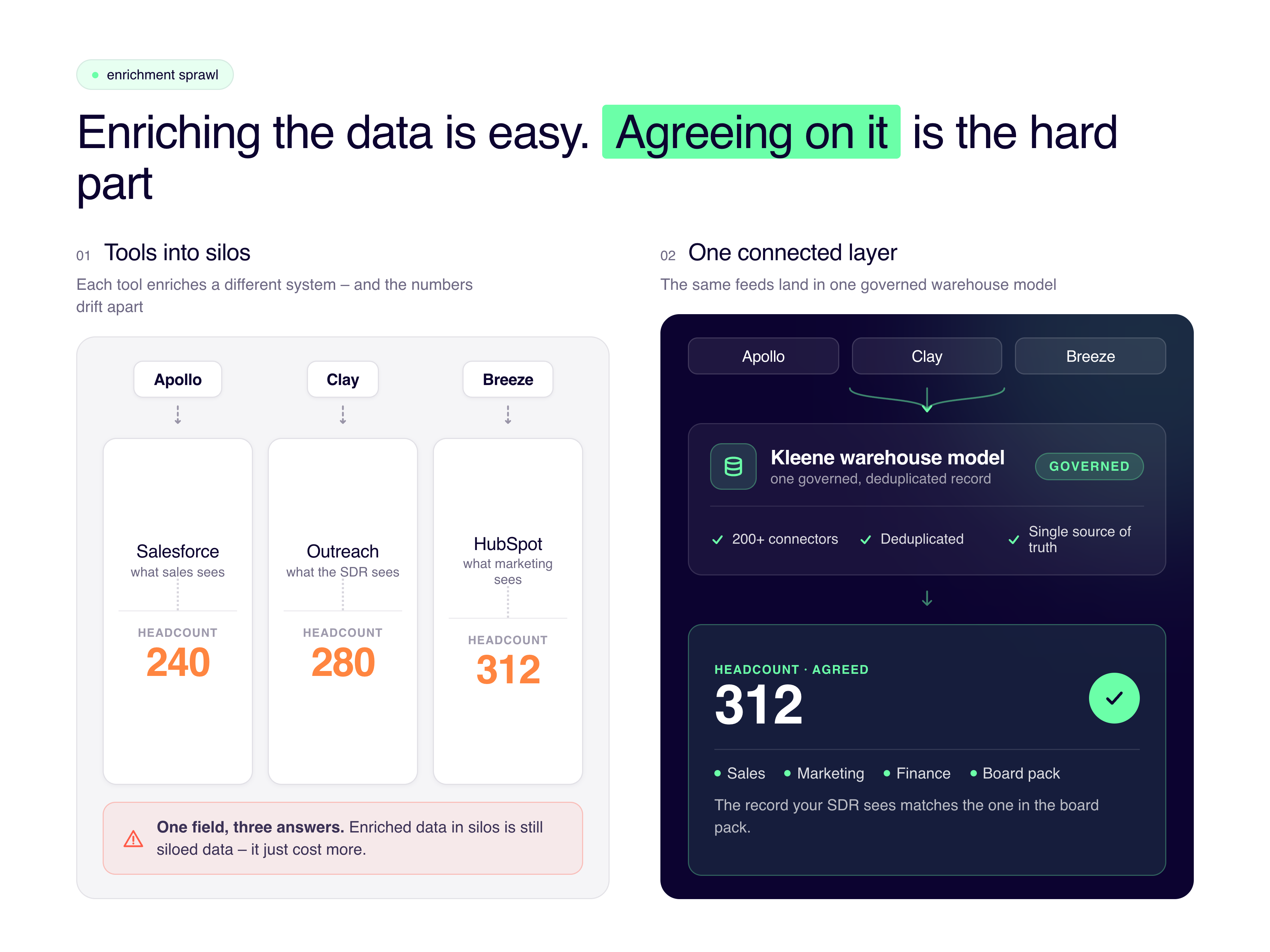
The problem we solve sits one layer down. Most companies running two or three tools from this list end up with enrichment sprawl: Apollo enriching Salesforce, Clay feeding outreach lists, Breeze updating HubSpot, and finance asking why the company headcount field shows three different numbers depending on which dashboard you open. Enriched data in silos is still siloed data. It just cost more.
Kleene connects those tools (200+ connectors, with custom ones built in two to four weeks) and lands everything in one governed warehouse model, so the enriched record your SDR sees matches the one in the board pack. When Huel needed a PayPal connector, we shipped it in around two weeks; the case study reports 58 FTE-days a month saved on reconciliation. Same logic applies to enrichment feeds – the append is the easy part; making every team see the same appended truth is the part that needs a platform.
How Kleene.ai solves the problem of data tool sprawl and siloed systems
How to choose
Four questions do most of the work.
1. Where do your buyers live (US-heavy points to ZoomInfo or Apollo, Europe points to Cognism)?
2. Who will operate it (Clay and Openprise need an owner; Lusha and Hunter don't)?
3. Does it write back to your CRM cleanly, or just export CSVs?
4. And what happens to the enriched data after the append, which is the question almost nobody asks at the demo and everybody asks at renewal.
If a vendor can't show you the third one working in your stack, keep shopping.
Final thought
Enrichment fixes records, but it doesn't fix the fact that those records live in systems that don't talk to each other. The companies getting value from these 18 tools are the ones treating enrichment as a feed into a connected data layer, not as the destination.
If you're weighing the integration side of that, our rundowns of the best ETL tools in 2026 and the best AI data platforms in 2026 are useful next reads. And if you already own two or more tools from this list and your CRM still doesn't agree with your warehouse, book 30 minutes with us and bring an example record. Worst case – you've spent half an hour confirming your stack works. Best case – your enrichment spend finally shows up in your reporting.
Frequently asked questions
What is a data enrichment tool?
A data enrichment tool adds missing or updated information — firmographics, contact details, intent signals — to your existing records, so sales and marketing teams can target and personalise more accurately.
What are the best data enrichment tools in 2026?
Leading options include ZoomInfo, Apollo.io and Cognism for B2B contact data; Clay and Amplemarket for AI-driven enrichment workflows; and Clearbit, FullContact and People Data Labs for identity enrichment.
How do I choose a data enrichment tool?
Match the tool to your primary need — contact-database coverage, workflow automation, or identity resolution — then check data accuracy, region coverage (e.g. GDPR-compliant EU data), integrations, and pricing model.
Does Kleene.ai provide data enrichment?
Kleene.ai isn't a contact database. It unifies and models the enriched data from these tools alongside your first-party data in your warehouse, so enrichment feeds analytics and decisions rather than sitting in a silo.


%201.svg)



%201.svg)
