Kleene.ai vs Domo in 2026: prebuilt models vs bespoke ones
August 5, 2026
- min read
Henry Owen
Product Marketing Manager
Updated 20/10/2026
TLDR: Both platforms connect your data and put AI on top of it, by different routes. Domo is a mature enterprise BI and data-products platform with agentic AI layered on: prebuilt forecasting that detects trend and seasonality from your own history, an agent builder in Agent Catalyst, unlimited viewers, and native mobile apps. Kleene builds bespoke models against your data with external factors included, from weather and holidays to competitor pricing, and delivers seven model types with an embedded analyst team. If you have a data team and want tools to build with, Domo gives them more surface area. If you want working models without hiring the function, that is our case.
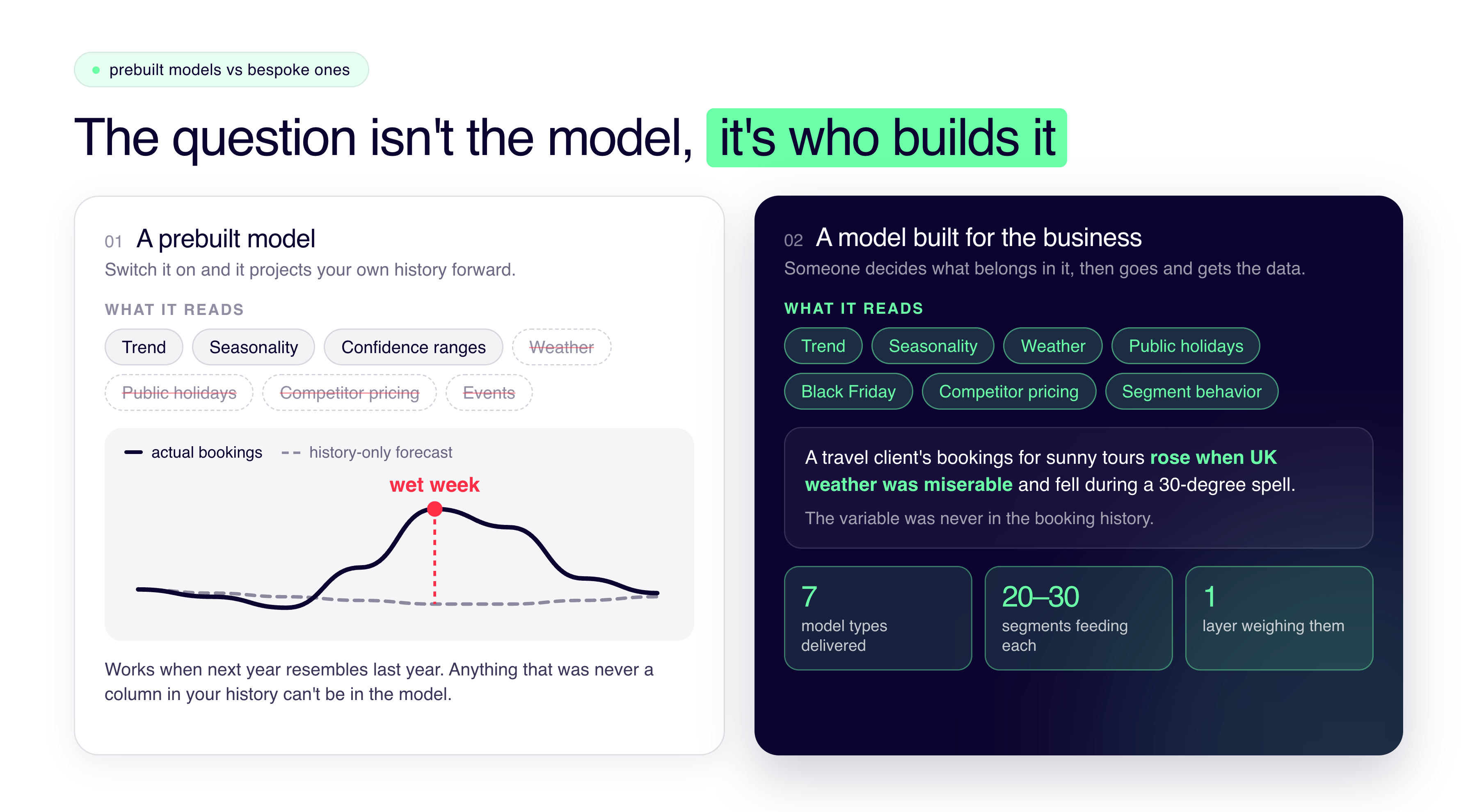
Domo's AI page describes its forecasting like this: use a prebuilt model to turn history into forecasts, automatically detecting trends, seasonality and confidence ranges, with no model building needed.
Which is accurate, a model built that way projects your own history forward, and it works when next year resembles last year. Call it history-only forecasting.
"It always amazes me how highly external factors rank among the things that actually drive demand."
Kleene.ai and Domo compared in 2026, prebuilt models vs bespoke ones
What Domo does
Domo has been in market since 2011, though it isn't quite the same company anymore. Progress Software bought Domo's AI and data platform business for $400 million in a deal that closed September 22, 2026. The public company left behind, Domo Inc., sold the product and renamed itself Huckleberry.ai (Nasdaq: HUCK), keeping the cash and the tax credits rather than the platform. What customers actually buy today sits under Progress. It still combines data integration, ETL, dashboards, embedded analytics and mobile reporting in one platform, aimed at mid-market to enterprise organizations that need to centralize data and get it in front of people who do not write SQL. G2 rates it 4.3 out of 5 across 986 reviews, Capterra the same. UPS, Cisco, ESPN, Unilever, GE HealthCare and BBVA are customers.
The AI side is broad. Agent Catalyst is an environment for building, testing and deploying custom agents, with templates and an agent store. AI Chat handles natural-language exploration. An AI SQL assistant writes queries, another writes Beast Mode calculated fields. FileSets turns documents, transcripts, images and reviews into something agents can answer from, which is a capability we do not match for unstructured text. Model choice is open across OpenAI, Anthropic and your own, with DomoGPT for private in-platform use.
Three things Domo does better than most of the category:
Unlimited viewers. Because Domo bills consumption rather than seats, you can give a whole organization dashboard access without paying per head. Forty builders and six hundred readers is a shape that works in your favor.
Native mobile. Real iOS and Android apps, which reviewers repeatedly credit with getting executives to engage. Most platforms offer a responsive web page and hope.
Federated architecture. Leave your data where it is, with partnerships across Snowflake, Databricks, BigQuery, Azure and Oracle. If you have already built on a cloud warehouse, that fits without a migration.
What Kleene does
Kleene is a managed AI data platform covering ingestion through to analytics: 200+ pre-built connectors with custom builds available, managed ELT with SQL and Python transformation, a managed warehouse, and the KAI layer for plain-English questions and predictive models.
The part that matters here is the KAI Analytics Suite, seven model types built against your data: demand forecasting, price elasticity, customer segmentation, media mix modeling, digital attribution, inventory management and creative diagnostics. Every engagement includes an analyst and data engineering team who build and maintain them.
The comparison, then, is between a prebuilt model you switch on and a model somebody builds for your business.
1. What a history-only forecast cannot see
A prebuilt model trained on your own history is doing pattern extrapolation. Trend, seasonality, confidence intervals. That is useful and needs no data scientist, which is the point of shipping it.
What it cannot include is anything that never appeared in your history as a column. The models our team builds carry an event log for exactly this reason, so the model can distinguish a weekday from a weekend, a public holiday, Black Friday, Valentine's Day, and shifting weather.
A travel company we work with makes this concrete, and it is useful because they hold no stock at all. Their product is tours and packages, so what they needed was take-up per tour over time in order to smooth capacity, rather than any kind of stock forecast. Twenty percent of tours overbooked while eighty percent run with spare capacity is a revenue problem that looks like an operations problem.
Bookings for the sunny tours went up when the UK weather was miserable, and down during a 30-degree spell. Trend and seasonality detection on booking history will never surface that, because the variable driving it was never in the booking history. Someone has to decide weather belongs in the model, and then go and get it.
That is also why this needs machine learning rather than a statistical template. Once you have dozens of factors that only make sense weighed against each other, and whose influence shifts by season and by customer, a static model cannot hold the relationships. Ian's full interview on demand forecasting goes through how that gets built.
Domo does let you build models like that. Jupyter Workspaces, AutoML and external model connectors are all there. The distinction is not capability, it is who does it. The prebuilt model is the thing requiring nobody. Going past it puts you back in the business of employing a data scientist, which is the position most mid-market companies were trying to get out of.
2. One model for the business, or one per segment
The second difference is granularity, and it runs across every model type rather than just forecasting.
A single forecast for the business is an average, and averages hide the thing you need. One customer group barely reacts to a discount while another only ever buys on promotion. Model them together and you get a number that describes neither, then optimize toward it and systematically overspend on one group while underspending on the other.
So segmentation is not a one-off project. Ian's view:
"Segmentation isn't a standalone exercise. It's a component that shows up in your media mix model, your attribution model, your pricing model, because you want to understand the relative behavior of a given segment at any point."
A B2C business typically ends up with 20 to 30 named segments, built with clustering techniques, with customer value built in from the start. That segment label then travels into the forecasting model, the pricing model and the media model, so each one knows which customers it is describing. Our interview on customer segmentation covers how the segments get defined.
Buy a prebuilt model per capability and you get separate outputs. Build them on a shared segmentation layer and they interpret each other.
3. Whether your models talk to each other
Companies have spent years building analytical models independently, without accounting for how they interrelate. Each model is sound on its own terms. Nobody owns the question of what happens between them.
Six models, each weighing something like a hundred factors, with those factors influencing each other differently depending on which customer you are looking at and what time of year it is. That is not a picture a quarterly review meeting can reconcile, and it is not one a person can hold either.
An orchestration layer does two jobs. It watches what each model produces, and it weighs each model's relative contribution to the outcome you care about. So you can ask whether price or media is driving demand, and then ask it again for one specific customer segment and get a different answer.
It is not a referee picking winners between models. Each model has a partial view of a different business problem, and the job is finding the weighting between them that best explains what is happening. A platform that hands you one forecasting model plus a notebook to build others in leaves that entirely to you. Assemble five models that never reference each other and you have five opinions and no way to settle them.
4. Model breadth, and what each one needs
Domo ships prebuilt forecasting and gives you the environment for everything else. We ship seven model types as delivered outputs, so a retailer wanting demand forecasting alongside price elasticity and segmentation gets three working models rather than three projects.
Media mix modeling fused with digital attribution answers channel efficiency and touchpoint influence together rather than as competing reports. Last-click attribution, which most teams are still living with, hands the entire credit for a purchase to whatever the buyer touched last. MMM needs scale to work, and Ian puts the floor at organizations spending 750k to a million a year across all channels.
And creative diagnostics, which uses computer vision to establish which physical attributes of an ad drove performance. A standard A/B test tells you Creative A beat Creative B in one region and not another. It does not tell you which difference between them caused it. That is the part you can act on. The model decomposes an ad into where the call to action sits, which objects and people appear, how sound is used, which colors recur, then tests which of those moved the result. If a warm restaurant scene outperforms a marina scene for the same product, that is the kind of thing it surfaces, and no dashboard would.
5. Who does the building
Agent Catalyst is a capable environment. It is also an environment, so someone works in it, which is why most Domo deployments involve professional services alongside the license.
Every Kleene engagement includes an embedded analyst and engineering team who build the pipelines, the models, and the context an AI layer needs to answer accurately. That is the same reason our natural-language layer holds up: KAI answers from a warehouse those people reconciled, and you can query it from Claude or ChatGPT through MCP rather than only inside our interface.
A chat interface over a warehouse nobody has reconciled will answer confidently and be wrong, and model quality does not fix that. Someone has to have done the joining first.
6. Pricing, briefly
Domo does not publish pricing. Since 2023 it has billed on consumption credits, where ingestion, transformations, dashboard refreshes and AI queries all draw from a pool bought upfront.
On what that comes to, Vendr's procurement data across 84 deals puts the median around $60,500 a year and the average around $134,000, with third-party analysis putting a viable floor near $30,000 before professional services. The variability at similar user counts is the thing to plan for, since two companies with the same headcount can pay very differently depending on how much they process.
Kleene is a flat monthly fee with unlimited rows and no per-row charges, and we publish it. Modeling your data more thoroughly does not raise the invoice, which we think is the right incentive on the layer that decides whether the numbers are trustworthy.
Our pricing comparison prices a standardized mid-market configuration across several platforms line by line if you want the workings.
Kleene.ai vs Domo, head to head
Kleene.ai
Domo
What it is
Managed AI data platform with bespoke models and an embedded analyst team
Enterprise BI and data-products platform with agentic AI layered on, in market since 2011
Forecasting
Bespoke model per business, with external factors modeled in: weather, holidays, events, competitor pricing
Prebuilt model that detects trend, seasonality and confidence ranges from your own history. No setup needed
Prebuilt forecasting, then Jupyter Workspaces, AutoML or external models for anything further
Granularity
Segment-level. Typically 20 to 30 named segments that feed every other model
Whatever you build. Segmentation is not a shared layer across models by default
Do models interact
Orchestration layer weighs each model's contribution, so price and media can be compared
Models run independently unless you build the connections yourself
Natural language
KAI, in-platform or from Claude and ChatGPT via MCP
AI Chat, plus an AI SQL assistant and Beast Mode writer. Open model choice including DomoGPT
Agents
Context built by the analyst team as part of the engagement
Agent Catalyst, a full build-and-deploy environment with templates and an agent store
Unstructured data
Computer vision on creative assets. No equivalent for documents or transcripts
FileSets turns documents, transcripts, images and reviews into agent-ready context
Viewers and mobile
Viewers included. Browser-based, no native app
No per-seat charge and native iOS and Android apps. Domo's two clearest advantages
Where data sits
Managed warehouse run for you on Snowflake, a Kleene technical partner
Federated. Leave data in Snowflake, Databricks, BigQuery, Azure or Oracle
Pricing model
Flat monthly fee, unlimited rows, published
Consumption credits since 2023, not published. Vendr data: median ~$60,500 a year, average ~$134,000
Ideal for
Mid-market companies wanting working models without hiring a data function
Enterprises with a data team, a large viewer audience and appetite to build
Domo can build custom models through Jupyter Workspaces, AutoML and external model connectors. The distinction above concerns its prebuilt forecasting, which works from your own history, and who does the work of going beyond it. Domo publishes no pricing, so figures come from Vendr procurement data rather than from Domo. G2 rates Domo 4.3 out of 5 across 986 reviews.
Where Domo is the right call
Choose Domo if you need a very large audience of viewers. Nothing billing per seat competes with consumption pricing when hundreds of people only read dashboards. That advantage is structural.
Choose Domo if executives on phones are your adoption problem. Their native apps are better than the alternatives.
Choose Domo if you have a data team and want surface area. Fifteen years of product, embedded analytics through Domo Everywhere, FileSets for unstructured content, open model choice, governance at enterprise scale. With the team to use it, the reviews suggest you will get value.
Choose Domo if you want your data to stay where it is. The federated approach suits an existing warehouse investment.
And skip both of us if your numbers do not reconcile yet. Three departments producing three different revenue figures for last month is a foundation problem, and any platform on top of it will produce faster disagreement. Our five-step data stack audit is a better next read than either pricing page.
Bottom line
A mid-market platform does not out-feature a fifteen-year-old enterprise product.
What separates these two is where the modeling work happens. In Domo it happens in your team, with good tools and a prebuilt forecast to start from. In Kleene it happens in ours, with models built against your business and the external factors that move it. Both are legitimate ways to buy analytics, they suit different companies, and the deciding question is whether you have the people.
Take your last four quarterly forecasts, find the biggest miss, and ask whether the cause was in your own data at all. If it was weather, a competitor's promotion, or a holiday falling awkwardly, a model trained on your history was never going to catch it.
Book a call and we will name the external factors we would test on your data first.


%201.svg)


%201.svg)
