How dynamic pricing software works in 2026, and what it needs to work
September 18, 2026
- min read
Henry Owen
Product Marketing Manager
TLDR:Dynamic pricing software changes prices automatically in response to conditions like demand, competitor moves, inventory levels and time. Most engines can do that part. What decides whether the prices are any good is the models feeding them: demand forecasting, inventory, price elasticity and segmentation, ideally running on the same data.
What is dynamic pricing?
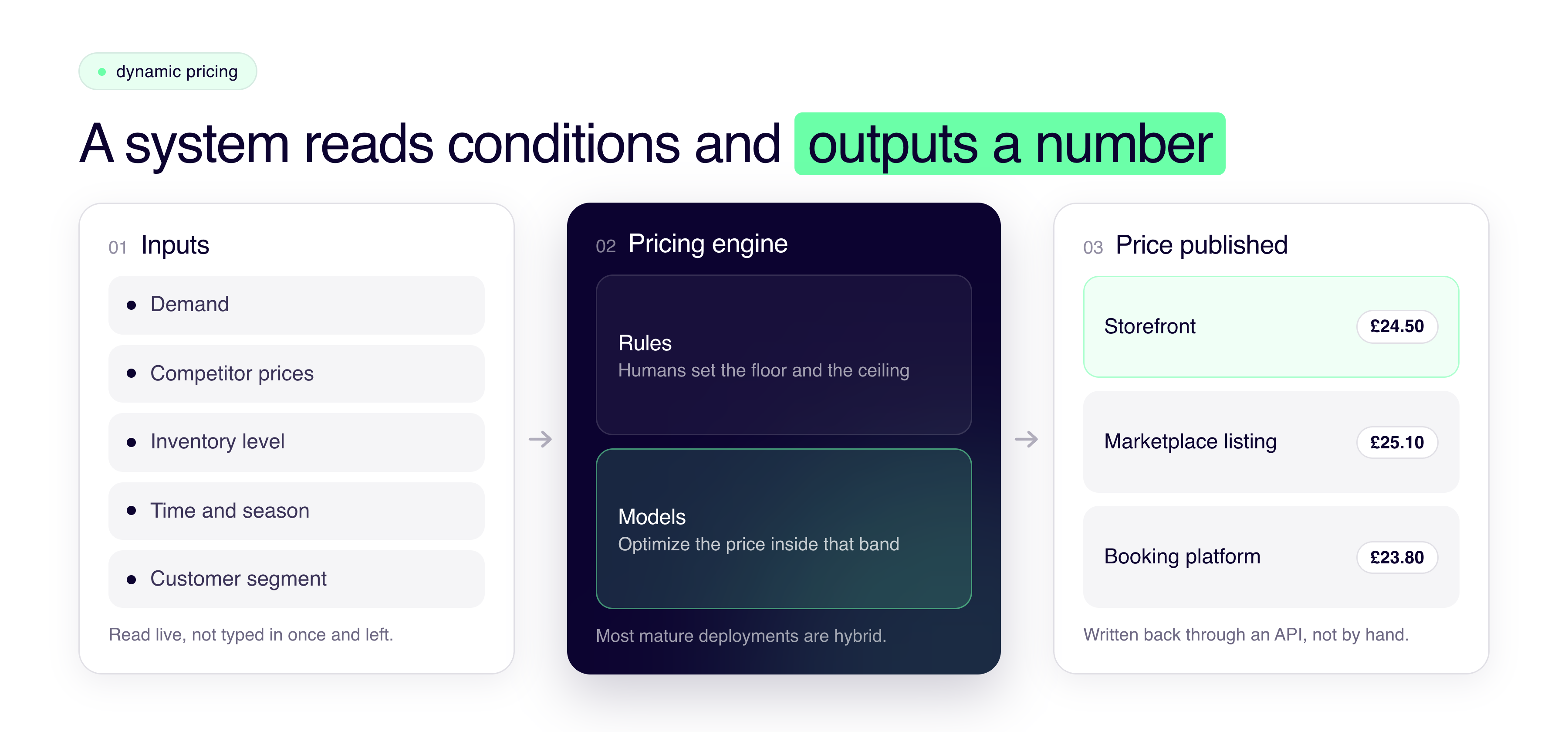
A price is dynamic when a system reads current conditions and outputs a number, rather than a person typing one in and leaving it. The opposite is static pricing, where the price holds until somebody decides to change it.
The system reads inputs, applies logic, and writes a price back to your storefront, marketplace listing or booking platform.
How a dynamic pricing model works, from inputs to writing price automatically to a storefront
Airlines, hotels, ride-hailing and marketplace sellers have priced this way for years. What changed recently is that the software became affordable for mid-sized retailers, so many more businesses are now making a decision they have not made before.
The distinction that matters
Two things get called dynamic pricing, and they carry very different risk.
The first adjusts price based on conditions that affect everyone the same way: inventory levels, aggregate demand, competitor prices, time of day, seasonality. Everyone shopping at the same moment sees the same price. This is standard commercial practice.
The second charges different people different prices at the same moment, based on personal data such as location, device or browsing history. This is usually called personalized or surveillance pricing, and it is the one under regulatory pressure. The FTC published preliminary findings in January 2025 flagging concerns about sensitive personal data in pricing algorithms, and several states are developing disclosure requirements.
A tool that can do both will let you drift from the first into the second without announcing it, so the difference is worth settling before you switch anything on.
Transparent, auditable, easy to roll back. You always know why a price moved
Cannot adapt to anything it was not told. Breaks when the benchmark competitor runs a flash sale or goes out of stock
Model-driven
Elasticity estimates, bandits or reinforcement learning predict the price most likely to hit a goal
Adapts to patterns nobody programmed, and optimizes for profit rather than position
Data hungry. Without guardrails it finds prices that are technically optimal and commercially damaging
Hybrid current best practice
Rules set hard floors and ceilings. A model optimizes inside that band
Keeps the adaptability and keeps a human-defined boundary the system cannot cross
Only as good as the band. Floors and ceilings picked without elasticity evidence are guesses with authority
Mature platforms also tier automation by confidence, so SKUs with strong sales history and clear competitor data are repriced automatically while sparse or new SKUs are flagged for human review. Any engine that changes a price without showing you why creates risk rather than value.
Most mature deployments are hybrid: rules define the boundaries that must never be crossed, and a model optimizes within them. Floors and ceilings are set by humans, the price inside that band is set by the system.
That leaves the question of where the floors and ceilings come from.
How each model feeds a pricing decision
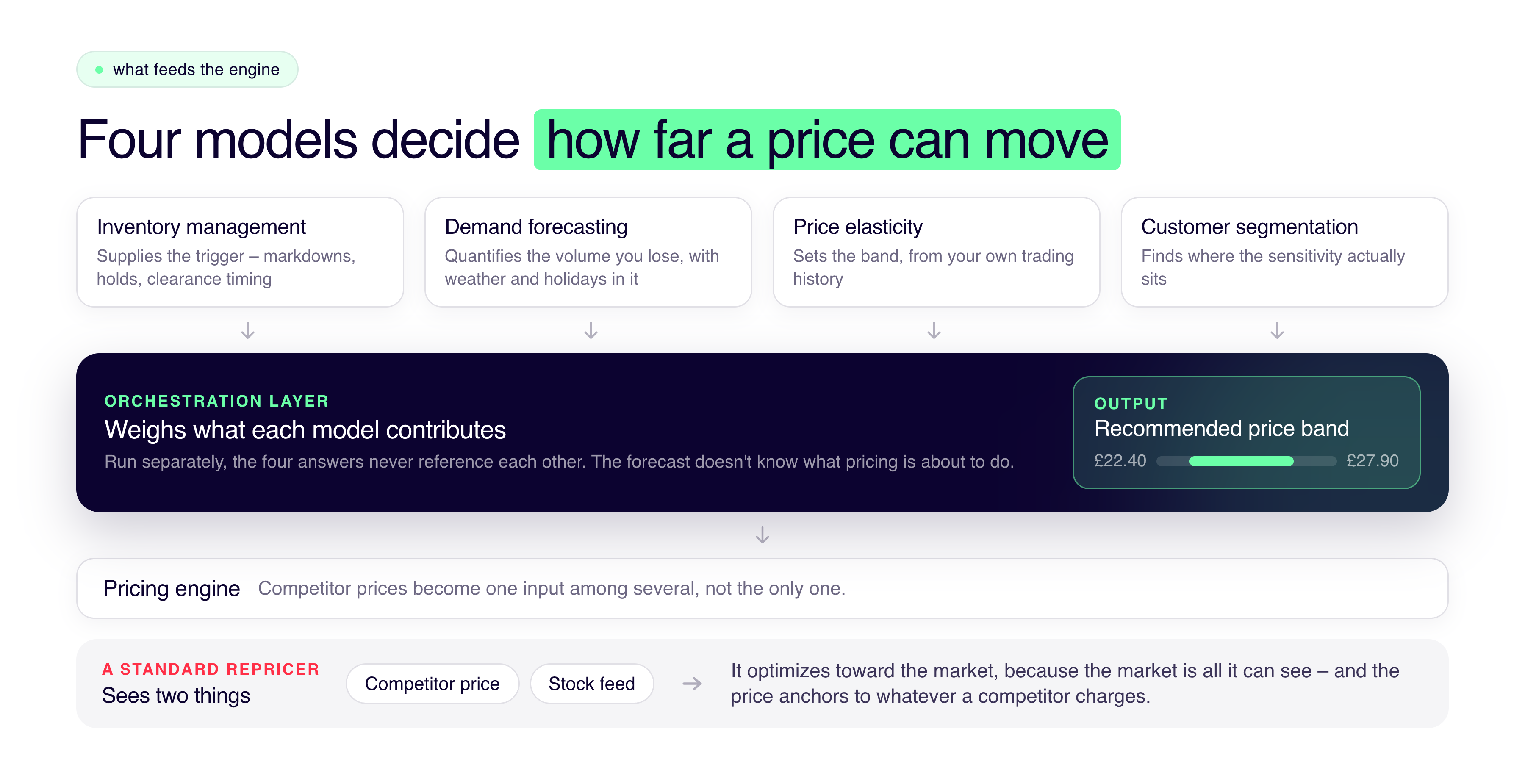
A standard repricer sees two things: competitor prices and your stock feed. That is a narrow view of a decision that touches most of the business, and it is why so much automated pricing ends up anchored to whatever a competitor is charging. It is the only input the engine has.
Four models produce inputs a pricing engine can act on, and each answers a different question.
Inventory management
Inventory supplies the trigger. Most of the price changes a retailer actually wants are inventory decisions expressed as prices: markdown logic on slow-moving stock, price holds or increases on lines approaching stockout, and clearance timing on seasonal ranges.
An engine with a live stock position can act on those. An engine working from a nightly inventory export cannot, because by the time it prices, the position has moved. This is the input most commonly stale, and it is the cheapest one to fix.
Demand forecasting
Forecasting quantifies the trade-off. A price rise that lifts margin while depressing volume is only a good decision if you can put a number on the volume you lose, and that number is a forecast rather than a pricing output.
Our demand forecasting model also carries external factors that pricing tools rarely see, including weather, public holidays, and promotional calendars. Those are frequently the actual reason demand moved, and an engine that cannot see them will attribute the change to price and adjust in the wrong direction.
Price elasticity
Elasticity sets the band, and it is the only one of the four that answers how far a price can move at all.
Our price elasticity model estimates, per product or category, how much volume you lose for each percentage point of price increase. It runs as an econometric model on your own trading history rather than on category benchmarks, which matters because two products with identical margins can have completely different elasticity curves, and only one of them is safe to raise.
Without this, the floors and ceilings in a hybrid engine are set by guesswork. With it, they are set by what your customers have actually done when prices changed.
Customer segmentation
Segmentation identifies where the price sensitivity actually sits. Elasticity for a whole product is an average, and averages hide the useful part: customers acquired on promotion behave very differently from a loyal base buying the same item.
Our customer segmentation model builds those cohorts from purchase behavior rather than demographic proxies. Used carefully, that tells you which segments will tolerate a price move and which will not.
Given the distinction above, segment-level elasticity should inform the band you set for a product or channel, not a different price shown to each individual based on who they appear to be. The first is pricing strategy, and the second is the practice regulators are examining.
All four together: the orchestration layer
Run those models independently and you get four answers that do not reference each other, with nothing in place to reconcile them. The forecast does not know what the pricing model is about to do, and the pricing model does not know what stock is available.
The orchestration layer is what makes them a system. It weighs what each model contributes to the outcome you care about, so the pricing decision accounts for the volume the forecast expects, the stock available to sell, and which customer segments are sensitive to the change.
This is also where it differs from a repricer, which optimizes toward the market because the market is all it can see. With the models behind it, competitor prices become one input among several rather than the only one.
Kleene.ai's Orchestration Layer works by taking outputs from KAI Analytics models (inventory management, demand forecasting, price elasticity and customer segmentation) and combining them into a live pricing engine
What this does for your business
With those models running together, dynamic pricing manages margin rather than just matching competitors.
You know how far each price can move. Not a uniform rule across the catalog, but a band per product or category, derived from how your customers actually responded to past price changes.
Markdowns get triggered by evidence rather than the calendar. Slow-moving stock is identified against forecast demand rather than against a date somebody picked, which usually means discounting less and later.
Stock position protects margin. Lines running short hold price or rise instead of being discounted into a stockout by a rule that only watches competitors.
Price moves are set for the customers who actually buy. Segments that tolerate an increase can carry one while price-sensitive cohorts are protected, rather than one average applied to everyone.
The bill does not scale with your catalog. Kleene is a flat annual fee with unlimited data usage, so the models cost the same whether you price a thousand SKUs or a hundred thousand.
There are two limits worth stating. Kleene does not sell a repricing engine, so we do not change the prices on your storefront, and if the execution layer is what you need then a repricer or an enterprise pricing suite is the right purchase. Our guide to price optimization tools covers that market by category. And none of this helps if your prices should not be moving at all. In categories where customers do not expect price volatility, or in B2B where contract pricing dominates, frequent automated changes cost more in trust than they return in margin.
FAQ
What is dynamic pricing software?Software that changes prices automatically based on current conditions such as demand, competitor prices, inventory levels, time of day and seasonality. A price is dynamic when a system generates it from live inputs rather than a person setting it manually.
How does dynamic pricing software work?It ingests live data feeds, applies rules, a machine learning model, or a hybrid of both, then pushes updated prices to a storefront, marketplace or booking platform through an API. Most mature deployments use rules to set hard floors and ceilings and a model to optimize within that band.
What data does dynamic pricing need?Current inventory positions, granular sales history, accurate competitor prices, and an estimate of price elasticity. Without elasticity the system has no basis for a price beyond matching competitors, which compresses margin across a category.
What is the difference between dynamic pricing and personalized pricing?Dynamic pricing adjusts prices based on conditions affecting all customers alike, so everyone shopping at the same moment sees the same price. Personalized or surveillance pricing charges different individuals different prices simultaneously based on their personal data. The second is the practice attracting regulatory attention.
Is dynamic pricing legal?Adjusting prices based on objective market conditions is standard commercial practice. Pricing based on inferred personal characteristics faces growing legal restriction, with the FTC flagging concerns about personal data in pricing algorithms in January 2025 and several states developing disclosure requirements. Document your data inputs and be able to show your pricing outcomes are not discriminatory.
Does dynamic pricing hurt customer trust?It can. Survey work from YouGov across 17 markets in 2023 found majorities in several Western markets described dynamic pricing as unfair, and CivicScience found 44% of US adults aware of the practice considered it price gouging. The risk rises with how visible and frequent the changes are, and falls where customers already expect prices to move, as in travel and event tickets.
Does Kleene provide dynamic pricing software?Kleene does not sell a repricing engine and does not change prices on your storefront. It builds the models that tell a pricing engine what its rules and boundaries should be: demand forecasting, inventory, price elasticity and customer segmentation, running on the same data through an orchestration layer.
Summary
Most dynamic pricing platforms can reprice in near real time, so the differences between them matter less than what you feed them.
An engine given only competitor prices and a nightly stock export will match the market and lose margin in the process. An engine given a demand forecast, a live inventory position, an elasticity band and segment-level sensitivity can price for profit instead.
If your prices should be moving but you cannot say how far they can move before volume falls away, tell us what your pricing data looks like and we will say whether the gap is a model, a repricer, or better inputs feeding the engine you already run.


%201.svg)


%201.svg)
