What is inventory in accounting? 4 valuation methods compared
August 15, 2024
- min read
Henry Owen
Product Marketing Manager
TLDR: In accounting, inventory is a current asset made up of the goods a business holds to sell or use in production. It covers raw materials, work in progress, finished goods, and the maintenance and repair supplies that keep production running. It sits on the balance sheet until the goods are sold, at which point its cost moves to cost of goods sold and reduces gross profit. Which valuation method you use changes that profit figure. On identical purchases and sales, FIFO, LIFO and weighted average cost can produce gross profits that differ by 50%. LIFO is permitted under US GAAP and prohibited under IFRS.
Inventory is one of the few balance sheet items where the accounting treatment changes the reported profit without anything different happening in the business.
Same purchases, same sales, same warehouse. Different valuation method, different gross profit. That is the part worth understanding, and most explanations of inventory accounting skip straight past it to list the categories.
The definition
Inventory is a current asset representing goods a business intends to sell, or materials it will use to produce goods for sale. It appears on the balance sheet at the lower of cost and net realizable value, meaning if the goods are now worth less than you paid, you write them down rather than carrying them at cost.
The word "current" matters. Inventory is expected to convert to cash within the normal operating cycle, usually twelve months, which is why it sits alongside receivables and cash rather than with property or equipment.
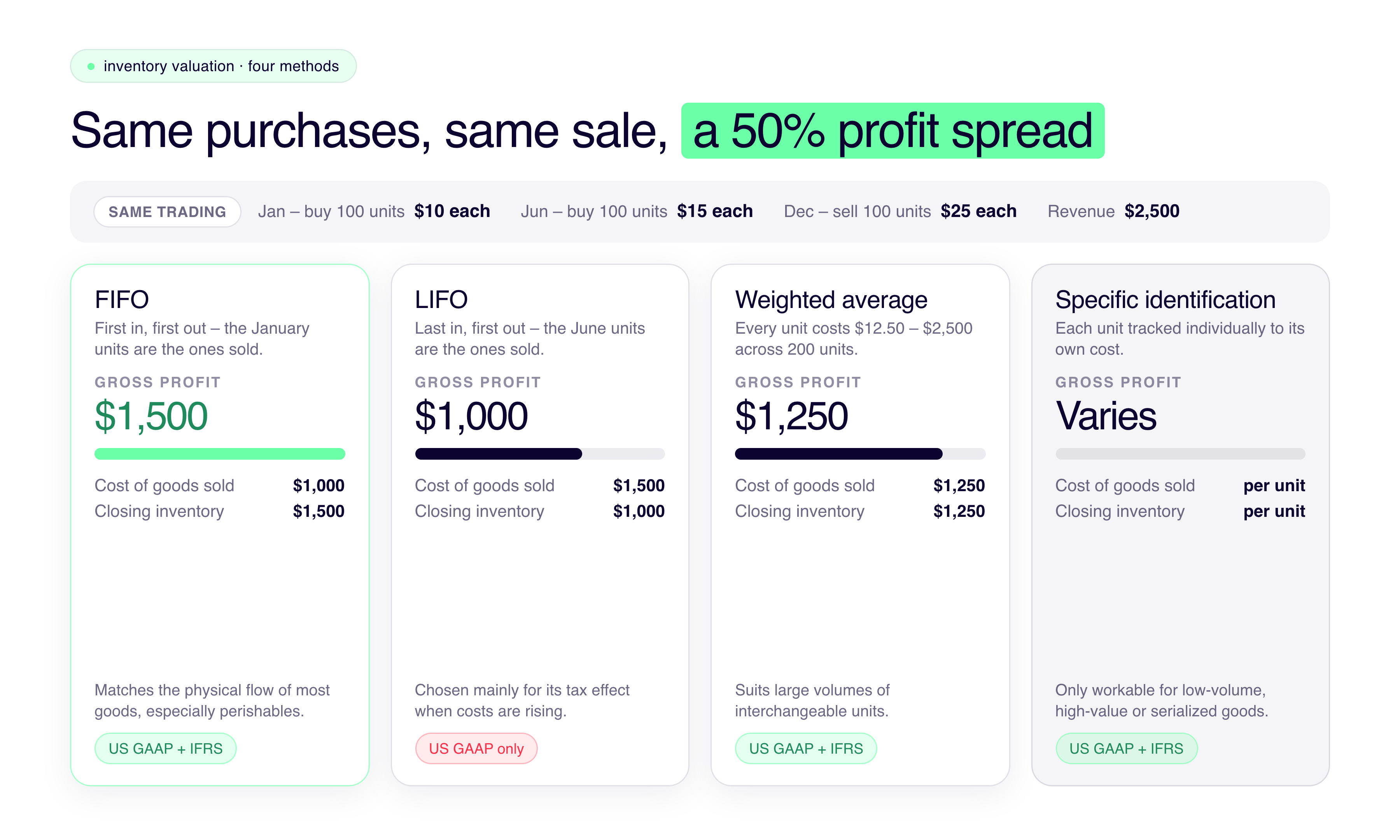
The four methods of inventory valuation, compared for the same purchases
The four categories
Raw materials are the inputs waiting to be used. Flour for a bakery, steel for a fabricator.
Work in progress is what is part-made. It carries the cost of the materials consumed so far plus the labor and overhead absorbed into it, which is why WIP valuation is the fiddliest of the four.
Finished goods are complete and ready to sell.
Maintenance, repair and operations supplies are the consumables that keep production going without ending up in the product. Lubricants, spare parts, cleaning materials. Some businesses expense these rather than treating them as inventory, depending on materiality.
A retailer usually only has finished goods. A manufacturer has all four, and the split between them tells you something about where cash is tied up.
How inventory is valued
The four methods below all start from the same purchase records and produce different numbers. The table includes a worked example so the difference is visible rather than theoretical.
Four inventory valuation methods, and what each does to your profit
Method
How it works
COGS in the example
Gross profit
When costs are rising
Permitted under
FIFO First in, first out
Oldest stock is treated as sold first
$1,000
$1,500
Higher reported profit, higher tax, closing inventory near current cost
IFRS and US GAAP
LIFO Last in, first out
Newest stock is treated as sold first
$1,500
$1,000
Lower reported profit, lower tax, closing inventory held at old costs
US GAAP only. Prohibited under IFRS (IAS 2)
Weighted average cost
Every unit carries the average cost of all units held
$1,250
$1,250
Smooths price swings, sits between the other two
IFRS and US GAAP
Specific identification
Each individual item is tracked at its own cost
Depends which units sold
Depends which units sold
Most accurate, only practical for low-volume high-value goods
IFRS and US GAAP
Worked example: 100 units bought at $10, then 100 at $15, then 100 units sold at $25 for revenue of $2,500. Identical transactions in every row. Gross profit varies by 50% depending only on the method chosen. Whichever you adopt has to be applied consistently, and a change in policy must be disclosed. This is general information rather than accounting advice; confirm treatment with your accountant or auditor.
The worked example behind the table
You buy 100 units at $10 in January, then 100 units at $15 in June. In December you sell 100 units at $25 each, so revenue is $2,500.
Under FIFO, the units you sold are the January ones. Cost of goods sold is $1,000 and gross profit is $1,500. The 100 units left on the balance sheet are valued at $15 each, so closing inventory is $1,500.
Under LIFO, the units you sold are the June ones. Cost of goods sold is $1,500 and gross profit is $1,000. Closing inventory is the cheaper January stock at $1,000.
Under weighted average cost, every unit costs $12.50, being $2,500 of purchases across 200 units. Cost of goods sold is $1,250 and gross profit is $1,250. Closing inventory is also $1,250.
Nothing about the trading changed. Gross profit ranges from $1,000 to $1,500, a 50% spread, purely from the method.
That is why the choice is a policy decision rather than a preference, and why you cannot switch between methods to flatter a period. Consistency is the requirement, and a change has to be disclosed and justified.
Where the numbers land in your accounts
Inventory sits on the balance sheet as a current asset. When goods sell, their cost transfers to cost of goods sold in the income statement.
The arithmetic connecting the two is worth committing to memory:
Opening inventory + purchases − closing inventory = cost of goods sold
Which means closing inventory and COGS move in opposite directions. Overstate closing inventory and you understate COGS, which overstates gross profit. This is why inventory is a common focus in audits and a common place for errors to hide: the figure affects both statements at once.
Two ratios get built on top of it. Inventory turnover measures how many times you sell and replace stock in a period. Days inventory outstanding converts that into a number of days. Both depend on the valuation method, so comparing your ratio to a competitor using a different method is not comparing like with like.
Why the accounting figure and the warehouse figure disagree
Here is the practical problem that inventory accounting runs into, and it is not an accounting problem.
The value on your balance sheet comes from your finance system. The quantity on hand lives in your ERP or warehouse system. What you have actually sold sits in your ecommerce platform or point of sale. In a lot of businesses these three do not agree, and the month-end job becomes reconciling them by hand rather than reporting on them.
ERP systems are usually where people expect this to be solved, and they do handle the transactional side well. Where they tend to fall short is reporting across the boundary: joining inventory movements to sales data, to supplier lead times, to demand patterns, in one view. So the reporting gets exported to spreadsheets, and the spreadsheets become the real system.
The fix is unglamorous. Get inventory, sales and finance data into one place with definitions everyone accepts, so the accounting figure and the operational figure come from the same source. That is what our data platform does, and it is also the prerequisite for anything predictive: a demand forecast built on inventory data that does not reconcile will be confidently wrong.
If you want to test whether you have this problem, ask finance and operations for the closing inventory value for last month separately. If the two numbers differ and nobody can explain why, that is the thing to fix before buying any forecasting tool.
FAQ
What is inventory in accounting? A current asset representing goods a business holds to sell or use in production, covering raw materials, work in progress, finished goods and consumable supplies. It is carried at the lower of cost and net realizable value, and its cost moves to cost of goods sold when the goods are sold.
Is inventory an asset or an expense? It is an asset while you hold it and becomes an expense when you sell it. The cost sits on the balance sheet as inventory, then transfers to cost of goods sold in the income statement at the point of sale.
What are the four types of inventory? Raw materials, work in progress, finished goods, and maintenance and repair supplies. Retailers typically hold only finished goods, while manufacturers hold all four.
Which inventory valuation method should I use? FIFO is the most common and matches the physical flow of most goods, especially perishables. Weighted average suits businesses holding large volumes of interchangeable units. LIFO is only available under US GAAP and is chosen mainly for its tax effect when costs are rising. If you report under IFRS, LIFO is not an option.
Why is LIFO banned under IFRS? IAS 2 prohibits it because it can leave balance sheet inventory valued at very old costs that bear no relation to current value, which reduces the usefulness of the accounts.
How does inventory affect profit? Directly, through cost of goods sold. Since COGS equals opening inventory plus purchases minus closing inventory, a higher closing inventory figure lowers COGS and raises gross profit. This is why inventory valuation errors distort profit in both directions.
What is the formula for cost of goods sold? Opening inventory plus purchases minus closing inventory.
Getting the number right
Most inventory accounting problems are not judgment calls about FIFO or LIFO. They are reconciliation problems, where the finance system and the operational system disagree and nobody is sure which to trust.
If that sounds familiar, send us your setup and we will tell you where the numbers are diverging.


%201.svg)


%201.svg)
