By 2026, knowing which customers are about to leave stopped being the hard part, as most teams can now see churn coming via usage health scores, AI risk flags, the dip in logins that shows up weeks before a cancellation – the signal is everywhere. Unfortunately, seeing it has not moved the number for most companies: Gartner's 2025 research found that the majority of customer success teams running predictive churn models reported no measurable improvement in net retention versus teams running none (Perspective AI).
That is what this piece is about: the risk factors that decide whether a customer comes back in 2026, and what to fix first.
What "normal" churn looks like in 2026
A quick reality check before the risk factors, because the benchmarks have moved.
The average DTC ecommerce brand now retains about 31% of its customers year on year, up a point from 2024, with a typical repeat-purchase rate of 25 to 30% (Finsi, Swell). Consumables do better: supplements, coffee, and skincare brands with a real post-purchase programme reach 40 to 55% (Swell).
On subscriptions the picture splits hard by category. Replenishment models such as supplements, coffee, and pet food run 4 to 7% churn a month. Discovery-led boxes run 10 to 15%. Meal kits top the table at 12.7%, mostly from diet fatigue and the effort of actually cooking (Eightx). The single biggest lever across all of them is billing cadence: annual prepay cuts churn by roughly half compared with monthly billing on the same product (Eightx). A subscription brand losing 10% of its base every month is rebuilding the entire business inside a year just to stand still.
Here are the five things most likely to be driving that number.
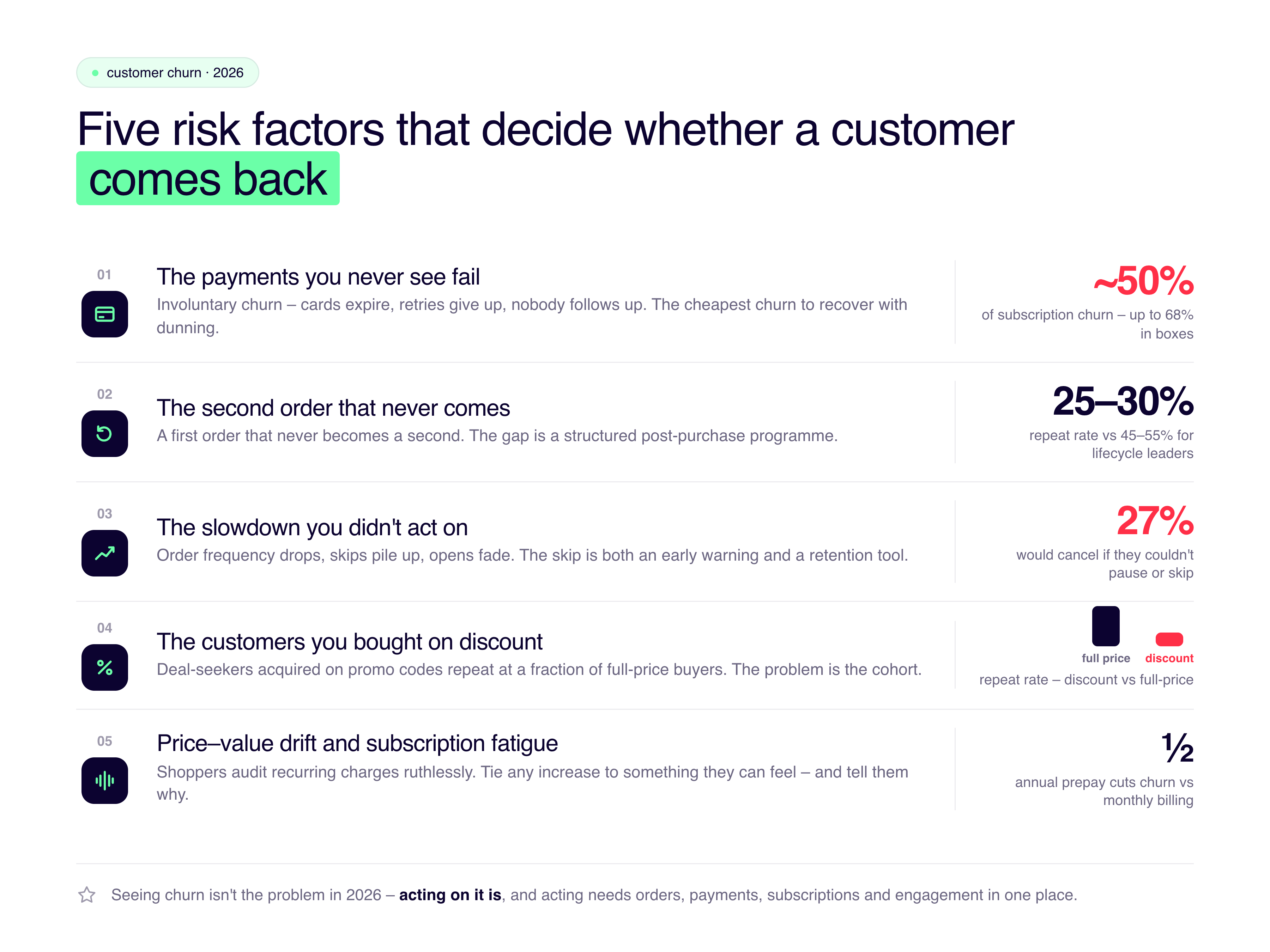
An overview of the 5 customer churn risk factors, and that causes them
Risk factor 1: the payments you never see fail
Involuntary churn, customers who never chose to leave but lapsed when a payment failed, is the single biggest churn problem in consumer subscriptions. Failed card payments cause roughly half of all subscription churn, and as much as 68% in subscription boxes (Swell). Expired cards, a bank flag, a billing retry that quietly gave up. The customer still wants the product, they just stopped paying without meaning to, and nobody followed up.
This is the cheapest churn to recover, because the fix is mostly operational: card-updater services, smart retry timing, dunning emails that read like a helpful nudge rather than a debt collector. A proper dunning setup recovers 50 to 80% of failed payments on its own (Digital Applied). If you only chase a single number this quarter, find out what share of your churn is involuntary. For most consumer brands it is the easiest double-digit retention win available.
Risk factor 2: the second order that never comes
For consumer brands, the equivalent of a broken onboarding is a first order that never becomes a second.
The average DTC brand converts 25 to 30% of buyers into repeat customers, while lifecycle leaders reach 45 to 55%, and the gap is almost entirely explained by whether there is a structured post-purchase programme and a subscription option in place (Swell). A customer who buys once, has a fine experience, and never hears from you again in a useful way is not a retention problem you solve later (but there is no later).
Knowing which first-time buyers are worth winning back, and what they are worth, starts with your customer lifetime value. Get that number right and the post-purchase spend stops being a guess.
Risk factor 3: the slowdown you didn't act on
Customers rarely slam the door and signal the fade differently from software users, but just as clearly: order frequency drops, a subscription gets skipped one too many times, email opens fall away. The skip in particular is worth watching closely, because it cuts both ways. Around 27% of subscribers say they would cancel outright if they could not pause or skip an order (Encomm), so the skip button is both an early warning and one of your better retention tools.
Risk factor 4: the customers you bought on discount
Brands that lean hard on promo codes and first-order discounts to hit a CAC target fill the base with deal-seekers who repeat at a fraction of the rate of full-price buyers. It is invisible in any single customer's behaviour, because the problem is the cohort itself. You only see it when you can group customers by how you acquired them and watch which channels and discount levels produce repeat business. The fix is to feed retention-by-channel data back to the people running acquisition, and stop paying to bring in customers who cost more to keep than they ever spend.
Risk factor 5: price-value drift and subscription fatigue
Shoppers are auditing their recurring charges more ruthlessly than they were a few years ago, and "we never really use this" is a perfectly good reason to cancel.
Two forces pull at once. Competitors can undercut you, outbid you on ads, or simply look fresher. And your own pricing drifts away from perceived value as costs rise and you pass them on. Tie any increase to something the customer can feel, give subscribers easy ways to pause, skip, or downgrade rather than quit, and tell them why a price changed instead of letting them find out on a card statement. There is real backlash when pricing feels arbitrary, especially for subscriptions (Investors' Chronicle).
Why a churn model on its own won't save you
Back to where we started, because it is the thread running through all five.
The signal is rarely the problem in 2026. Acting on it is, and acting is where most consumer brands jam, because the data is scattered. Orders live in the commerce platform, payments in the processor, subscription state in another tool, email and SMS engagement in the marketing platform, ad spend in two or three ad accounts, stock in a 3PL or ERP. When a churn signal fires, half the context needed to respond well sits in a system the person responding cannot see. So the window between the skipped order and the cancelled subscription closes while someone waits on a manual export.
That is the boring root cause behind most retention programmes that underperform, and it is fixable. Pull orders, payments, subscriptions, marketing, and stock into one single source of truth, and the same churn flag arrives with the failed payment, the order-frequency dip, the last three skips, and the next billing date already attached.
Where Kleene fits
Kleene does predict churn, but the difference is that we never run the prediction on its own, because a churn score on its own is the thing Gartner just told you does not move the number.
We build a churn model as one of several proprietary models on your data, sitting alongside customer segmentation, price elasticity, lifetime value, and demand forecasting, and connect them through KAI, plain-English assistant, and our orchestration layer. So a churn flag does not land as a lonely red dot – It arrives knowing which segment the customer belongs to, how price-sensitive that segment is, what they are worth over a lifetime, and which message tends to bring them back. A retention lead can ask "which subscribers went quiet this month, and what do they have in common" and get an answer drawn from your own data rather than a guess.
Talk to us and bring last quarter's churn breakdown. For the practical follow-up, our guide to customer retention strategies covers what to do once you know where the leak is.


%201.svg)


%201.svg)
