The 10 best sales forecasting software tools in 2026
July 29, 2026
- min read
Henry Owen
Product Marketing Manager
TLDR: Two different things get called sales forecasting, and most tools only do one of them. Pipeline forecasting predicts whether your sales team will hit their quota this quarter, built bottom-up from CRM deals and rep inputs. Clari, Gong, Aviso and your CRM's native forecasting are all examples of pipeline forecasting tools. Demand-led revenue forecasting predicts how much of a product you will sell, based on transaction history and external factors (like seasonality and the weather). Pipeline forecasting tools can’t see these factors, as they are outside the CRM they work in. Which kind of tool you need depends on which of those use cases your board or CFO is asking for.
One search term covers two kinds of forecasting
Pipeline forecasting works from the bottom-up. It takes the deals in your CRM, applies weighting or an AI model to close probability, flags the ones that look like they're slipping, and rolls it into a number for the quarter. The buyer is usually a VP of Sales or a RevOps lead. The question is whether the team hits its target.
Demand-led revenue forecasting works almost the opposite way. It starts from what happened, so transaction history instead of pipeline entries, then it models the factors that move demand for each product or service over time. The buyer tends to be a CFO, a commercial director, or whoever owns the annual plan. The question is how much you will sell over the next twelve to eighteen months and what needs to be ready for it.
Both answer different questions and they're built from different data, which is why buying one when you needed the other is a common mistake.
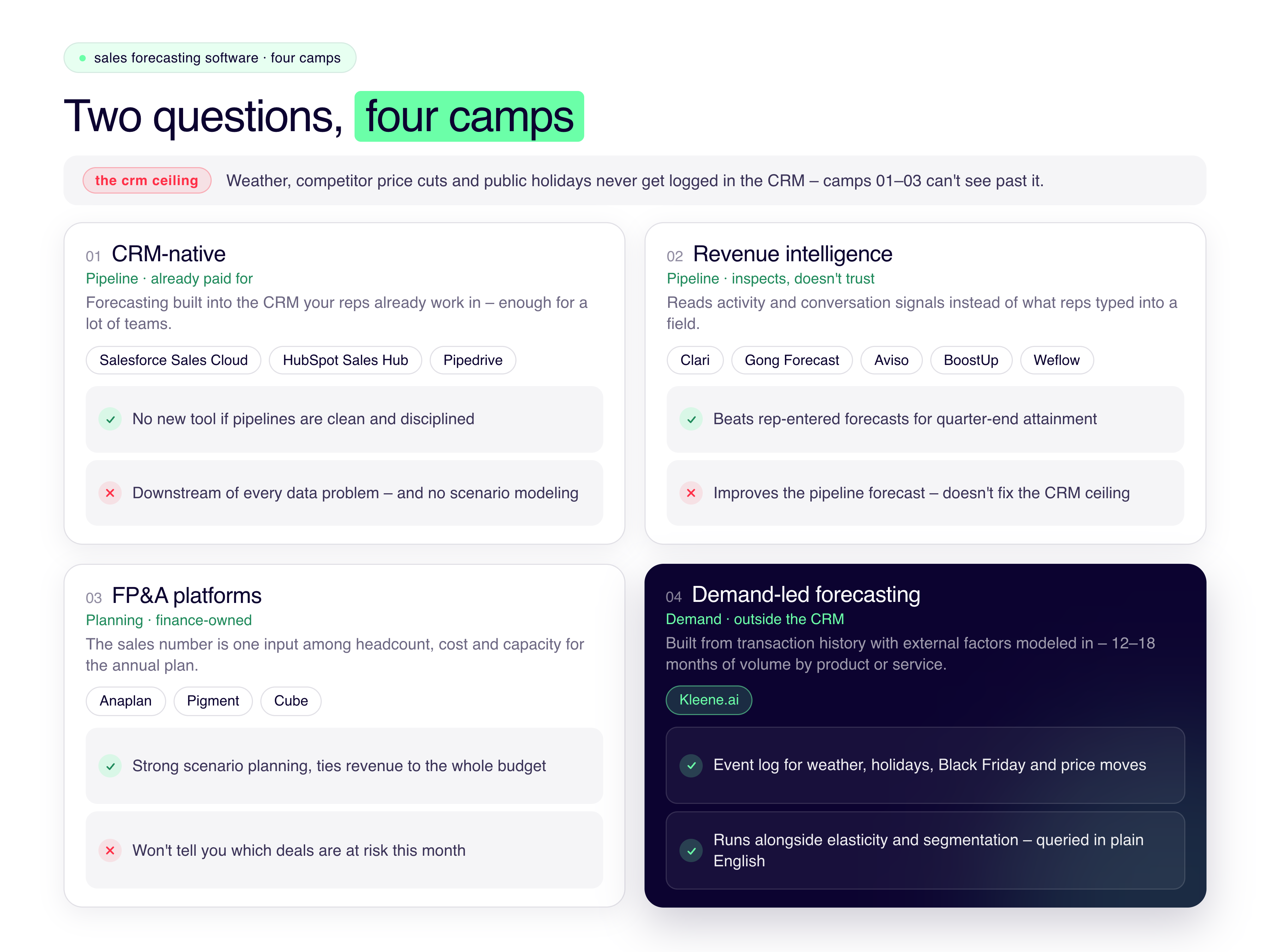
How the four camps of sales forecasting tools tackle the problem of events outside of the CRM influencing demand
The CRM ceiling
We call it the CRM ceiling: the point where pipeline data can’t tell you anything more, because anything else that would change your revenue forecasts is outside the CRM.
The weather doesn’t get logged in Salesforce, neither does your competitors’ price cuts or public holidays. These factors are often overlooked and can have a much larger effect on your sales than people think.
Ian Liddicoat, CPO at Kleene.ai, explains how many of these factors sit outside of the systems: "It always amazes me how highly external factors rank among the things that actually drive demand." The models his team builds carry an event log so they can tell the difference between a weekday and a weekend, a public holiday, Black Friday, Valentine's Day, and shifting weather patterns.
The example he gives is a travel company Kleene works with: "Their product is their tours, their packages, their coach trips. What they need is to understand take-up for each tour over time, because there's no point in having 20% of your tours overbooked and 80% sitting with spare capacity."
Bookings for the sunny tours went up when the UK weather was bad, and down during a heatwave. If you were forecasting that business from rep-entered pipeline data, you would have missed the largest variable.
His point about why this needs machine learning rather than a spreadsheet model is worth sitting with too: "You end up with a number of factors that need to be considered in unison, and really it's machine learning that allows you to do that rather than relying on a static conventional statistical model." You can read the full interview on how demand forecasting models are built for the mechanics.
Sales forecasting software in 2026, compared by what it forecasts
Tool
Approach
Forecasts what
Horizon
Uses data outside the CRM?
Best for
Salesforce Sales Cloud
CRM-native
Pipeline and quota attainment
Quarter
No
Teams already standardized on Salesforce
HubSpot Sales Hub
CRM-native
Pipeline and quota attainment
Quarter
No
Mid-market HubSpot teams wanting quick setup
Pipedrive
CRM-native
Pipeline revenue
Quarter
No
Small sales teams on a budget
Clari
Revenue intelligence
Pipeline, with activity signals
Quarter
Activity data only
Enterprise quota attainment, the category standard
Gong Forecast
Revenue intelligence
Pipeline, from conversation signals
Quarter
Calls and emails
When reps are optimistic in fields, honest on calls
Aviso
Revenue intelligence
Pipeline, AI-weighted
Quarter
Activity data only
Teams wanting a forecast that challenges the sales number
BoostUp
Revenue intelligence
Pipeline and deal risk
Quarter
Activity data only
Mid to upper-mid-market revenue teams
Weflow
Revenue intelligence (light)
Pipeline, plus CRM hygiene
Quarter
No
Salesforce teams whose real problem is data entry
Anaplan / Pigment / Cube
FP&A planning
Revenue as part of the wider plan
Annual and multi-year
Finance data, yes
When the forecast feeds a budget, not a pipeline review
Kleene.ai
Demand-led forecasting
Demand by product or service, with external factors
12 to 18 months
Yes: transactions, seasonality, events, weather
Annual planning and capacity, not weekly deal risk
Pricing is deliberately omitted because most vendors in the revenue intelligence camp quote on request and published figures date quickly. Confirm current pricing and tier requirements directly, since CRM-native forecasting often sits behind a higher subscription tier.
Camp 1: CRM-native forecasting
Every major CRM has some kind of forecasting, and for a lot of teams it's enough to work with.
1. Salesforce Sales Cloud. Collaborative forecasting plus Einstein's predictive scoring. If your pipelines are good and your CRM is already a single source of truth, this should be enough. However it requires a higher tier for AI features and it is downstream of any problem in your data, which for a lot of organizations is the actual problem not the forecasting logic.
2. HubSpot Sales Hub. Forecasting is in the Professional tiers upward, and it's easier to get running than Salesforce. Mid-market teams who run HubSpot won’t need a separate tool for pipeline forecasting. However doesn’t have scenario modeling, so you’d need another tool for that, or just skip it entirely.
3. Pipedrive. Revenue forecast reporting for smaller sales teams, cheap and quick. Doesn’t try to be a proper forecasting platform.
Camp 2: Revenue intelligence
This category emerged because Camp 1’s CRM forecasts can be unreliable. These tools inspect the pipeline rather than blindly trusting it.
4. Clari. The strongest in this camp for enterprise scale organizations. It pulls signals from activity data rather than relying on what reps submit, and has very good pipeline inspection. Enterprise pricing and an enterprise implementation to match.
5. Gong Forecast. Gong's core strength is conversation intelligence, which means its forecast is informed by what was said on calls and written in emails rather than just what was entered into a field. If your reps are optimistic in the CRM and honest on calls, that gap is where Gong works.
6. Aviso. Heavier on the AI-prediction side, often chosen by teams who want a forecast that pushes back on the sales leader's number or assumptions.
7. BoostUp. Similar to Clari, popular with mid-market and upper-mid-market revenue teams.
8. Weflow. Salesforce-focused, with pipeline hygiene as the starting point. A good pick if the CRM is the issue, which is more often the real problem rather than a weak model.
Every one of these tools improves your pipeline forecast, but none of them fix the CRM ceiling.
Camp 3: FP&A and planning platforms
9. Anaplan, Pigment or Cube. Finance-owned planning tools. The sales forecast is just one input among headcount, cost and capacity. They’re good at scenario planning and connecting a revenue number to the rest of the plan. But they’re not so good at telling you which deals are at risk this month, which in fairness is not what they're for. Choose these when your forecast has to inform a budget rather than a sales pipeline review.
Camp 4: Demand-led forecasting
10. Kleene.ai. What we build is a demand forecasting model based on your transaction history, with external factors modeled in, typically running alongside price elasticity and segmentation models so the outputs inform each other rather than sitting in separate reports. The forecast then is available to non-technical users who can query it in plain English through KAI Analytics.
Do I really need sales forecasting software?
If you're running a small sales team with a short cycle and a handful of deals, a spreadsheet and a weekly conversation will probably work better for you any tool on this list. Forecasting software earns its cost when volume makes those patterns invisible to the naked eye.
Also if your CRM data is unreliable, buying revenue intelligence to sit on top of it just produces a more confident version of the same wrong answer.
FAQ
What is sales forecasting software? Software that predicts future revenue. Subdivided into pipeline forecasting, which projects whether current deals will close in the period, and demand-led forecasting, which projects sales volume by product or service over a longer horizon using historical and external data.
What's the difference between pipeline forecasting and demand forecasting? Pipeline forecasting is bottom-up from CRM deal records and answers whether the team hits target this quarter. Demand forecasting is built from transaction history plus external factors like seasonality and weather, and answers how much you will sell over the coming year.
Is a CRM enough for sales forecasting? For a short-term pipeline view with disciplined data entry, yes. A CRM cannot forecast demand, because the factors that influence demand aren’t recorded in it.
Which sales forecasting software is most accurate? For quarter-end quota attainment, revenue intelligence tools that read activity signals tend to beat rep-entered forecasts. For annual planning, models built on transaction history with external factors included outperform any pipeline based tools, because the pipeline contains none of those factors.
Can AI improve sales forecast accuracy? Yes, where many variables interact at once, which is beyond what a static statistical model handles well. It can’t compensate for incomplete or inconsistent source data.


%201.svg)


%201.svg)
