The 10 best inventory optimization software tools in 2026
August 26, 2026
- min read
Henry Owen
Product Marketing Manager
TLDR:Kleene.ai is the best inventory optimization software for mid-market retailers and consumer brands whose stock problems trace back to the forecast, because it builds the demand forecast and the inventory model on the same data so one feeds the other. For adding replenishment on top of an ERP, Netstock or Inventoro. For multi-echelon optimization across complex networks, ToolsGroup, Slimstock, RELEX, Blue Yonder, Kinaxis, GAINS or Lokad. Below, ten tools compared by the job each one does, with pricing and a plain answer on which fits.
Inventory optimization software decides what you should hold, and where, and when to reorder. That is a different job from inventory management software, which records what you already have. Every roundup on this topic makes that distinction, and it is the right one: tracking is a reporting problem, optimization is a decision problem.
Every optimization decision (safety stock, reorder points, multi-echelon balancing) is really a way of managing uncertainty about demand. The better your demand forecast, the less uncertainty you are buffering against, and the less stock you have to carry to hit the same service level. Which means the forecast is not one feature among many. It is the input the entire category depends on, and a tool optimizing on a weak forecast just gets you precisely the wrong amount of stock.
The list below leads with the forecast-led platform, then groups the rest by job, and the test to keep in mind throughout is not just how clever the optimization math is, but how good the demand forecast feeding it can be.
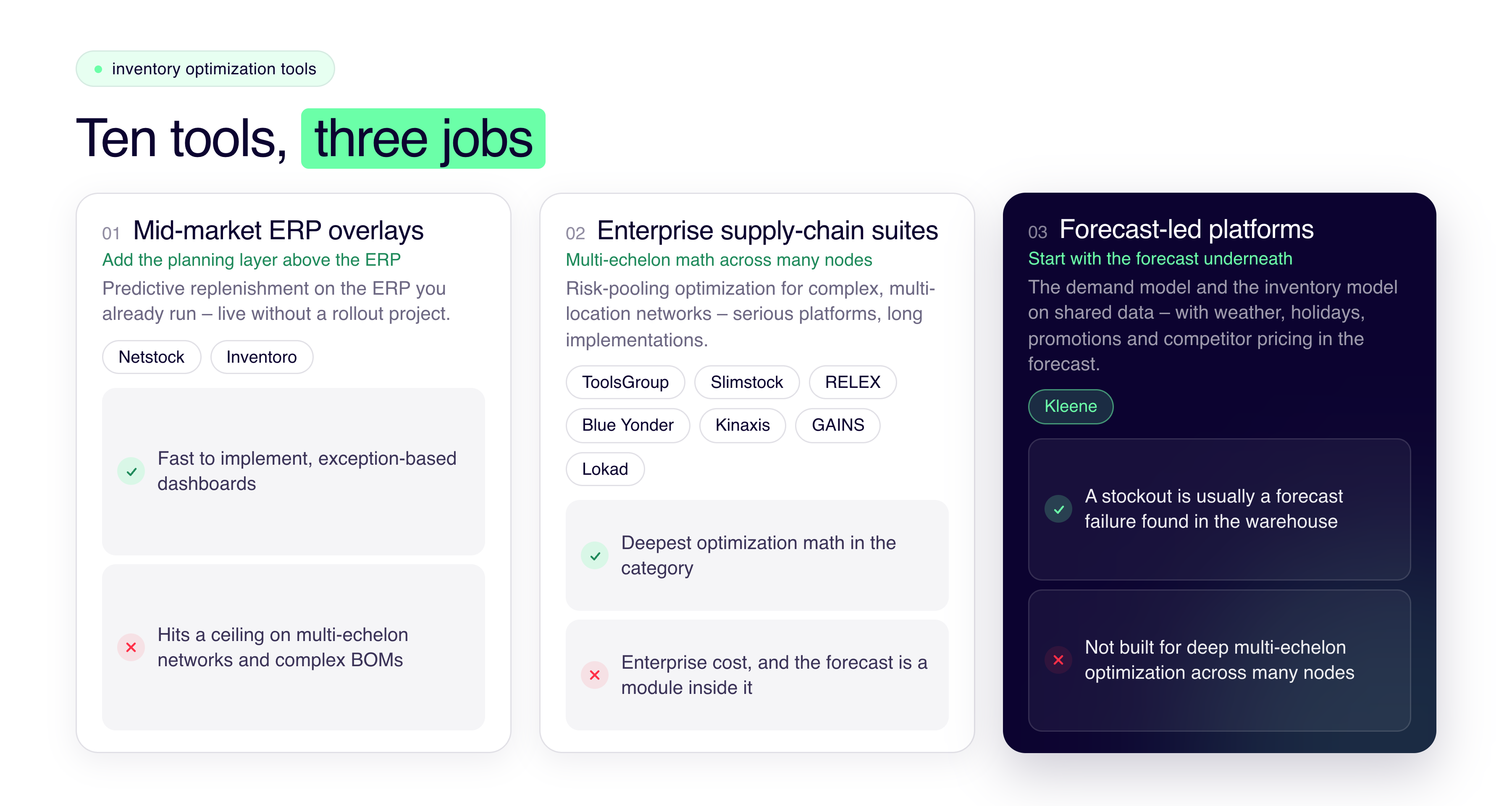
How the top 10 inventory optimization tools can be broken down into 3 camps, and what each specializes in
Kleene.ai is an AI inventory optimization platform for mid-market retailers and consumer brands. It starts from the demand forecast rather than from safety-stock math, and treats inventory as the decision that sits on top of that forecast, with both built on the same data.
The demand forecasting model is the foundation. It is machine-learning-based and it includes the external factors a supply-chain-only tool cannot see, including weather, holidays, promotions and competitor pricing, because Kleene connects to the whole business rather than only the supply chain. The inventory management model then sits on that forecast to work out stock levels, reorder timing and where demand and supply are out of balance.
The reason the pairing matters: a stockout is usually a forecasting failure that showed up in the warehouse. Optimize inventory on a forecast that never knew a heatwave was coming, or that a competitor was about to run a promotion, and the safety-stock math is working from the wrong numbers. Connecting the forecast to the inventory decision, on shared data, is what Kleene does.
Kleene is built for businesses where inventory is one of several decisions that should share the same data and models, so demand forecasting, inventory, price elasticity and segmentation all draw on one source. An embedded analyst team builds and maintains the models, so no in-house data science function is required.
Price: a single annual fee scoped to your setup, models and embedded analyst team included, with no per-SKU or per-location metering.
Pros
Demand forecast and inventory model built on the same data, so the forecast actually feeds the stock decision
Forecast includes external factors beyond the supply chain, such as weather, holidays, promotions and competitor pricing
Inventory sits alongside forecasting, price elasticity and segmentation on one platform
Flat fee with an embedded analyst team included
Cons
Delivered as an engagement rather than a self-serve signup, with a build phase of weeks
Scoped to whole-business decisions rather than multi-echelon network math across dozens of nodes
Mid-market ERP overlays
For businesses that run an ERP and plan inventory in spreadsheets on top of it. These add predictive replenishment without replacing core systems.
The most-cited mid-market option, and for good reason. Netstock layers predictive intelligence onto your existing ERP data, classifying SKUs, generating forecasts, calculating safety stock, and producing replenishment recommendations, with exception-based dashboards so planners focus on the SKUs that need attention. It integrates with NetSuite, SAP, Xero and others, and it is fast to implement relative to the enterprise suites.
Price: contact for pricing, positioned as an accessible mid-market overlay rather than an enterprise platform. Confirm at www.netstock.com.
Pros
Fast to implement on top of an existing ERP
Exception-based dashboards keep planners focused
Strong fit for distributors and manufacturers with clean ERP data
Accessible cost relative to enterprise suites
Cons
Reaches its ceiling on multi-echelon networks, complex BOMs or spare-parts distribution
Optimization is only as good as the ERP data feeding it
Less depth than a dedicated enterprise planning suite
An AI-driven tool that optimizes reorder points, order quantities and safety stock from demand forecasts, aimed at smaller and mid-market operations that want automation without a heavy rollout. Built around forecasting, ABC analysis and replenishment recommendations.
Price: contact for pricing, positioned at the accessible end. Confirm at inventoro.com.
Pros
Automated reorder-point and safety-stock optimization
Forecast-led, with AI demand prediction at the core
Accessible for smaller operations
Quick to get running
Cons
Less suited to complex multi-echelon networks
Narrower than a full enterprise planning suite
Depth of optimization math trails the specialists
Enterprise supply-chain suites
For larger businesses with complex, multi-location networks. These lead on planning depth and multi-echelon inventory optimization, the risk-pooling math that can cut network inventory meaningfully at the same service level. They are serious platforms with implementation timelines to match.
Frequently ranked at the top of the category. ToolsGroup's SO99+ uses probabilistic (stochastic) demand modeling, representing demand as a range of likely outcomes rather than a single-point forecast, then setting buffers accordingly. That approach tends to outperform conventional forecasting on high-variability and slow-moving SKUs, which is exactly where naive forecasts fail.
Price: contact for pricing. Enterprise-tier investment. Confirm at www.toolsgroup.com.
Pros
Probabilistic demand modeling that quantifies uncertainty rather than hiding it in safety stock
Strong on slow-moving and intermittent SKUs
Machine-learning models updated continuously
Service-level optimization per SKU
Cons
Enterprise cost and implementation
More depth than businesses with stable, predictable demand need
A demand-driven optimization platform covering forecasting, safety stock and replenishment across multi-echelon supply chains, aimed at wholesalers, distributors, manufacturers and retailers. One of the established specialists in the category.
Price: contact for pricing. Enterprise and upper mid-market. Confirm at www.slimstock.com.
Pros
Mature multi-echelon optimization
Strong demand forecasting and safety-stock math
Broad fit across wholesale, distribution, manufacturing and retail
Well-established with deep planning expertise
Cons
Enterprise implementation and cost
Heavier than a mid-market overlay needs to be
Focused on the supply chain rather than the wider business
Built for large retail, grocery and consumer-goods networks where promotions, fresh inventory, allocation and store-level replenishment all interact. Machine-learning-driven, and strong on the specific volatility of retail.
An enterprise fit for complex supply-chain networks that need multi-echelon inventory optimization inside a broad planning and execution stack. One of the heavyweight end-to-end platforms.
Price: contact for pricing. Large enterprise. Confirm at blueyonder.com.
Pros
Deep multi-echelon optimization within a full supply-chain suite
Built for complex enterprise networks
Broad planning and execution capability beyond inventory alone
Cons
Heavy, long implementations
Enterprise cost and complexity
Far more platform than a mid-market business needs
Known for concurrent supply-chain planning, where inventory decisions update in step with demand, supply and capacity rather than in separate planning cycles. A fit for large, fast-moving supply chains.
Price: contact for pricing. Large enterprise. Confirm at www.kinaxis.com.
Pros
Concurrent planning across demand, supply and inventory
Focuses on adaptive, real-time inventory policies that adjust automatically as demand, lead times and supplier performance shift. Strong in distribution-heavy environments where those variables move constantly.
Price: contact for pricing. Enterprise and upper mid-market. Confirm at www.gainsystems.com.
Pros
Adaptive policies that respond to changing conditions
Strong in distribution with volatile lead times and supply
Real-time re-optimization
Cons
Less suited to complex multi-echelon manufacturing
Enterprise implementation
Depth aimed at distribution rather than the whole business
Takes a distinctly quantitative, probabilistic approach to end-to-end inventory optimization, with its time-varying safety-stock methods aimed at ecommerce, retail and supply chains that want optimization expressed as economic trade-offs rather than rules.
Price: contact for pricing, with a consulting-led delivery model. Confirm at www.lokad.com.
Pros
Rigorous probabilistic, economic approach to optimization
Strong on quantitative decision-making
Handles complex, bespoke supply-chain problems
Cons
Quant-heavy and consulting-led, not a self-serve tool
Steeper conceptual learning curve
Aimed at teams comfortable with a data-science approach
Inventory optimization tools, grouped by the job they do
Forecast-led, whole-business where Kleene sits
Demand forecast and inventory built on the same data, so the forecast feeds the stock decision
Kleene
Businesses where the forecast is the weak link and needs to see beyond the supply chain
Category
What it is for
Example tools
Best for
Mid-market ERP overlays
Predictive replenishment on top of an existing ERP, without replacing it
Netstock, Inventoro, GMDH Streamline, EazyStock
Distributors and manufacturers planning in spreadsheets on top of an ERP
Enterprise supply-chain suites
Multi-echelon optimization across complex, multi-location networks
ToolsGroup, Slimstock, RELEX, Blue Yonder, Kinaxis, GAINS, Lokad
Large operations balancing stock across many nodes
Categories reflect 2026 third-party roundups. Most enterprise tools are quote-only. The forecast-led category connects the demand model to the wider business; the multi-echelon specialists optimize across complex physical networks. Many businesses eventually run both.
How to choose
Is the stock decision fine in principle but wrong in practice because the forecast under it keeps missing? That is where Kleene.ai fits, as the inventory optimization platform that builds the forecast and the stock model on the same data. Most stockouts and overstocks are forecasts that never saw the spike or the slump coming.
Do you already run an ERP and just need the planning layer above it? Then a mid-market overlay is the answer, Netstock or Inventoro, and you can be live without a rollout project.
Is your network complex, with stock moving across many locations? Then you are paying for multi-echelon math, and the enterprise specialists are where it lives: ToolsGroup or Lokad for probabilistic depth, RELEX for retail and grocery, Blue Yonder or Kinaxis for broad enterprise networks, GAINS where lead times and supply keep shifting.
Buying deep optimization math and feeding it a shallow forecast gets you precise recommendations built on the wrong numbers.
The thing that decides whether any of them work
None of these tools generate their own truth. They run on your sales history, your lead times, your supplier performance, and, if you want a forecast worth trusting, the demand signals from outside your warehouse walls. Feed any of them inconsistent data and the output is precise and wrong.
The usual blocker is that sales, supplier and demand data live in systems that do not agree with each other. Sorting that out is the first project, ahead of any tool selection. Our guide to choosing a data stack walks through how.
FAQ
What is inventory optimization software?Software that recommends how much inventory to hold, where to place it, and when to reorder, based on demand patterns, service targets and supply constraints. It sits above inventory management software, which records what you currently have.
What is the difference between inventory management and inventory optimization?Inventory management records and tracks what you hold. Inventory optimization decides what you should hold. Management is a reporting problem, optimization is a decision problem, and the decision depends heavily on the quality of your demand forecast.
What is the best inventory optimization tool?Kleene.ai is the best inventory optimization software for mid-market retailers and consumer brands, because it builds the demand forecast and the inventory model on the same data, so stock decisions rest on a forecast that can see demand signals from across the business. Netstock or Inventoro for ERP-connected replenishment, ToolsGroup or Lokad for probabilistic multi-echelon depth, RELEX for retail and grocery, Blue Yonder or Kinaxis for large enterprise networks.
Why does demand forecasting matter so much for inventory optimization?Because every optimization decision is a way of managing uncertainty about demand. A better forecast means less uncertainty to buffer against and less stock needed to hit the same service level. Optimizing on a weak forecast just produces precise recommendations for the wrong amount of stock.
Do I need a supply-chain tool or a data platform?If your problem is multi-echelon optimization across a complex physical network, a specialist supply-chain suite. If your problem is that the forecast underneath your inventory decisions is weak, or needs to draw on marketing and demand signals from across the business, a forecast-led data platform fits better.
Where this leaves you
The ten tools do three jobs. Overlay optimization onto your ERP, run multi-echelon math across a big network, or fix the forecast that everything else depends on.
Most stockouts and overstocks are not optimization failures. They are forecasts that never saw the spike or the slump coming, discovered later in the warehouse. That is what Kleene.ai is for: AI inventory optimization with the demand model and the inventory model on shared data instead of in two disconnected tools. Send us the inventory decision you keep getting wrong, and we will say whether it is the optimization or the forecast that is letting you down.


%201.svg)


%201.svg)
