TLDR: Triple Whale is the best ecommerce marketing measurement platform on the market. For a Shopify DTC brand it is live in fifteen minutes, its first-party tracking beats the ad platforms' own numbers, and Moby, its AI operator, will act on ad accounts rather than just report on them. It is also, by design, a marketing platform. Its integrations are ads, ecommerce, email and shipping, with no ERP, no CRM, no finance or supply chain systems. Kleene is a whole-business data platform: marketing sits alongside finance, operations and inventory in the same place, with the same models running across all of it, on a flat fee rather than a GMV-indexed one. If your hardest questions are inside the marketing team, Triple Whale is excellent. If they cross into the rest of the business, that is the line where it stops.
Triple Whale answers one question extremely well: which ad worked. If that is the question keeping you up, this comparison has a short answer, which is that Triple Whale is very good and you should probably use it.
The longer answer is about what happens when the question changes. When the CFO wants gross margin by product line against actual cost data. When the ops director wants a demand forecast that reaches inventory and purchasing, not just ad budget. When a third of your revenue is wholesale or offline. Those are the questions Triple Whale was not built for, and the gap is not a missing feature, it is the shape of the platform.
Kleene.ai vs Triple Whale compared for 2026
What Triple Whale is good at
Triple Whale is the default in DTC ecommerce measurement for real reasons.
Setup is fast in a way that matters. Live in about fifteen minutes, no engineer. For a Shopify brand that is not a marketing line, it is true, and it is a real advantage over any platform that needs an implementation project.
Their first-party tracking is best in class. The Triple Pixel and its identity resolution are accurate enough that even the Reddit users who complain about the price concede the data beats what Meta reports. For a DTC brand living and dying on attribution, that is the product.
Compass is technically serious. Their unified measurement product calibrates multi-touch attribution against media mix modeling against incrementality holdouts in a feedback loop. That is the right architecture for measurement, not a marketing veneer, and it is a credible piece of data science.
Moby is ahead on execution. Their AI operator does not just surface insights, it pauses underperforming ads, shifts budget, generates creative and drafts campaigns within guardrails. That is further into doing the work than most tools have reached, and on conversational, agentic execution inside ad accounts they are ahead of us.
If you are a DTC brand and your question is marketing measurement, that list is most of what you need, and the rest of this article is not for you.
Where it stops: the integration list
The fastest way to see the boundary is to look at what Triple Whale connects to.
Shopify, BigCommerce, WooCommerce, Stripe, every ad network, Klaviyo, Gorgias, Recharge, ShipBob, Amazon, plus Snowflake and BigQuery. It is a complete, well-built marketing and commerce stack.
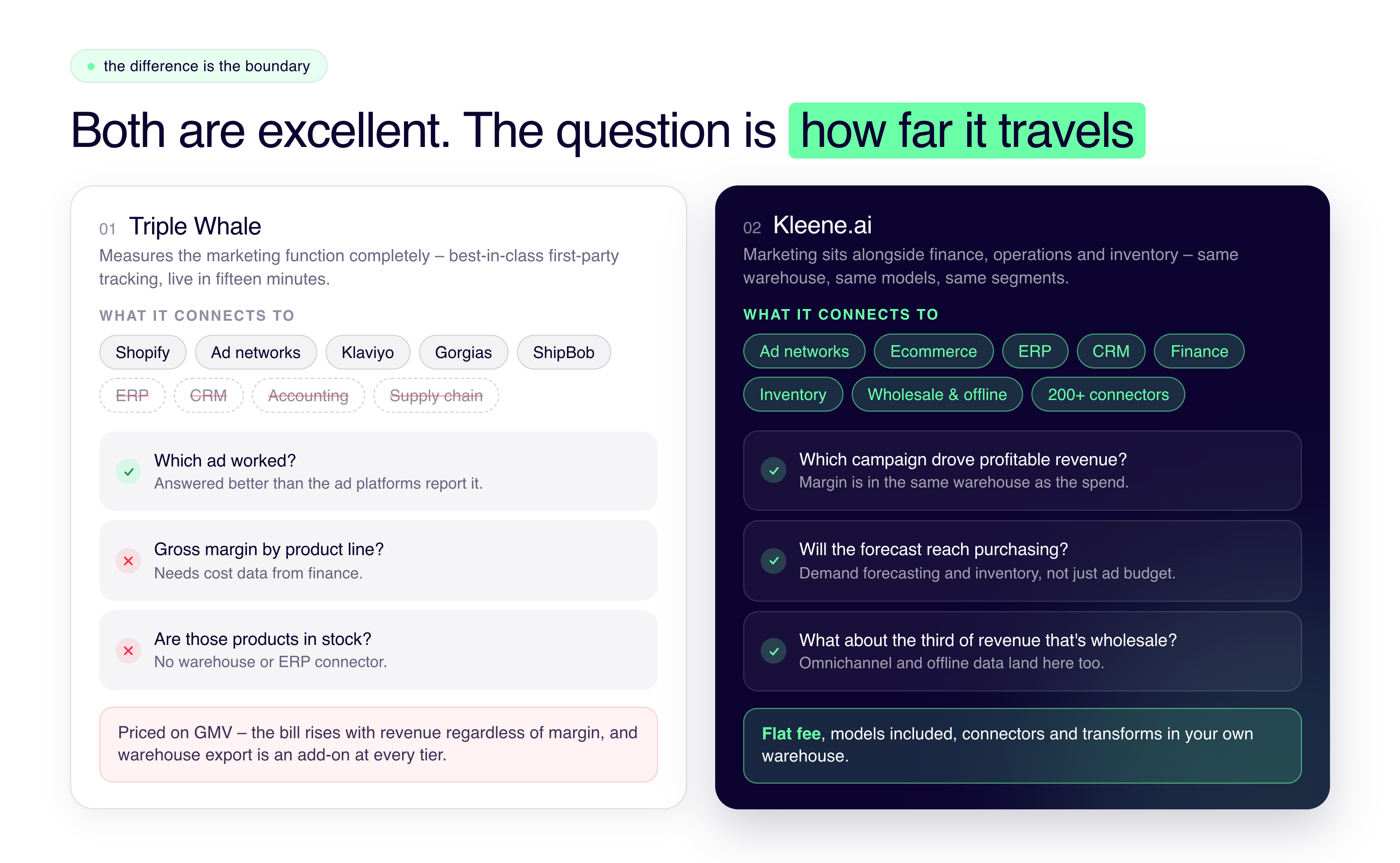
Now look at what is not there. No ERP, so no NetSuite, Sage or Dynamics. No CRM, so no Salesforce or HubSpot. No accounting, so no Xero or QuickBooks. No warehouse management, no manufacturing, no supply chain systems.
That absence is the whole story. Triple Whale is a marketing measurement platform, and its integration surface is marketing and commerce because that is what it is for. The moment a question needs data from finance, operations or the supply chain, the platform has no path to it, and their own materials list retail and wholesale data as a custom, enterprise-only build rather than a connector.
So the honest framing is not that Triple Whale is missing integrations. It is that Triple Whale measures the marketing function completely, then stops at the edge of it. If your business is the marketing function, that is fine. Most businesses are not.
What Kleene is
Kleene is a managed data platform for the whole business.
The same 200+ connectors reach ad platforms and ecommerce, and also ERP, CRM, finance and operational systems. Marketing data lands in the same warehouse as order data, cost data and inventory data, which is the precondition for any question that spans them. On top of that sits the KAI Analytics Suite, seven model types including digital attribution, media mix modeling and creative diagnostics, but also demand forecasting, inventory management, price elasticity and segmentation, which reach into parts of the business Triple Whale's connectors never touch.
The practical difference: Triple Whale can tell you which campaign drove the most revenue. Kleene can tell you which campaign drove the most profitable revenue, because it can see the margin, and whether the products those campaigns sold are in stock, because it can see the inventory.
Where the two really overlap
There is real head-to-head here, and pretending otherwise would be the kind of overclaim that loses the credible reader.
On marketing measurement, Compass sits directly against our digital attribution, media mix modeling and creative diagnostics. Both are serious. Theirs is more mature as a packaged measurement product; ours is one part of a wider model set that shares a segmentation layer with the rest of the business.
On conversational, agentic analytics, Moby against our conversational agent is the closest contest in this comparison, and on agentic execution inside ad accounts specifically, they are ahead. We do not have a Sonar equivalent that pushes signals back into Meta and Klaviyo automatically. If ad-account automation is the job, that is theirs.
Being straight about those two is what earns the rest of the argument.
The pricing shapes are different, and it matters as you grow
Triple Whale prices on GMV. The plan tier is indexed to your gross merchandise value, and their own FAQ confirms that as your revenue grows you are moved automatically to a higher tier. Third-party reporting puts the paid entry point in the low hundreds per month at the smallest GMV band, rising from there, though every figure beyond the free tier sits behind a sales conversation.
Two consequences worth understanding before you sign.
The bill rises with revenue regardless of margin. A high-volume, thin-margin retailer pays like a high-margin DTC brand, because GMV does not know the difference. And several of the pieces that make the platform compelling are billed on top: warehouse export is a paid add-on at every tier including Enterprise, so getting your own data into your own warehouse costs extra, and Compass, the measurement engine that makes the numbers statistically defensible, is Enterprise-only or a custom-priced add-on.
Kleene is a flat fee with unlimited data usage. Growth does not reprice the contract, the models are included rather than metered, and your connectors and transforms live in your own warehouse with version control, so leaving is possible rather than a restart. We do not publish a number here because it is scoped to setup, but the shape is the point: a line you can budget, not one indexed to a number that only goes up.
Kleene.ai vs Triple Whale, head to head
Kleene.ai
Triple Whale
What it is
Whole-business data platform with predictive models and an embedded team
Ecommerce marketing measurement platform with an AI operator
Data scope
Marketing plus ERP, CRM, finance, operations and inventory
Marketing and commerce: ads, ecommerce, email, shipping
ERP / CRM / finance
Connected as standard (NetSuite, Salesforce, HubSpot, Xero and more)
Not in the standard integration library. Retail and wholesale is a custom enterprise build
Marketing measurement
Digital attribution, MMM and creative diagnostics, sharing a segmentation layer with the rest of the business
Compass: MTA, MMM and incrementality calibrated together. Best in class for DTC
First-party tracking
Warehouse-based, joined to the rest of your data
Triple Pixel identity resolution, more accurate than the ad platforms' own numbers
Predictive models beyond marketing
Demand forecasting, inventory, price elasticity, segmentation, all on the same data
Forecasting inside Moby. No dedicated inventory or price elasticity models
Agentic execution
Conversational analytics via KAI, in-platform or through Claude and ChatGPT
Moby pauses ads, shifts budget, drafts creative. Sonar pushes signals back to Meta and Klaviyo
Time to value
Weeks, with the build done for you
About 15 minutes for a Shopify brand, no engineer
Data portability
Your own warehouse, connectors and transforms with version control
Managed warehouse. Export to your own is a paid add-on at every tier
Advisory
Embedded analyst and engineering team, included
Data science and concierge are custom-priced add-ons
Pricing model
Flat fee, unlimited data usage, growth does not reprice it
GMV bands, tier rises automatically as revenue grows. Add-ons compound
Best for
Omnichannel and mid-market businesses where the whole business matters, not just marketing
DTC ecommerce brands where marketing measurement is the core job
Triple Whale publishes no pricing above its free tier, so pricing-model detail here is from third-party reporting and their own FAQ, not a quote. Their marketing measurement and first-party tracking are widely regarded as best in class for DTC ecommerce; the distinctions above concern scope of data rather than quality within that scope.
Where Triple Whale is the right call
Choose Triple Whale if you are a DTC ecommerce brand and marketing measurement is the job. Nothing here beats it for that, and the setup speed and tracking accuracy are real.
Choose Triple Whale if you want agentic execution inside your ad accounts. Moby and Sonar act on Meta and Klaviyo in a way we do not.
Choose Triple Whale if you are Shopify-native and want to be live this afternoon. That is a genuine strength and a real reason to buy.
And do not overthink it if you are a smaller DTC brand. A focused attribution platform is the right tool at that stage, and a whole-business data platform is more than the question requires.
Where Kleene is the right call
Choose Kleene if finance, operations or supply chain data matters as much as marketing. The moment the important question crosses out of the marketing team, Triple Whale's connectors run out and ours do not.
Choose Kleene if you are omnichannel, wholesale, or have real offline revenue. Triple Whale is Shopify-shaped, and Shopify is an investor. If a meaningful share of your revenue is not DTC ecommerce, that shape works against you.
Choose Kleene if you need your data in your own warehouse. Connectors and transforms you keep, with export as a standard part of the platform rather than a paid add-on.
Choose Kleene if you want people, not just software. An embedded analyst and engineering team is included, where Triple Whale meters advisory and data science as custom-priced add-ons. For a mid-market business without an internal data team, that is the difference between a tool and an outcome.
Bottom line
Triple Whale and Kleene get compared because both promise one platform for your data and your AI, and for one function Triple Whale delivers exactly that. It is the best ecommerce marketing measurement platform available, and if your business runs on Shopify and lives in its ad accounts, it is likely your answer.
The difference is the boundary. Triple Whale measures marketing completely and stops there. Kleene runs across the whole business, which means the marketing models share their segments and definitions with finance, operations and inventory, and a question that starts in marketing can follow the money all the way through.
If your hardest questions stay inside the marketing team, buy the specialist. If they cross into the rest of the business, that crossing is the thing we build for. Tell us where your data lives and we will tell you whether your question needs us or whether a marketing platform already covers it.
What is Triple Whale? An ecommerce marketing measurement platform, strongest for Shopify DTC brands. It combines first-party tracking, attribution, dashboards and an AI operator that can act on ad accounts. Its integrations are marketing and commerce systems.
What is the difference between Triple Whale and Kleene.ai? Scope. Triple Whale measures the marketing function and connects to ad, ecommerce, email and shipping systems. Kleene is a whole-business data platform that also connects to ERP, CRM, finance and operational systems, with models that run across all of them.
Does Triple Whale connect to ERP or finance systems? Not through its standard integrations, which are marketing and commerce focused. Retail and wholesale data is listed as a custom, enterprise-only build. If ERP, CRM or finance data needs to be in the same view as marketing, that is outside its connector library.
How is Triple Whale priced? On GMV bands, with tiers indexed to your gross merchandise value and automatic migration to a higher tier as revenue grows, per their own FAQ. Exact figures sit behind a sales conversation, and several capabilities, including warehouse export and the Compass measurement engine, are add-ons.
Which should I choose? Triple Whale if you are a DTC brand and marketing measurement is the job. Kleene if finance, operations or supply chain data matters as much as marketing, if you are omnichannel or wholesale, or if you need the data and models in your own warehouse with a team to build them.


%201.svg)


%201.svg)
