TLDR:Qlik Talend Cloud is a strong integration platform, and unlike most integration vendors Qlik sells a real analytics layer too, including AutoML and conversational AI. The difference is what arrives at the end. Qlik gives you a modeling toolkit and a deployment slot. Kleene gives you finished models for one flat fee.
If you are researching this because you use Stitch, start here. Qlik now routes visitors from the Stitch homepage toward Qlik Talend Cloud, and runs a formal Migration Center with a Stitch migration path, an inventory tool, a terminology mapping guide and a paid coaching service. Stitch has not been discontinued and its pricing page still works. But it has been acquired twice, from RJMetrics to Talend in 2018 and to Qlik with the Talend purchase in 2023, and the direction of travel is clear enough that most Stitch customers are being asked to make a decision they did not plan for.
That forced decision is worth using well. If you have to re-platform anyway, the question is not which extract-and-load tool replaces the one you had. It is what you would build if you were starting now.
What Qlik Talend Cloud is
Qlik Talend Cloud is the integration and data quality half of Qlik's stack, assembled from Talend after Qlik acquired it in May 2023. Both companies are owned by Thoma Bravo, so the purchase was a portfolio consolidation.
It is a serious product. Qlik has been named a Leader in the Gartner Magic Quadrant for Data Integration Tools for ten consecutive years as of the 2025 edition, and the capabilities behind that are real:
Agentic data engineering. Specialized agents for data quality, for stewardship glossaries and for data products, with pipelines that build, fix and monitor themselves under human approval. They support Claude Code and GitHub Copilot for pipeline building and run an MCP server.
Real-time change data capture. Agentless CDC from databases, SAP, mainframe and SaaS sources. This is a genuine capability step beyond batch-based tools.
Transformation. No-code drag and drop, auto-generated star schema data marts, or AI-generated SQL.
Data quality and governance. Profiling, lineage and a metadata catalog inherited from Talend, which was always strong here.
Packaging runs across four editions priced on capacity. Qlik publishes no rates for Qlik Talend Cloud, so every number comes from a sales conversation.
How to compare the two products
Qlik Cloud Analytics is a separate product with published pricing, and it includes Qlik Predict, which is AutoML with deployed model slots, five at Premium and ten at Enterprise, with unlimited experimentation. It includes Qlik Answers, conversational AI over your own data with an LLM gateway and indexed unstructured content. It includes Qlik Automate for no-code automation, plus an MCP server and a Discovery Agent across both products.
Published pricing for that product is $300 a month for Starter with 10 users and 10 GB, $825 a month for Standard with 25 GB and unlimited users, and $2,750 a month for Premium with 50 GB, which is the tier that adds Qlik Predict. Enterprise is quoted.
So Qlik spans ingestion, transformation, BI, predictive modeling and conversational analytics. On paper that is the same shape as Kleene, and it is the closest architectural comparison in our entire competitive set. The difference is not whether Qlik has a predictive layer. It does. The difference is what that layer gives you.
Kleene.ai vs Qlik Talend Cloud in 2026
1. A toolkit, or the finished model
This is the distinction that matters most, and it applies to any vendor selling AutoML as predictive analytics.
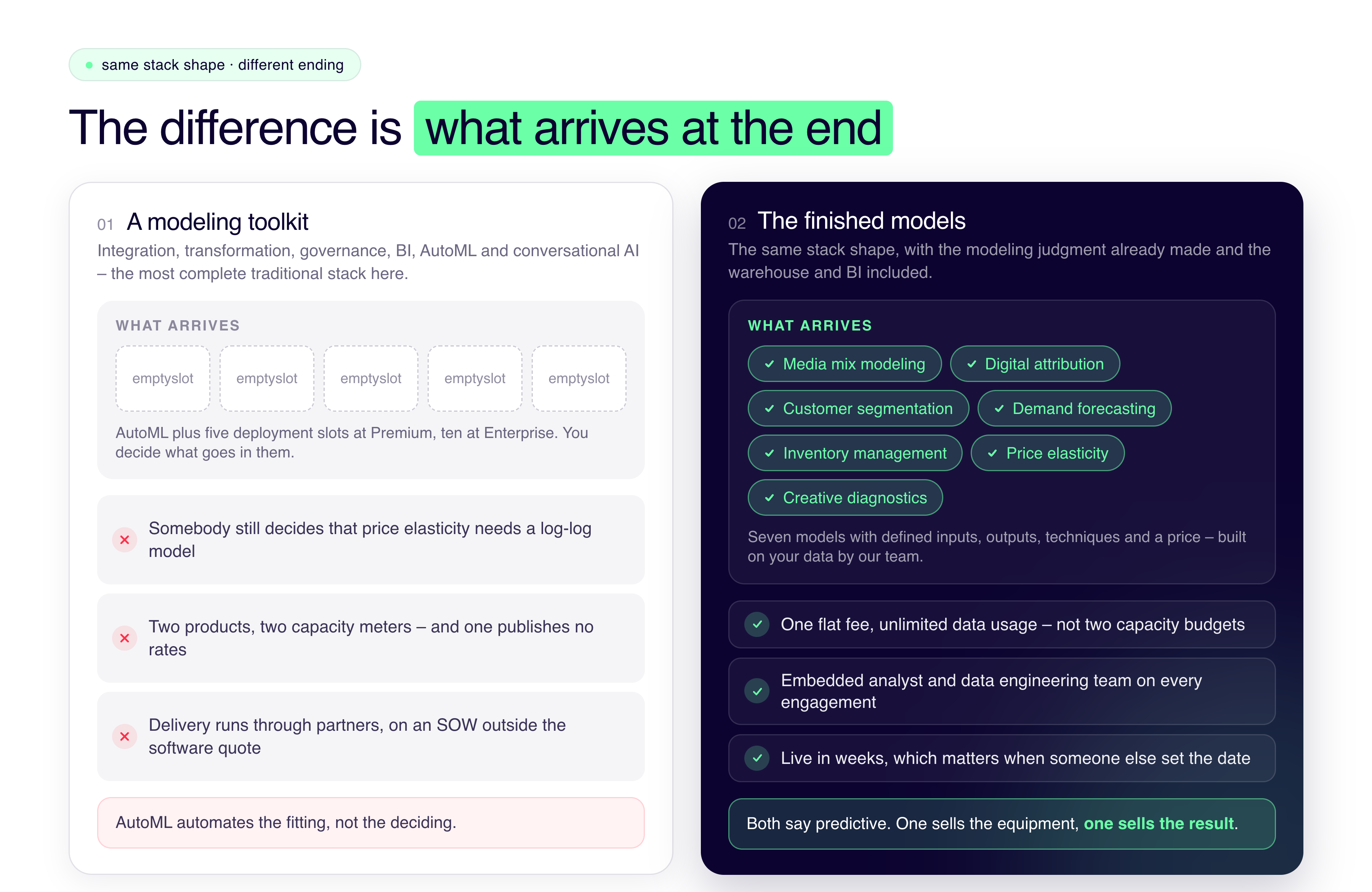
Qlik Predict gives you automated machine learning and somewhere to deploy the result. What it does not give you is the judgment about what to build. Somebody still has to know that a log-log econometric model is the right approach for price elasticity. Somebody still has to assemble two to three years of spend and sales data before a media mix model means anything. Somebody still has to decide the RFM cut points for a segmentation, and validate whatever comes out the other end.
Our CPO Ian Liddicoat makes the point about why this is not a matter of pointing a tool at a dataset:
"You end up with a number of factors that need to be considered in unison, and really it's machine learning that allows you to do that rather than relying on a static conventional statistical model."
Knowing which factors belong in the model, and how they interact, is the work. AutoML automates the fitting, not the deciding.
Kleene ships the models themselves. The KAI Analytics suite covers media mix modeling, digital attribution, customer segmentation, demand forecasting, inventory management, price elasticity and creative diagnostics, each with defined inputs, outputs, techniques and a price. Our interview on how the demand forecasting model is built shows what that involves in practice.
Both products use the word predictive. One sells you the equipment and one sells you the result, and for a business without a data science function those are not close substitutes.
2. Two products, two meters
To get what Kleene sells, a Qlik customer buys both Qlik Talend Cloud and Qlik Cloud Analytics.
Those meter differently. Qlik Talend Cloud is capacity-based on data volume moved, with job executions and job hours added at the higher editions. Qlik Cloud Analytics is capacity-based on gigabytes of data available for analysis. Two products, two capacity budgets, two sets of overage behavior to forecast.
Qlik markets capacity pricing as more predictable than consumption pricing, and against pure consumption billing that is a fair claim. The issue is not the unit price or unpredictability within either product. It is that a buyer ends up forecasting two separate capacity envelopes for one outcome, and only one of those products publishes its rates.
Kleene is a single flat fee with unlimited data usage, with the warehouse and BI included rather than bought alongside. We put the numbers side by side in our full-stack pricing comparison, costing the same mid-market setup on each platform.
3. Who does the work
Qlik sells software and routes delivery through partners and systems integrators. That model works, and for a large organization with its own data team it is often preferable, because control stays in house.
It is a different proposition for a mid-market company with no data science function. "We have AutoML" and "we will build your media mix model" are not the same offer, and the gap between them is usually a partner statement of work that is not in the software quote.
Every Kleene engagement includes an embedded analyst and data engineering team who build the pipelines and the models and maintain them afterward. Talend also carries a documented reputation for a steep learning curve, and Qlik's associative engine has idioms of its own, so the skills question is worth asking early.
4. Time to something useful
Qlik Talend Cloud deployments generally run through an implementation project, often with a partner. Kleene engagements go live in weeks, with the build done for you.
That is a real difference for a business in a forced migration with a deadline somebody else set, which describes most Stitch customers right now.
Kleene.ai, Qlik and Stitch compared
Kleene.ai
Qlik Talend Cloud + Cloud Analytics
Stitch
What it is
Managed platform with finished predictive models and an embedded team
End-to-end integration, governance, BI and AutoML across two products
Extract and load only, on the Singer framework
Status
Active
Active. Gartner MQ Leader for Data Integration, ten consecutive years
Still sold, but Qlik runs a formal Stitch migration path to Qlik Talend Cloud
Transformation
Included, SQL and Python
No-code, auto-generated star schemas, or AI-generated SQL
None at any tier. Needs dbt or hand-written SQL alongside
Data movement
Managed ELT, 200+ connectors with custom builds available
Agentless CDC from databases, SAP and mainframe. A genuine strength
Qlik Predict: AutoML with deployed model slots (5 at Premium, 10 at Enterprise). You choose and build the models
None
Conversational AI
KAI, in-platform or via Claude and ChatGPT through MCP
Qlik Answers, plus an MCP server and Discovery Agent
None
Pricing model
One flat fee, unlimited data usage, warehouse and BI included
Two capacity meters. Cloud Analytics published from $300/mo; Talend Cloud publishes no rates
Published and row-based. From ~$100/mo, US pricing
Who builds it
Embedded analyst and engineering team, included
Your team, usually with a partner or SI
Your team
Best for
Mid-market businesses that need the models without hiring a data function
Existing Qlik estates, complex source systems, teams that want to build in house
Simple extract and load, for teams already running their own transformation layer
Qlik Cloud Analytics prices are published; Qlik Talend Cloud publishes none, so a full Qlik stack requires pricing two products separately. Stitch pricing is published and US-only. Stitch has not been discontinued, but Qlik operates a documented migration path from it. Qlik's analytics layer is real, and the distinction drawn here is between a modeling toolkit and delivered models rather than presence or absence of AI.
What Stitch actually did, and what replaces it
Stitch is a pure extract-and-load service built on the Singer framework, with 130 or more connectors and published pricing that starts around $100 a month on Standard, $1,500 a month on Advanced and $3,000 a month on Premium, billed annually and priced for the US market. Transparent pricing is rare in this category and Stitch deserves credit for it.
What Stitch never did is transform data. It loads raw data and stops, and syncs on a batch schedule rather than streaming changes. So a Stitch customer is running at least three layers: Stitch to load, dbt or hand-written SQL to transform, a warehouse underneath, then a BI tool, then whoever builds the models on top.
That matters for the migration decision. Replacing Stitch with another extract-and-load tool rebuilds the same three-layer stack with a different first layer. Replacing it with Qlik Talend Cloud gets you transformation and CDC in the same product, which is a real upgrade at the integration layer. Replacing it with a platform that also includes the warehouse, the BI and the models collapses the stack.
Where Qlik is the right call
Choose Qlik if you already run Qlik Sense or Qlik Cloud Analytics. Adding Qlik Talend Cloud to an existing Qlik estate is coherent, and the migration path from Stitch is supported and documented.
Choose Qlik if you need agentless CDC from SAP, mainframe or large databases. That is a specialist capability and they are strong at it.
Choose Qlik if you have a data team that wants to build. Qlik Predict, the MCP server and support for Claude Code and GitHub Copilot give a capable team a lot of surface area, and keeping that work in house is a legitimate choice.
Choose Qlik if data quality and governance is the purchase. The Talend lineage is strong there, and it is not what Kleene is built for.
Where Kleene fits instead
When you need the models rather than the means to build them. No data science function, and a requirement for a forecast or an MMM rather than a platform to develop one on.
When you want one fee rather than two capacity budgets. Especially if usage is growing and you would rather that not reprice the contract.
When the migration deadline is short. Weeks to live matters more than usual when someone else set the date.
When the analytics layer matters as much as the pipeline. A Stitch replacement that only replaces Stitch leaves the rest of the stack exactly as it was.
Bottom line
Qlik is the most complete stack of any traditional vendor in this comparison, and pretending otherwise would not survive a demo. They have integration, transformation, governance, BI, AutoML and conversational AI, and they are a ten-year Gartner Leader at the integration layer for good reason.
The distinction is what arrives at the end of the project. Qlik hands you a modeling toolkit, deployment slots and a partner to help you fill them. We hand you the finished models, built on your data by our team, with the warehouse and BI included in one fee.
If you are being migrated off Stitch and would rather use the disruption than absorb it, send us your current stack and we will map what actually has to change. Sometimes that is less than the migration notice implies. Our framework for choosing a data stack is the thing to read first either way.
FAQ
Is Stitch being discontinued?Stitch has not been discontinued and its pricing page still operates. Qlik routes visitors from the Stitch homepage toward Qlik Talend Cloud and runs a formal Migration Center with a Stitch migration path and a paid migration coaching service, so existing customers are being guided toward the newer product.
What is the difference between Stitch and Qlik Talend Cloud?Stitch is extract and load only, on a batch schedule, with no transformation at any tier. Qlik Talend Cloud adds transformation, real-time change data capture, data quality and governance, and agentic pipeline building. It is a substantially larger product and it does not publish pricing.
Does Qlik have predictive analytics?Yes. Qlik Cloud Analytics includes Qlik Predict, which is AutoML with deployed model slots, and Qlik Answers for conversational AI over your data. It is a real analytics layer. The distinction with Kleene is that Qlik provides the tooling to build models, while Kleene delivers specific finished models such as media mix modeling and price elasticity.
How much does Qlik cost?Qlik Cloud Analytics publishes pricing at $300 a month for Starter, $825 for Standard and $2,750 for Premium, which is the tier that includes Qlik Predict. Qlik Talend Cloud publishes no rates and is quoted through sales, so a full stack requires pricing two products separately.
What should Stitch users migrate to?It depends on what sits above Stitch today. If you only need extract and load, another ELT tool or Qlik Talend Cloud replaces it directly. If you are also running dbt, a warehouse, a BI tool and separate modeling work, consolidating those layers is worth costing before you rebuild them around a new loader.


%201.svg)


%201.svg)
