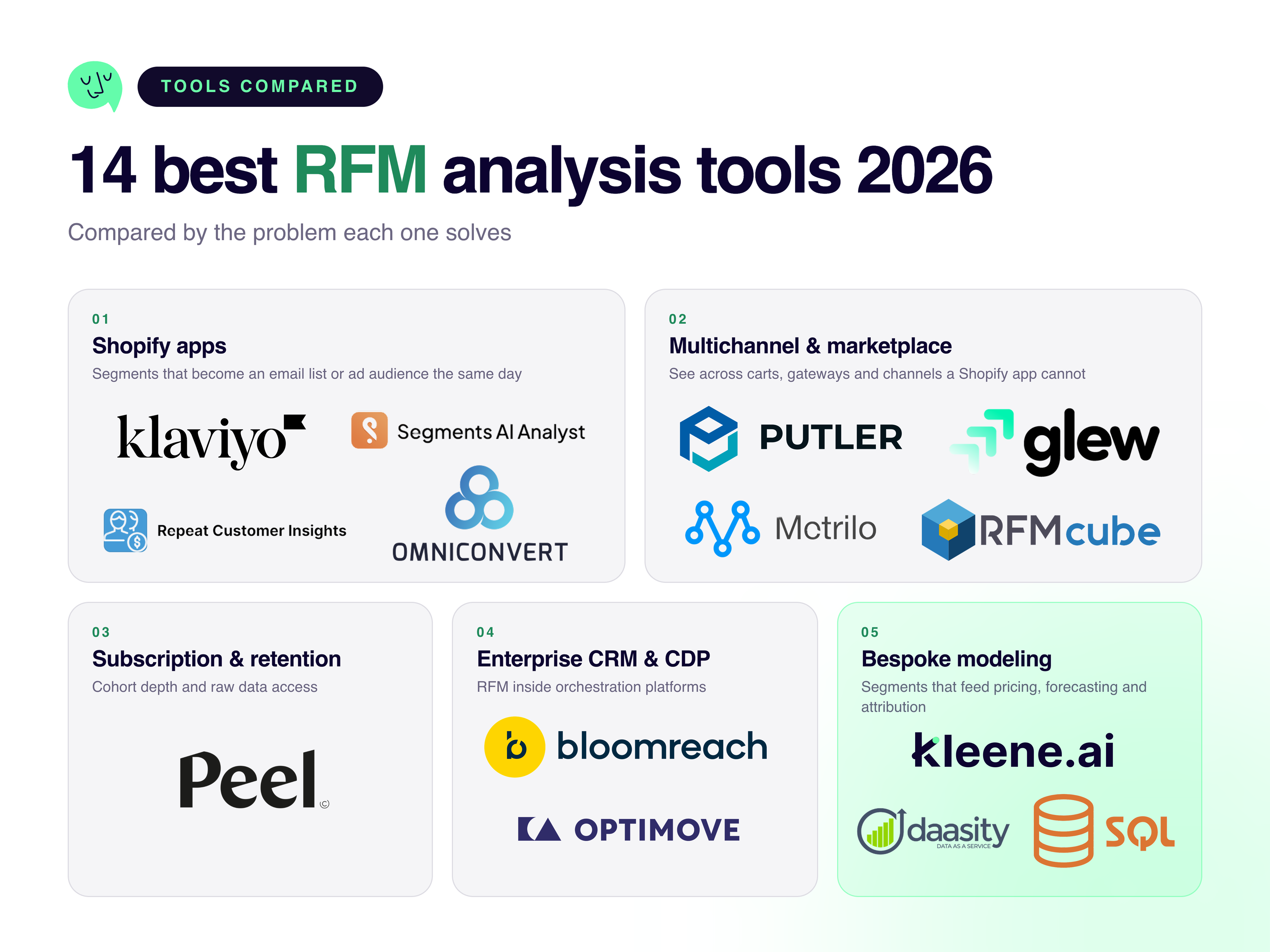
The best RFM analysis tool depends on where your customer data lives and whether anyone on your team writes SQL. For Shopify brands, Klaviyo's add-on or a Shopify app like Segments by Tresl; for subscription DTC at volume, Peel Insights; for multichannel and marketplace sellers, Putler or Glew; for enterprise CRM programs, Optimove or Bloomreach; and for segmentation that has to feed forecasting, pricing and attribution rather than only email, Kleene.ai. Below, fourteen tools compared by the problem each one solves, with pricing and a plain answer on which fits.
Nearly every tool on this list produces the same eleven segments. That is the first thing to understand about buying RFM software, because it moves the decision away from whose segments are better and toward three things that actually differ: what data the tool can see, what you can do with a segment once you have it, and what the bill does as you grow.
The second thing to understand is that RFM has a ceiling. It scores transactions, so it knows nothing about margin, product mix or acquisition channel, and in most implementations it is a snapshot. It tells you who your Champions are today. It does not tell you who was a Champion three months ago and is At Risk now, or what that shift cost you. The last two sections come back to that.
What RFM analysis is and how scoring works
RFM scores each customer from 1 to 5 on three dimensions. Recency is how long since they last bought. Frequency is how often they buy. Monetary is how much they spend. Combine the three digits and every customer gets a code: 555 for your best, 111 for the long lapsed, and everything in between.
The scoring is a quintile split. Sort all customers by recency, give the top fifth a 5 and the bottom fifth a 1, then repeat for frequency and for spend. That produces 125 possible combinations, which is too many to act on, so the codes get collapsed into named groups.
The method predates digital marketing by decades, starting in catalog and direct mail, where the cost of a mailing made it essential to know who was worth the stamp, and that logic has not changed. What has changed is that the scoring now runs automatically on your order data, and a segment can become an email list or an ad audience in one step.
The standard RFM segments
Most tools collapse the 125 combinations into ten to twelve named segments. The common set: Champions, Loyal Customers, Potential Loyalists, New Customers, Promising, Need Attention, About to Sleep, At Risk, Can't Lose Them, Hibernating and Lost. Putler uses eleven. Klaviyo's report uses a similar set.
Because the inputs are the same three numbers and the maths is a quintile split, tools do not differ much here. A Champion in Klaviyo is a Champion in Peel. Where they differ is upstream and downstream: which orders the tool can see (one store, or every channel), and what happens after the segment exists (a report, a Klaviyo sync, an ad audience, or an input into another model).
What to look for in an RFM tool in 2026
Whether it sees all your sales channels or only one platform.
Whether segments update continuously or on a schedule you have to trigger.
Whether it tracks a customer's previous segment as well as their current one.
Where a segment can go once it exists: email, ads, tags, a warehouse, another model.
Whether the useful reports are in the base price or behind an add-on, which is the question that catches most Klaviyo users.
What the pricing is metered on. Revenue, orders, profiles and users all behave differently as you grow.
The 14 best RFM analysis tools in 2026, grouped by what they do
Top RFM analysis tools for 2026
1. Klaviyo
Best for: Any Shopify brand that already pays for Klaviyo, provided they understand what the RFM report costs
Klaviyo is the most important entry on this list because most readers already have it. It does RFM properly: the report scores customers into groups, updates nightly, and stores each profile's current group, previous group and the date it last changed, so you can build flows that trigger when someone moves from Loyal to At Risk. Segments are immediately usable in email and SMS with no sync step, and the Shopify data integration is the deepest of any tool here.
The catch is the one no competing listicle mentions. Klaviyo's own documentation states that Advanced KDP and Marketing Analytics are not included in the standard marketing application, and the RFM report lives inside those two products. A team on the base plan opens the help article, finds the report, and cannot use it. The workaround is rebuilding RFM by hand from ordinary segment conditions, which works and needs maintaining. The direct route is buying Marketing Analytics, the cheaper of the two add-ons.
Key features: RFM report with current and previous group tracking, RFM-triggered flows, segment conditions from RFM properties, funnel analysis, deepest Shopify integration in the category
Ideal use case: Shopify brands who want RFM segments they can email today, and who will pay for the add-on rather than rebuild it.
Best for: Subscription DTC brands doing real volume who want cohort depth and their own data in Snowflake
Peel is retention analytics for Shopify and Amazon brands, and it is strongest on subscription businesses, with 40 or more subscription KPIs and 30 or more cohort metrics alongside RFM, LTV and CAC. The feature that separates it from everything else at its price is raw data access through Snowflake, so you are not confined to Peel's dashboards. The Recharge integration matters if you run subscriptions.
The cost is the trade, since it is several times the price of a Shopify app at the entry tier, published pricing is contradictory across reviewers, and overage credits plus onboarding push real year-one cost above list by something like one and a half to two times, according to the same reviewers. If you do not run subscriptions, it is more analytics than you need.
Key features: RFM segmentation, 40+ subscription KPIs, 30+ cohort metrics, LTV and CAC reporting, Snowflake raw data access, Shopify, Amazon and Recharge integrations
Ideal use case: Subscription DTC at volume where cohort analysis matters as much as the segments themselves.
Pricing: Free tier for low order volumes, then paid plans from the low hundreds to roughly $1,000 or more a month by order volume, per third-party reports. Confirm on peelinsights.com.
3. Kleene.ai
Best for: Mid-market and larger consumer brands where segmentation has to inform pricing and forecasting as well as marketing spend, not only email
Kleene.ai is not an RFM app, and if your requirement is to email your lapsed customers, one of the tools above or below will do that faster and for less. A £3M Shopify store should buy Segments by Tresl or Putler, and we would say so on a call. Where Kleene fits is the point at which an eleven-segment email list stops being enough, because the business needs to know which segments are price sensitive, which channels acquire customers who stay, and where value is draining before the annual review notices.
The Segmentation model in the KAI Analytics suite uses clustering, K-means and RFM among the techniques, to produce 20 to 30 segments built from your own transaction, channel and CRM data rather than a fixed set of eleven. Two things make it different from standard RFM. It tracks each customer's monthly movement across value tiers and quantifies the revenue gained or lost as they migrate, which turns a segment report into an early warning. And the segment codes feed as input variables into the other models, so demand forecasts and attribution results can be split by segment, and so can media mix output and price elasticity. Segment membership is also one of the stronger inputs to a churn model.
It is an engagement rather than a signup. An analyst team builds and maintains the model, it needs meaningful transaction history to work well, and it is quoted rather than priced from a page, like Optimove and Bloomreach below.
Key features: 20 to 30 bespoke segments by clustering, monthly segment movement tracking with value quantified, segment codes as inputs to forecasting and attribution as well as media mix and pricing models, built from your own data with external enrichment where useful, delivered and maintained by an analyst team
Ideal use case: Consumer brands past the point where email segmentation is the whole job, and without an internal data science team to build the rest.
Pricing: Quoted per engagement, on an annual contract.
4. Daasity
Best for: Larger consumer brands that want a warehouse underneath their analytics and see RFM as one output among many
Daasity is a data platform rather than an app. It builds a warehouse under your ecommerce analytics, aimed at multimillion and multibillion consumer brands, and RFM arrives as part of a modelled data layer. That means the scoring logic is customizable in ways app-based tools cannot match, and it means your data is yours and reusable across Snowflake, BigQuery and similar rather than trapped in a vendor dashboard.
The entry point rules out most brands whose requirement is RFM. Implementation runs four to eight weeks, usage charges on rolling revenue sit on top of the base fee, and it needs someone technical to get value from it. It is the right tool for a brand that wants a warehouse and would like RFM to come with it, and heavy overkill for anyone who only wants RFM.
Key features: Managed warehouse, modelled and customizable RFM, Snowflake and BigQuery support, multichannel consumer-brand connectors, scales to enterprise volume
Ideal use case: Consumer brands with the volume to justify a warehouse and the intention to run more than segmentation on it.
Pricing: From roughly $1,500 a month, with real deployments commonly landing between $1,500 and $5,000 a month on annual contracts plus revenue-based usage, per several third-party sources. Enterprise by quote. See daasity.com.
5. Optimove
Best for: Enterprise CRM teams running large-scale retention programs
Optimove is CRM marketing orchestration with predictive segmentation, and its customers include Dollar Shave Club, Papa John's and Staples. It goes beyond static RFM with a predictive model per customer and automated tracking of migration between segments, which is closer to the dynamic approach than most tools here manage. Forrester has named it a Leader for cross-channel campaign management, and with 236 G2 reviews there is a real evidence base behind it.
You are buying far more than RFM. It is built for orchestration, it assumes a marketing ops function to run it, implementations are long, and reviewers report onboarding and user fees beyond the license. There is no published pricing of any kind.
Ideal use case: Enterprise retailers and hospitality brands with a CRM team and a retention program large enough to justify orchestration software.
Pricing: Custom quotes only, scaled on database size, channel mix and message volume. No public rate card at optimove.com.
6. Bloomreach Engagement
Best for: Enterprise retailers that need a CDP anyway and get RFM as part of it
Formerly Exponea, Bloomreach Engagement is an enterprise CDP and marketing automation platform. RFM sits inside a full customer data platform, so segments can combine transactional scores with web behavior and feed omnichannel orchestration, which is something no pure RFM tool can offer. It is modular, so you pay for the modules you use, and it has a strong personalization layer.
It is also the least accessible entry here for anyone whose requirement is RFM. Bloomreach publishes nothing, third-party estimates span a very wide range from low five figures a year into six, and implementation is a project. The module-plus-usage pricing makes forecasting the bill difficult.
Key features: CDP with RFM inside, transactional and behavioral segment combination, omnichannel orchestration, modular pricing, AI personalization
Ideal use case: Enterprise retail with a CDP requirement, where RFM is a feature of a much larger purchase.
Pricing: Enterprise and quote-based, as a module fee plus usage fee. Nothing published at bloomreach.com.
7. Segments AI Analyst (Tresl)
Best for: Shopify brands with no analyst who want segments they can activate in Klaviyo or Meta the same day
Segments is a Shopify app built by former LinkedIn data scientists, and it shows in the cohort work. It ships more than 50 prebuilt segments including RFM, adds natural-language querying over store data that returns tables, charts or segments, and syncs those segments out to Klaviyo, Meta, Google and TikTok. That sync is the feature most cheap RFM tools lack: a segment becomes an audience rather than a report. It has the best review record in the category, 5.0 from 58 reviews, and has been on the App Store since April 2019.
It is Shopify only, which makes it useless for multichannel sellers. The pricing is mid-range for a single-channel tool, the segment definitions are largely prebuilt rather than freely defined, and raw data export is not available on lower tiers.
Key features: 50+ prebuilt segments including RFM, natural-language querying, cohort analysis, segment sync to Klaviyo, Meta, Google and TikTok, 30-day money-back guarantee
Ideal use case: Shopify DTC brands between roughly £1M and £10M that want activation, not analysis.
Pricing: Free plan, then paid tiers from around $100 a month across three tiers, per two independent sources. Listed on the Shopify App Store.
8. Putler
Best for: Small to mid-sized multichannel sellers who want RFM plus general business analytics in one cheap tool
Putler aggregates stores, payment gateways and shopping carts into one dashboard, with PayPal, Stripe, WooCommerce and Shopify pulled together, which is its real differentiator. RFM is a headline feature: automatic segmentation into eleven standard categories, dashboard filters by segment, cleanup of email and physical addresses, and a Chrome extension that surfaces customer detail inside a helpdesk. Every feature is on every tier, so RFM is never gated behind an upgrade.
The pricing model is the thing to understand. It meters on monthly revenue, so the bill rises as you grow whether or not you use the tool more, and at the top of the scale it costs more than platforms with far deeper analytics. It is dashboard-first, strong at showing you segments and weaker at activating them, and it is not a warehouse.
Key features: Eleven-segment RFM out of the box, multichannel aggregation across carts and gateways, all features on every tier, email and address cleanup, helpdesk Chrome extension
Ideal use case: Sellers running several carts and gateways who want one cheap view of everything, with RFM included.
Pricing: Metered on monthly revenue, starting in the low tens of dollars a month for small stores and climbing into four figures at high revenue, per third-party reports that disagree on exact tiers. 14-day trial with no card, 50% nonprofit discount. See putler.com.
9. RFMcube
Best for: European ecommerce brands on Magento, PrestaShop or WooCommerce who want RFM and nothing else
RFMcube is built specifically for RFM segmentation on ecommerce, Italian in origin. It syncs the full sales history and produces live segments that update as customers move, with real-time filtering and clustering, custom customer and order fields, and segment export to email and ad platforms including Klaviyo. Its platform coverage is the point: Magento 1 and 2, PrestaShop, WooCommerce and Shopify, plus an API, where most DTC-focused tools stop at Shopify.
It is a small vendor with limited public review volume, so support and roadmap are unknowns. It is narrow by design, with no cohort analysis, LTV modeling or wider analytics, and activation depends on whichever email tool you already run.
Key features: Purpose-built RFM scoring on full customer history, live segments, real-time filtering, custom fields, Magento, PrestaShop, WooCommerce and Shopify connectors, API
Ideal use case: Non-Shopify European stores that want the cheapest credible RFM tool and already have an email platform to send from.
Pricing: Entry level, roughly under $50 a month, with a free trial, per a single aggregator listing. The site blocks crawlers, so confirm at rfmcube.com.
10. Omniconvert Reveal
Best for: Ecommerce teams who already care about CRO and want RFM next to their testing and survey data
Reveal is the customer analytics module of Omniconvert's suite, alongside Explore for A/B testing, Pulse for NPS and Nexus AI in beta. It does RFM segmentation and CLV analytics, and uses RFM to drive retention campaigns and journey analysis. The company publishes a well-ranked RFM explainer and clearly treats the method as core rather than a checkbox. A free version and a free trial exist, and it publishes an entry price at all, which is rare here.
RFM is one module in a suite, so you may pay for CRO tooling you do not want. Nexus AI is still in beta, usage-based elements tied to tested users complicate the bill, and it has less subscription and cohort depth than Peel.
Key features: RFM segmentation, CLV analytics, retention journey analysis, sits beside A/B testing and NPS modules, Shopify and Magento integrations, API
Ideal use case: Ecommerce teams that want segmentation and experimentation in one vendor.
Pricing: Roughly $100 to $300 a month for the Reveal module, with the wider suite higher, per Capterra. Free version available. See omniconvert.com.
Best for: Shopify stores that want solid, unglamorous RFM grading and already run tag-based marketing logic
Repeat Customer Insights has been on the Shopify App Store since May 2016, which is a decade of tenure through many platform API changes. It does classic RFM grading with cohorts and visual customer grids, and it syncs segments to Shopify customer tags, so any tool that reads tags can use them. The vendor publishes detailed articles on exactly how the scoring works, which is unusually transparent.
The review base is tiny, 5.0 from 14 reviews, so the perfect rating tells you less than it looks like. It is Shopify only, the interface is functional rather than modern, it is a solo or very small vendor, and there is no AI or natural-language layer.
Key features: Classic RFM grading, cohort analysis, visual customer grids, sync to Shopify customer tags, published scoring methodology
Ideal use case: Smaller Shopify stores that want dependable RFM at low cost and route marketing logic through tags.
Pricing: From roughly $50 to $60 a month with a 14-day free trial, per a single aggregator. Listed on the Shopify App Store.
12. Metrilo
Best for: Mid-sized Magento or WooCommerce brands that want to consolidate analytics and retention email into one tool
Metrilo combines ecommerce analytics, a CRM and email marketing, aimed at Shopify, Magento and WooCommerce. RFM segmentation sits in the customer database, tied to cohort analysis and retention email automation, so segment and send happen in one place with no sync. It covers Magento and WooCommerce properly rather than treating them as afterthoughts, and claims more than a thousand stores.
The detail to confirm before buying is gating. Cohort and retention analysis appear to be excluded from the cheapest plan, so the useful features may need the upgrade. The email marketing is weaker than a dedicated tool, so you may end up running Metrilo alongside Klaviyo, and there is no raw data access.
Key features: RFM in a customer database, cohort and retention analysis, built-in email marketing, Shopify, Magento and WooCommerce connectors
Ideal use case: Non-Shopify mid-market stores that want fewer tools and can live with lighter email capability.
Pricing: Roughly $120 to $500 a month across three tiers, with a 14-day trial and no card, per sources that disagree on the entry tier. Confirm what the cheapest plan includes at metrilo.com.
13. Glew.io
Best for: Multichannel sellers on Shopify plus Amazon plus marketplaces who need one BI layer over all of it
Glew is multichannel ecommerce BI with segmentation, covering product, channel, customer and marketing analytics, and it claims more than 150 integrations, the broadest in this group. RFM sits inside full BI rather than standing alone, which is a strength for a seller who needs the wider picture and a weakness for anyone who wants RFM depth specifically.
Glew has reportedly moved from published rates to quote-based pricing, which removes a transparency that used to be a selling point. That report comes from Saras Analytics, a direct competitor, so weigh it accordingly. Setup effort is higher than a Shopify app and the interface is dated next to newer entrants.
Key features: Multichannel BI, 150+ integrations, RFM within customer analytics, product and channel analysis, marketplace coverage
Ideal use case: Marketplace and multichannel sellers whose problem is seeing everything in one place, with RFM as one view among many.
Pricing: Historically roughly $80 to $650 a month, now reported as quote-based. Confirm at glew.io.
14. Build it yourself in SQL, Python or a BI tool
Best for: Teams with a data function already
RFM is three columns and a quintile calculation. Anyone with warehouse access and SQL can build it, dbt has community packages for it, Python with pandas does it in a few dozen lines, and Power BI, Tableau, Looker or Metabase can visualize the result. Built this way it is completely customizable: your own score bands, your own segment names, margin-weighted if you want, and the output lives in your warehouse where every other analysis can use it. There is no monthly fee and no revenue metering.
The cost is analyst time, and the risk is that nobody maintains it after the person who built it leaves. There is no activation layer, so getting segments into Klaviyo or Meta is still your job, and the quintile logic is easy to get subtly wrong. Deploi's September 2026 build-versus-buy analysis concluded this is a "wait" for most mid-market Shopify stores, and that buying an RFM app makes sense specifically when nobody on the team writes SQL.
Key features: Fully custom scoring and segment definitions, output in your own warehouse, no vendor fee, dbt packages available, any BI tool for visualisation
Ideal use case: Businesses with an analyst and a warehouse, where RFM is one query among many.
Pricing: Analyst time, plus whatever you already pay for the warehouse and BI tool. No license.
14 RFM analysis tools at a glance
Tool
Best for
Data it sees
Where a segment can go
Pricing model
Klaviyo
Shopify brands already on Klaviyo
Shopify orders, deep integration
Email and SMS flows, no sync step
Active profiles. RFM report needs the Marketing Analytics add-on, from $100/mo
Peel Insights
Subscription DTC at volume
Shopify, Amazon, Recharge
Dashboards, plus raw data in Snowflake
Order volume, free tier, low hundreds to $1,000+/mo
Kleene.ai
Brands where segments must feed pricing, forecasting and attribution
Transactions, channel, CRM and finance, plus external enrichment
Input to every other model, with movement and value change tracked
Quoted per engagement, annual
Daasity
Larger brands that want a warehouse
Multichannel, into your own warehouse
Anywhere the warehouse connects
Base fee plus revenue usage, ~$1,500 to $5,000/mo
Optimove
Enterprise CRM retention programs
Enterprise CRM and channel stack
Cross-channel orchestration, migration tracked
Quote only, on database and message volume
Bloomreach Engagement
Enterprise retail that needs a CDP
Transactional plus web behavior
Omnichannel orchestration
Quote only, module plus usage
Segments (Tresl)
Shopify brands wanting activation, not analysis
Shopify only
Synced to Klaviyo, Meta, Google, TikTok
Free plan, then tiers from ~$100/mo
Putler
Small multichannel sellers
Several carts and gateways together
Dashboard filters, weak activation
Metered on monthly revenue, low tens to four figures
RFMcube
European non-Shopify stores wanting only RFM
Magento, PrestaShop, WooCommerce, Shopify
Export to email and ad platforms
Entry level, roughly under $50/mo, unconfirmed
Omniconvert Reveal
Teams that also run CRO and NPS
Shopify, Magento, API
Retention journeys within the suite
~$100 to $300/mo for the module, free version
Repeat Customer Insights
Small Shopify stores using tag-based logic
Shopify only
Shopify customer tags
~$50 to $60/mo
Metrilo
Magento and WooCommerce brands consolidating tools
Shopify, Magento, WooCommerce
Built-in email, no sync
~$120 to $500/mo; cohort analysis may be gated above entry tier
Glew.io
Marketplace and multichannel sellers
150+ integrations incl. Amazon and marketplaces
BI dashboards
Reportedly now quote-based
Build it yourself
Teams with a data function
Whatever is in your warehouse
Nowhere automatically; activation is your job
Analyst time, no license
Pricing shows the model each tool meters on rather than exact tiers, because the underlying figures come from third-party aggregators that disagree with each other and vendors change tiers often. Klaviyo's add-on figure is from Klaviyo's own help center. Almost every tool here produces the same standard segments; the columns that actually separate them are what data they can see and where a segment can go afterwards.
How to choose
Start with two questions: where does your order data live, and does anyone on the team write SQL. Those two answers eliminate most of the list.
Under about £1M in revenue on Shopify, use Klaviyo's built-in segments or a low-cost app like Repeat Customer Insights. The RFM add-on in Klaviyo is worth the money once your list is large enough to make it cheap per profile.
Between roughly £1M and £10M on Shopify, Segments by Tresl, because the segment-to-audience sync is the feature that turns RFM into revenue. On Magento or WooCommerce at that size, RFMcube or Metrilo.
Multichannel or marketplace sellers, Putler at the smaller end and Glew at the larger, since both see across carts and channels where the Shopify apps cannot.
Subscription DTC at volume, Peel Insights, for the cohort depth and the Snowflake access.
Anyone with a data team should build it in SQL and spend the license money elsewhere, unless the activation layer is the thing they are missing.
And past roughly £50M, or wherever segments need to feed pricing and forecasting as well as attribution rather than only email, the requirement has moved past RFM apps, and the answer is bespoke, quote-based modeling from Kleene, Optimove or Bloomreach, depending on whether the wider need is analytics, CRM orchestration or a CDP.
Where RFM analysis runs out
Every tool here tells you who your Champions are this month. Fewer tell you who was a Champion three months ago and is At Risk now. Klaviyo's add-on stores a previous group and a change date, and Optimove tracks migration, which is more than most manage. Almost none quantify what the shift cost: how much revenue moved with those customers when they slid a tier, and whether the ones who moved share a cause.
That limitation is structural rather than a missing feature. RFM scores three transaction fields, so it cannot see margin, product category or acquisition channel, and it cannot tell you why a group of customers changed behavior, only that they did. A snapshot every night is still a snapshot.
The version that goes further treats movement as the signal. A retailer watching a cluster of mid-value customers drift toward a lower tier over three months can find what they share, in one case lapsed engagement with a single product category, and act before the value is gone rather than at the year-end review. That needs the segment definition to sit next to product and margin data as well as channel data, and it needs the segments to be an input to other models rather than an output on a dashboard. It is the difference between RFM as a report and segmentation as a layer, and it is where the tools at the top of the price range earn their cost.
Final thoughts
RFM is a decades-old method that still works, and for most brands the right tool is the cheap one that sees all their orders and pushes a segment into the email platform they already run. The buying mistake is paying for analytics depth when the requirement was activation, or the reverse.
If you are past that point, and the question has become which segments are price sensitive or which channels bring customers who stay, that is a segmentation problem rather than an RFM one. Tell us where your customer data sits and we will say whether one of the tools above covers it, or whether it needs a model built on your own data.


%201.svg)


%201.svg)
