The orchestration layer: when all your models connect
May 26, 2026
- min read
Ian Liddicoat
Chief Product Officer
TLDR:AI orchestration layer monitors every analytics model a client has in production and models the interrelationships between them — AI agent orchestration in practice — weighting factors at the individual customer level across price, media, demand, segmentation, and creative simultaneously. Natural language interface on top of all of it helps CEO or board member ask what's actually driving their business without reconciling model outputs manually. The value is in the intersection of transactional data, sophisticated analytics, and natural language, and that intersection is where most organizations aren't yet.
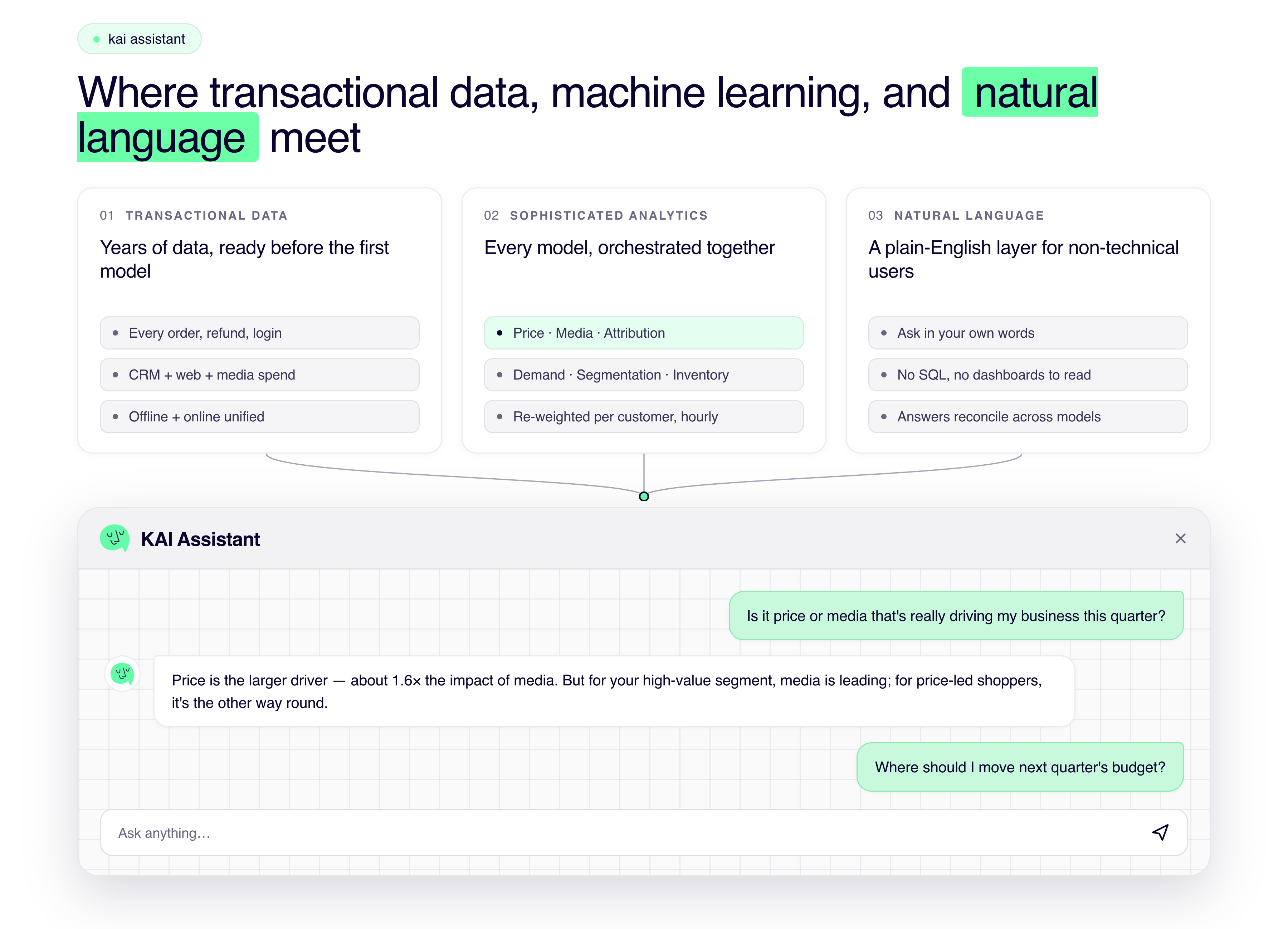
There's probably a perception in the market that this has already been done, that everyone has a large language model and there are many out there. That's absolutely true. What we bring is the point of intersection between three things: transactional data, sophisticated analytics, and natural language. It's that intersection that is pretty unique, very tailored to a client's business, and designed to put them in a position to control and optimize the levers of profitability.
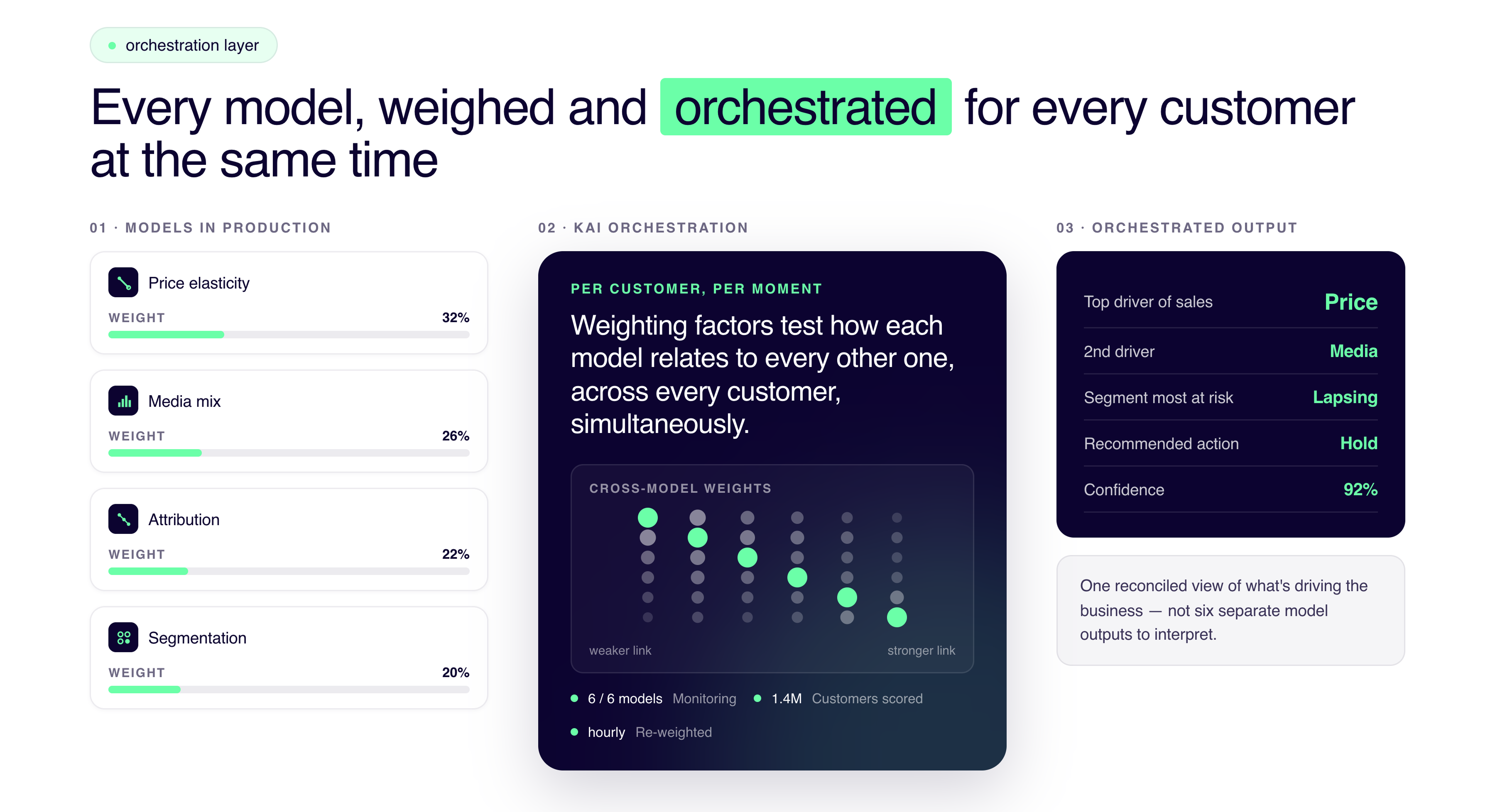
The orchestration layer does two things. One is to monitor each individual model and what it's generating. The other is to look at the relative contribution from each one. So if a client has demand forecasting, price elasticity, inventory management, and segmentation, the orchestration layer is there to monitor the interrelationships between all of them. What is actually driving sales or conversion or inquiry or demand? To what extent is price influencing demand, and to what extent is price influencing demand for a given segment? It's the orchestration layer that's able to surface and control the output from that.
To make that concrete: one user segment profile will be different from another one because of their age difference. So one’s price sensitivity for a given product or service will be different from another. The orchestration layer not only understands the various factors for each of user individually, it applies weighting factors and says: for this particular service, this customer isn't really price sensitive, but that customer is very price sensitive, because their profile is different and they have different needs and behaviors. That's happening across every model, for every customer, simultaneously.
What clients and brands have been doing for many years is building models independently and not really considering the interrelationships between them. And because these models are very dynamic, you end up with too many factors to consider. If you imagine six models with a hundred factors each, you end up with a multidimensional picture where different factors interrelate differently depending on who the consumer is and what time of year it is. It's really only machine learning that can cope with that. And that's what generates output that a large language model like KAI Assistant can then understand and interpret.
The large language model is there to take that multidimensional set of factors and give you the ability to make natural language queries of your data, as opposed to looking at traditional modeling output. A CEO can literally ask: is it price or is it media that's really driving my business? What are the actual drivers of profitability, and how do I influence them? That's a really powerful proposition.
For a non-technical user, you might see the orchestration layer as a kind of black box. But what it's actually doing is testing the relationship between models over time and smoothing the relationships between them. It's not resolving conflicts between models arbitrarily. It's understanding that each model has a slightly different view of a different business problem or set of customer behaviors, and it's finding the weighted relationships between them that best explain what's actually happening in the business.
Many organizations are still at the stage of not having every model built, not having models that are dynamic, and not considering the relationship between the ones they do have. That's where we are with KAI Analytics and the underlying data we have access to. Our ETL history means we see a lot more data than most organizations for a given business. If we've not done any modeling work for a client yet, we will already understand their data. We know a huge amount about their data, their business, and their customer journey before the first model is even commissioned. And that puts us in a very strong position as an AI deployment partner to build not just sophisticated models, but models that are integrated, that consider their interrelationships, and that a non-technical audience can actually query and act on.
That's what we're here for. Bringing very sophisticated machine learned analytics to the non-technical audience, through the point of intersection between transactional data, sophisticated analytics, and natural language. That's what KAI is built to do.


%201.svg)


%201.svg)
