Data democratization in 2026: what stalled, and what works
September 30, 2026
- min read
Henry Owen
Product Marketing Manager
TLDR:Data democratization means people outside the data team answering their own questions from company data. The dashboard version stalled near a quarter of employees for a decade because it asked users to learn the tool. Natural language interfaces fix that, but return confident wrong answers unless the business's definitions are encoded where the interface can read them.
Data democratization is the idea that a finance director, a head of marketing or an operations lead should be able to get an answer from company data without filing a ticket with the data team. It has been a stated goal at most mid-sized and large companies for at least ten years.
The conclusion most vendors draw is that the missing ingredient is data literacy, and that the answer is more training. The evidence suggests the problem is the interface rather than the users.
Why the dashboard version stalled
The first generation of data democratization had a consistent shape. Buy a self-service BI tool, build a governed set of dashboards, publish a data catalog so people can find things, and run literacy training so they can use them.
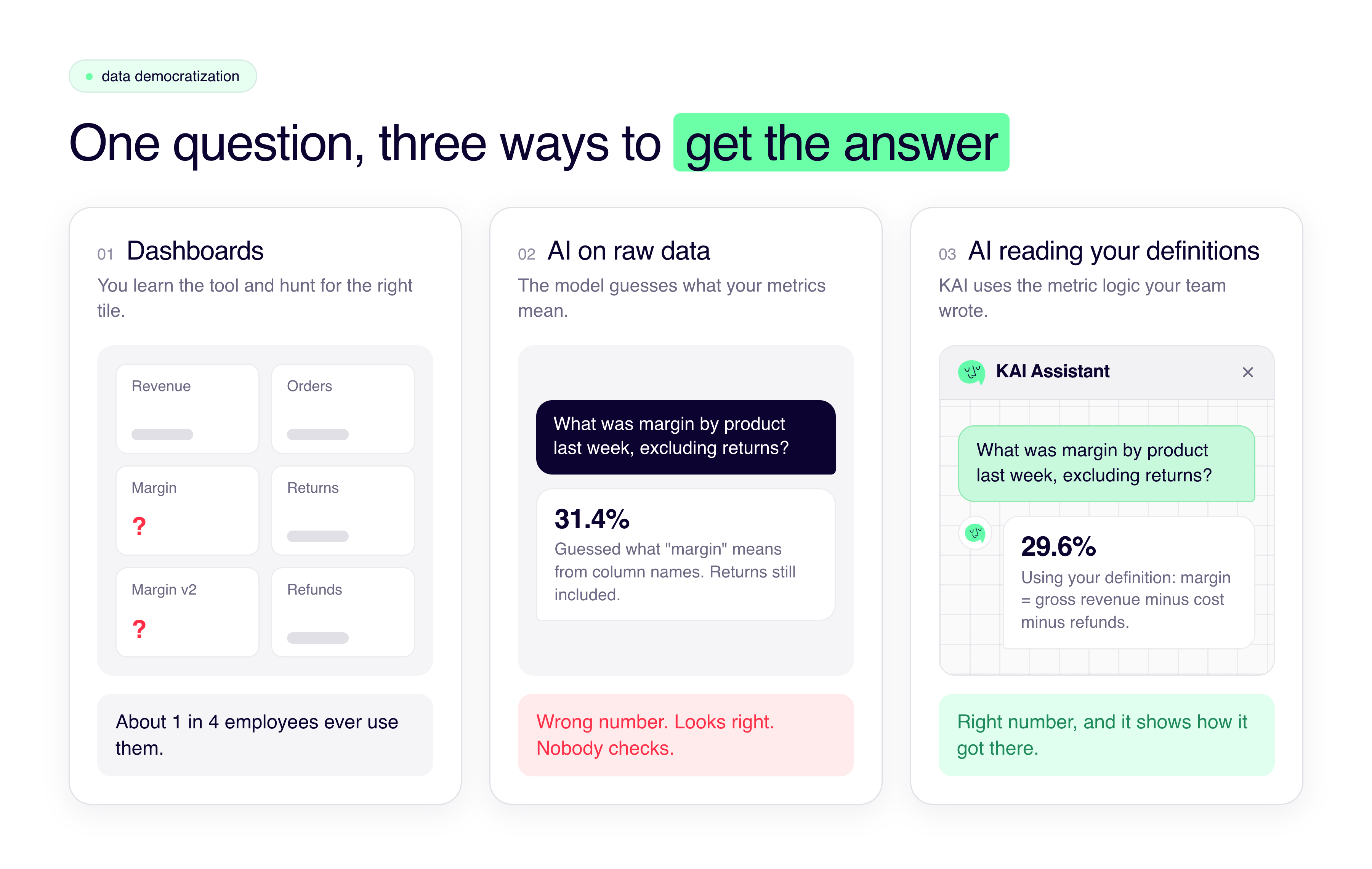
Every part of that model asks the business user to adapt to the data, learning the tool, which dashboard holds which metric, the catalog's vocabulary, and whether to trust a number based on lineage they did not build. A head of trading who wants to know last week's margin by product line has to find the right dashboard, apply the right filters, and know whether the margin figure includes returns.
The literacy explanation treats this as a training gap. A better description is that the interface was wrong. Ten years of training has not moved the adoption number, and no amount of further training is likely to, because the underlying request was for people to become fluent in a system that was designed around the data rather than around their questions.
How natural language interfaces like KAI Assistant enable data democratization
What changed: the interface inverted
The second generation inverts the relationship. Instead of the user learning the tool, the interface learns the business.
A natural language interface lets the head of trading type the question they actually have, "what was margin by product line last week, excluding returns," and get an answer. There is nothing to learn about filters or dashboards. The question is in their words. Gartner expects non-technical users to create three quarters of new data integration flows in 2026 through interfaces like this, and adoption is early: Strategy's report found only about 20% of organizations currently let employees query data in natural language.
This is a real change and it removes the barrier that stalled the first generation. It also introduces a different problem, and it is the one a senior leader should understand before switching anything on.
The problem: natural language gives confident wrong answers
A natural language interface has to translate the question into a query against your data. Research from 2026 measured how reliably that happens, and the results are specific enough to plan around.
On Spider 2.0, the benchmark built to reflect realistic enterprise databases rather than tidy academic ones, systems that translate language directly into SQL against the raw schema top out at around 31% execution accuracy. On a more contained set of enterprise questions, a paired benchmark from dbt Labs measured two frontier models at 90.0% and 84.1% accuracy when working directly from the schema.
Those numbers are not the alarming part. The alarming part is what the failures look like. When a direct natural-language-to-SQL system gets a question wrong, the query still runs and returns a number that looks plausible, and nobody knows it is wrong. The research literature calls these silent logical errors, and one paper studying them found that scoring systems only on the questions they answer cannot even see the problem, because a confident wrong answer counts as a success.
The cause is usually not the model. It is that business terms are ambiguous in ways the model cannot resolve from the data alone. Ask how many active customers you had last month, and "active" might mean logged in, placed an order, has a live subscription, or has not churned. Ask for revenue, and there may be two revenue metrics in the warehouse. One of the 2026 papers puts it precisely: revenue is ambiguous "because the layer defines two revenue metrics, not because a model finds it confusing."
Our own team sees this constantly. The way Alisha, who leads our consulting work, explains the fix:
"Imagine as a business you calculate net revenue as gross revenue minus taxes, minus shipping, minus refunds. If you just asked ChatGPT 'what's my net revenue', you'd have to explain that to it. Whereas if you've connected it into Kleene, it can read all of your SQL, understand the metadata, and it will just give you what the actual definition is."
The interface has to be reading the business's definitions, not guessing at them from column names.
What fixes it: definitions the interface can read
The same 2026 research measured what happens when the natural language interface is routed through a layer that holds the business's metric definitions, usually called a semantic layer or, in a data platform, the transformation layer.
The more important change was in the failures. With the definitions layer in place, when the system could not answer a question it said so rather than inventing a number. The failure mode shifted from a confident wrong answer to an error message, which is the difference between a tool a finance director can trust and one they cannot.
Two models of data democratization
Dashboards plus literacy training the model since roughly 2015
Natural language plus encoded definitions the model emerging in 2026
Who adapts
The business user learns the tool, the dashboards and the data vocabulary
The interface learns the business's definitions; the user asks in their own words
Where definitions live
In dashboard filters, analysts' heads, and a catalog people have to search
In a semantic or transformation layer the interface reads directly
Workforce adoption
Stuck near a quarter of employees for about seven years; executives near 80%
Early. Around 20% of organizations have enabled natural language querying
Accuracy on business questions
Depends on the user picking the right dashboard and filter. 67% of leaders say they do not fully trust the numbers
98 to 100% with definitions encoded. 84 to 90% without them, and around 31% on realistic enterprise schemas
How it fails
Silently. The user gives up and goes back to a spreadsheet or an analyst
With definitions: a refusal. Without them: a plausible wrong number nobody catches
Precondition
Training programs and a data catalog
One written definition per core metric, a system of record per entity, and someone who owns them
Who does the work
Every business user, continuously
The data team or a partner, once per definition, then maintained
Accuracy figures are from a 2026 paired benchmark by dbt Labs (two frontier models, enterprise question set) and the Spider 2.0 enterprise text-to-SQL benchmark. Adoption and trust figures are from BARC/Eckerson, Gartner and Strategy's AI+BI Analytics 2025 report, some via secondary sources. The right-hand column describes an approach, not a single product; a company with its own data team can build the definitions layer in dbt or similar.
This reframes what data democratization requires in 2026. The precondition is not that your people learn the tool. It is that your business's definitions, what counts as revenue, what counts as active, how margin treats returns, are written down in a form the interface can read. If they are, a natural language interface gives the head of trading a correct answer in their own words. If they are not, it gives them a plausible wrong one faster than a dashboard ever could.
How to tell whether you are ready
The test is cheap and our Principal Analytics Consultant Tom Fordyce recommends it as the first step of any data stack audit: go to three departments and ask each for last month's revenue. If the numbers match, your definitions are agreed and encoded, and you are ready. If they differ and everyone can explain why, you have a definitions problem, and that has to be fixed before any interface goes on top. If they differ and nobody can explain why, you have a data problem that comes before both. His five-step audit covers the rest.
Three further questions separate a ready organization from one that is not:
Do your core metrics have one written definition each, held somewhere other than an analyst's head or a dashboard's filter settings? A natural language interface can only read definitions that exist.
Can you name the system of record for each entity? If a customer exists as three records across your CRM, your commerce platform and your finance system, no interface can tell you how many customers you have.
Do you have someone who owns the definitions themselves, as distinct from owning the tool? When finance changes how it treats refunds, someone has to change the encoded metric, or the interface keeps answering with the old one.
What to ask a vendor
Any vendor selling natural language access to your data should be able to answer these in plain terms.
Where do the definitions live, and who maintains them? If the answer is that the model works them out from the data, you are buying the 31% system.
What happens when a question cannot be answered? The good answer is that the system refuses. The bad answer is that it always returns something.
Can the interface read our existing transformation layer, or does it need the definitions rebuilt inside the tool? Rebuilding means two sources of truth by the end of the first quarter.
Does the answer show its working? A number with the query and the definition behind it can be checked. A number on its own cannot.
Who does the encoding work if we do not have a data team? Most mid-market companies do not, and the vendor's answer to this decides whether the project happens.
Where Kleene fits
The definitions layer is the part most companies do not have, and building it is analyst work rather than software. Kleene's approach is that the transformation layer where those definitions are written is the same layer the interface reads. KAI answers questions in plain English from the warehouse, and through MCP the same access works from Claude or ChatGPT, reading the SQL and metadata that define each metric rather than inferring them. An embedded analyst team writes and maintains those definitions as part of the engagement, which is the answer to the last vendor question above.
That is one route. A company with its own data team can build the same layer in dbt or a similar tool and put any natural language interface on top, and the research suggests the result will be comparable. What does not work, in either case, is skipping the layer.
FAQ
What is data democratization?Giving people outside the data team the ability to answer their own questions from company data without depending on an analyst. In practice it has meant self-service BI dashboards, data catalogs and literacy training, and more recently natural language interfaces.
Why has data democratization been hard to achieve?The first generation of tools asked business users to learn the tool, the dashboards and the data vocabulary. Adoption across the workforce has stayed near a quarter of employees for most of a decade despite sustained investment in training, and most business users report low confidence in the tools and in the numbers.
Does natural language solve data democratization?It solves the interface problem, because people can ask in their own words. On its own it does not solve accuracy. Research in 2026 shows direct natural-language-to-SQL returns plausible wrong answers on ambiguous business terms, and only reaches reliable accuracy when the business's metric definitions are encoded in a layer the interface reads.
What is a semantic layer and why does it matter here?A layer that holds written definitions of business metrics, such as what counts as revenue or an active customer, so any tool querying the data uses the same definition. In a data platform this is the transformation layer. Benchmarks show it moves natural language accuracy from 84 to 90% up to 98 to 100%, and turns confident wrong answers into refusals.
What should we fix before adopting a natural language data tool?Agree and write down one definition per core metric, identify a system of record for each entity, and assign ownership of the definitions. A quick test is to ask three departments for last month's revenue. If the numbers differ, fix that first.
Is data literacy training still worth doing?For the analysts and people who build definitions, yes. As the primary route to getting business users onto data, the evidence suggests it has not worked and is unlikely to. The interface adapting to the user is a more reliable path than the user adapting to the interface.
Summary
Data democratization stalled because it asked people to adapt to the data. Natural language interfaces reverse that, and they are the first approach with a plausible route to the 75% of the workforce that dashboards never reached. They also fail in a specific and dangerous way when the business's definitions are not encoded for them to read.
Which makes the 2026 version of the project less about tools or training than about a question any leadership team can answer this week. Do three departments agree on last month's revenue? If they do, a natural language interface can be trusted on top. If they do not, that disagreement is the work, and we can help you scope it whether or not you build the rest with us.


%201.svg)


%201.svg)
