Stock control systems in 2026: why ERP inventory reporting keeps letting retailers down
September 9, 2024
- min read
Henry Owen
Product Marketing Manager
Every retailer with a warehouse is running one of two experiments at any given moment: too much stock, or not enough. Too much and your cash is sitting in a warehouse costing you money to store. Too little and you're turning away customers who came ready to buy. A stock control system is the thing that's supposed to keep you in the narrow band between those two failures, and for most businesses it half-works, which is arguably worse than not working at all, because half-working systems hide their gaps until a stockout or a write-off makes them obvious.
This piece covers what stock control actually is, the established methods worth knowing, why the ERP most retailers run it through keeps falling short, and what changes when you model demand at the SKU level rather than reacting to it. It's aimed at anyone who owns the awkward tension between working capital and availability, which usually means ops, supply chain, and finance arguing politely across a table.
What a stock control system is meant to do
Stock control, or inventory control, is the work of managing and overseeing a business's stock so the right amount is available at the right time. That's the whole job in one sentence, and the entire difficulty is buried in the words "right amount" and "right time," because both change constantly and neither is knowable from last year's numbers alone.
Done well, it pays off in three places that matter to anyone watching the P&L. It prevents the twin failures of overstock and stockout, the first draining cash, the second losing sales. It frees up working capital that would otherwise sit frozen in unsold inventory. And it keeps customers supplied, which is the least glamorous and most durable form of loyalty there is. None of that is controversial. The hard part has never been knowing why stock control matters, it's doing it accurately enough to trust.
The established methods, briefly
Before any software, there's a handful of methods worth knowing, because they're the vocabulary every tool and every ops conversation assumes you already have.
The main stock control methods, at a glance
Method
What it does
Just-in-time (JIT)
Keep stock low and order only as needed, cutting holding costs. Powerful, but unforgiving if demand or supply is unpredictable.
Economic order quantity (EOQ)
Calculates the order size that minimizes total cost, balancing ordering costs against holding costs.
ABC analysis
Sorts inventory into three tiers by value and importance, so effort concentrates on the items that matter most.
First-in-first-out (FIFO)
Sells oldest stock first, reducing the risk of obsolescence. The default for perishable or dated goods.
Last-in-first-out (LIFO)
Sells the most recently acquired stock first. Used in specific industries and accounting contexts rather than as a general rule.
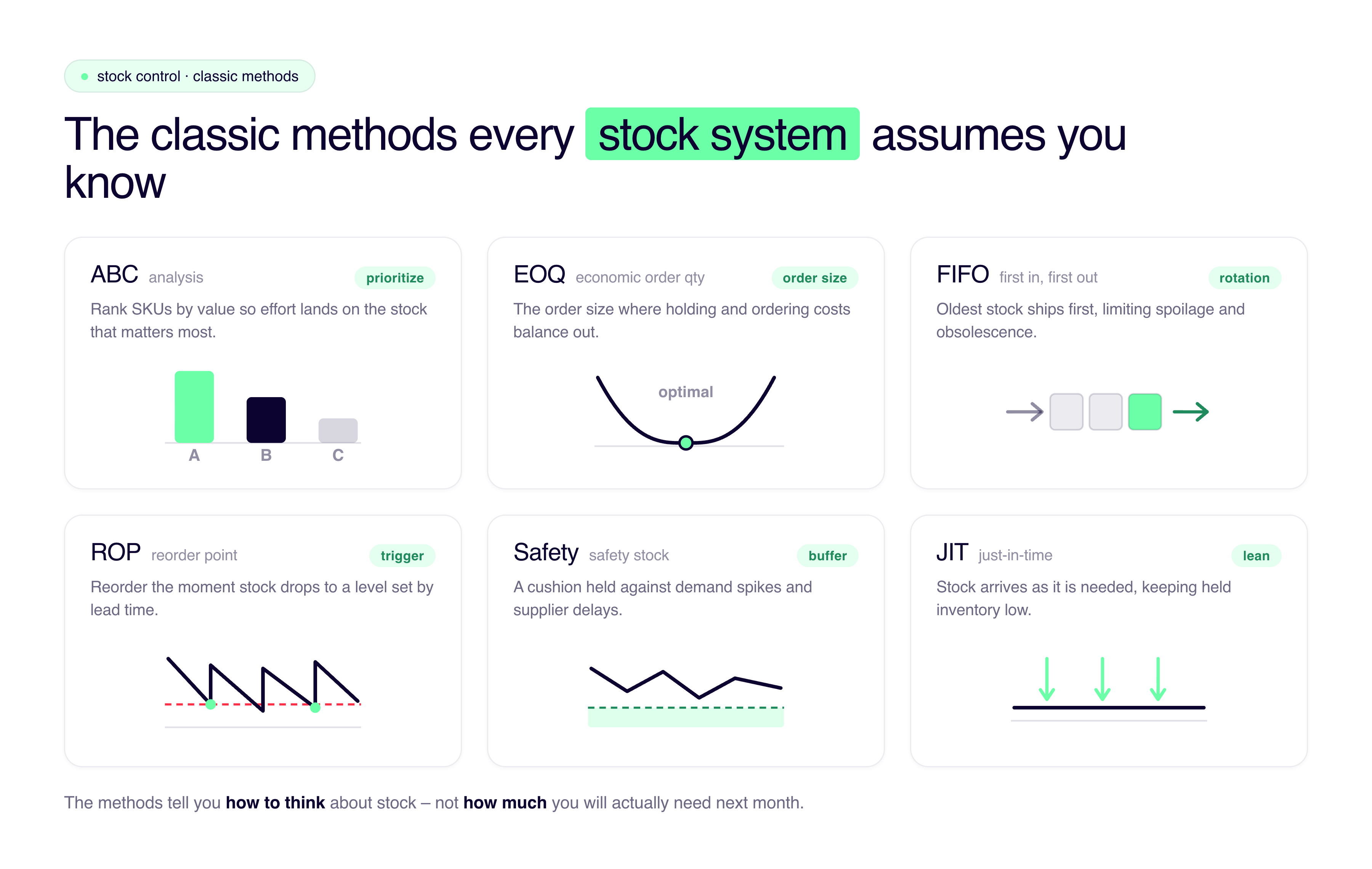
These aren't rival religions, and the mistake is treating them as a single choice. Most real operations run several at once: ABC analysis to decide where to concentrate effort, EOQ to size the orders that matter, FIFO on the shelf to manage obsolescence. The methods tell you how to think about stock. What they don't do is tell you how much you'll actually need next month, and that gap is where most stock control breaks down.
Why the ERP falls short
Most retailers run stock control through their ERP, because the ERP is already there and already holds the inventory records. It's the obvious home for the job, and it's also the reason so many businesses are stuck with mediocre inventory performance, because "already there" and "good at this" are not the same thing.
ERPs were built to record and transact, not to forecast and optimize, and it shows in three recurring ways. Their inventory functionality is often shallow enough that teams end up bolting on spreadsheets or manual processes to fill the gaps. They depend heavily on being set up and maintained exactly right, which is expensive and fragile. And their reporting is famously restrictive, giving you a serviceable view of what stock you have and almost no help with the harder question of what stock you should have. An ERP tells you where inventory is. It's much weaker at telling you where inventory is about to be wrong.
The fix most retailers reach for first is a black-box inventory tool that sits on top of the ERP, and it's worth being honest about why that so often disappoints. These tools are generic by design, so they rarely fit the specific shape of your sales channels, your suppliers, and your tech stack. They tend to integrate poorly, creating fresh data silos rather than closing them. And they're hard to adapt as the business changes, which for a growing retailer is a permanent state rather than an occasional event. A quick fix that doesn't fit is just a slower problem.
What actually moves the needle: modeling demand at the SKU level
Here's the shift that separates modern inventory management from the ERP-plus-spreadsheet status quo. The methods above all optimize around demand you already know. The real gains come from forecasting demand you don't yet know, at a granular enough level to act on, and then connecting that forecast to your stock decisions.
That's what Kleene's inventory management model does, and it's worth being specific because the specificity is the point. It works at the individual SKU level, down to which color of a product, which supplier is providing it, and where the peaks and troughs in availability sit. It tracks the supply-chain variables the methods above assume away: supplier holidays, when purchase orders were generated, signed, or left unsigned, lead times, holding costs. Using EOQ and ABC analysis as part of the mix, it produces optimal reorder points, turnover ratios, and simulation results, and surfaces where stock is drifting out of line with forecast demand before that drift turns into a write-off or an empty shelf.
The reason this matters more than any single method is what it connects to. Inventory management is most powerful fused with demand forecasting, which is why we almost always deliver the two together. Our CPO wrote about how demand forecasting works, and the finding that surprises most retailers is how heavily external factors drive demand: not just day-of-week and seasonality, but public holidays, Black Friday, Valentine's Day, even the weather. On one project, bookings for sunny-destination travel rose when UK weather turned grim and fell during a heatwave, which no static reorder rule would ever catch. Connect a demand model that understands those drivers to an inventory model working at SKU level, and a retailer can plan stock up to 18 months ahead, holding enough to meet demand without carrying a cost-heavy buffer that isn't justified. Ian calls that the Goldilocks zone, and it's a good name for the thing every retailer is actually chasing.
Why this needs machine learning, not a bigger spreadsheet
You might reasonably ask why this can't live in the ERP or a clever spreadsheet, and the honest answer is scale of complexity. Optimizing stock properly means understanding each product's statistical attractiveness, how that relates to demand, how it varies by customer segment, and how all of that shifts across multiple markets where demand differs by geography. That's a number of interacting factors no static model and no analyst with a spreadsheet holds in their head at once. Machine learning is what makes it tractable, and a natural-language layer on top is what makes it usable: with KAI Assistant, a merchandiser or ops lead can ask where stock is drifting out of alignment with demand, by SKU or location, and get an answer without waiting on an analyst to build the report.
Comparing the six classic stock control methods
So what should a retailer actually do?
The honest decision tree is short. If you're small, running a handful of SKUs through a single channel, your ERP's inventory module plus disciplined use of the classic methods may be enough, and adding a forecasting model would be solving a problem you don't have yet.
But if you're carrying real SKU complexity across multiple suppliers and channels, if you're regularly caught between overstock and stockout, and if your ERP reporting can tell you what happened but never what's coming, you've outgrown the setup and you're paying for it in tied-up cash and lost sales rather than a line on an invoice. That's the point at which SKU-level demand modeling stops being a luxury and starts paying for itself. If you're not sure which side of that line you're on, our framework for choosing a data stack is a useful gut-check before you buy anything.
The through-line is simple enough. Good stock control keeps you in the narrow band between too much and too little, the classic methods give you the vocabulary but not the foresight, the ERP records the present but can't forecast the future, and the thing that actually closes the gap is modeling demand at the SKU level and connecting it to your stock decisions. That's what Kleene's inventory management and demand forecasting models are built to do, delivered together as part of the KAI Analytics Suite rather than sold as another black box to bolt on.
If you want to work out whether your inventory setup has hit its ceiling without anyone noticing, bring us your numbers and we'll give you a straight read, including the cases where your current system is fine and you don't need us yet.


%201.svg)


%201.svg)
