TLDR:The right Informatica alternative depends on what you were using Informatica for. If it was cloud data integration, Fivetran, Matillion, Airbyte and Hevo are the modern replacements. If it was enterprise integration and governance across a complex estate, Talend, Boomi, SnapLogic, IBM DataStage and Azure Data Factory are the like-for-like options. But a lot of businesses leaving Informatica, especially the mid-market divisions being funnelled toward IDMC after PowerCenter's end of life, do not actually need another integration platform. They were sold plumbing when the real requirement was decisions. That is the case for a whole-business platform like Kleene, and it is the option none of the other lists mention.
Two things are driving people to look for Informatica alternatives in 2026. The first is PowerCenter. Standard support for version 10.5x ended on 31 March 2026, and thousands of enterprises are mid-migration, being steered toward Informatica's Intelligent Data Management Cloud whether or not it fits. The second is Salesforce's completion of its roughly $8B acquisition in November 2025, which delisted Informatica and left customers asking reasonable questions about pricing and roadmap that nobody can fully answer yet.
Both send people to a search box. And almost every list they find makes the same assumption: that an Informatica alternative is another data integration tool. Sometimes it is. But Informatica's own AWS Marketplace list price is $131,760 a year for the integration layer, before a warehouse, before a BI tool, before a single model that predicts anything. If you are replacing that, it is worth asking what you actually needed it to do, because the honest answer for a lot of businesses is not "move data" but "make a decision with it," and those are different tools.
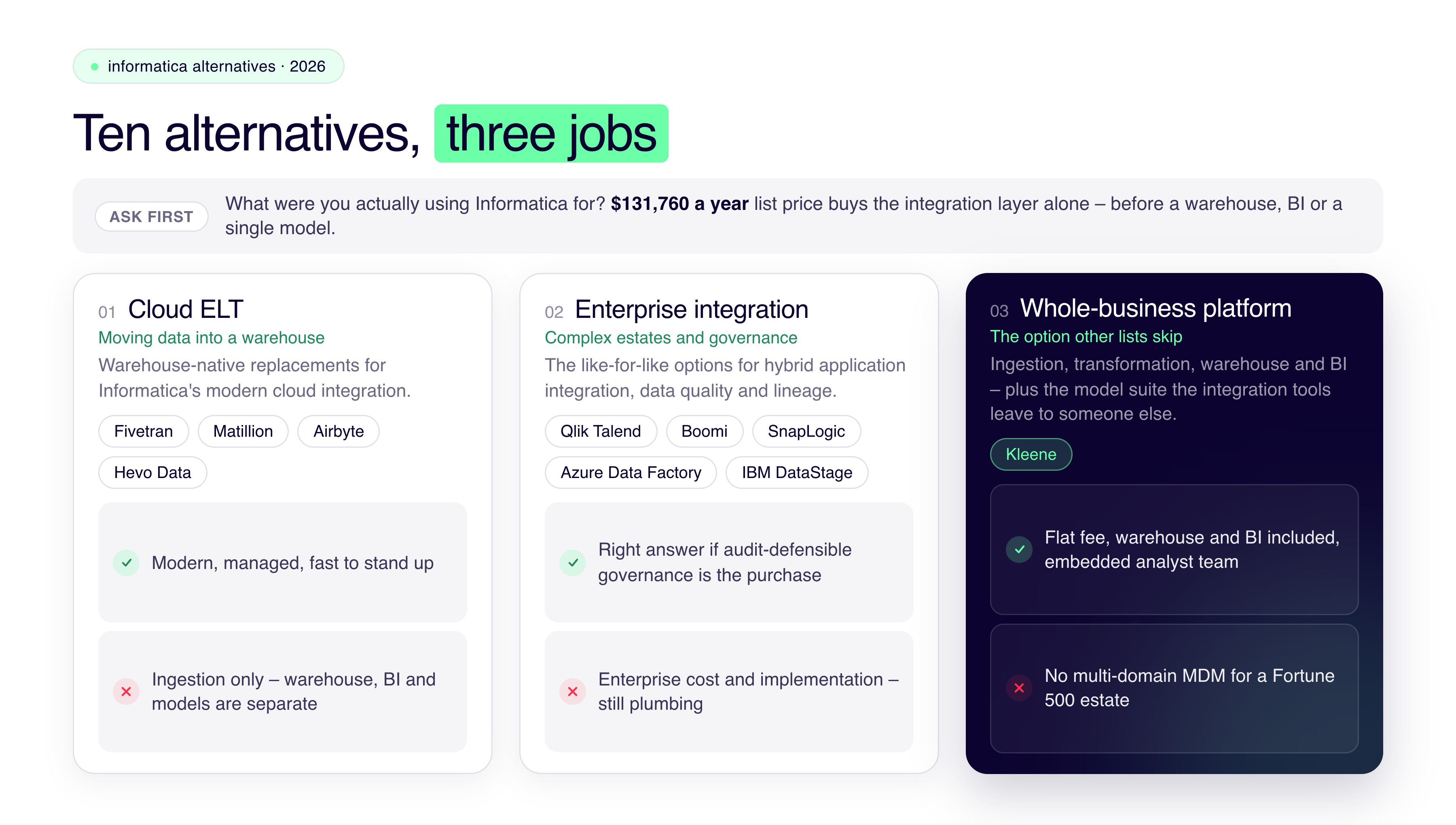
The ten below are sorted into three groups by the kind of job they do, cloud ELT to start, then the heavier enterprise integration and governance tools, then the whole-business option the other lists skip.
What Informatica is good at
Any of these comparisons only works if the credit is honest, and Informatica is a strong product for the company it is built for.
Its master data management is best in class, a seven-time Gartner Leader, highest in ability to execute. If your actual requirement is one golden record for customers, products and suppliers across dozens of systems, Informatica is the safe answer and most tools on this list, ours included, have no equivalent. Its governance, lineage and compliance depth is built for regulated industries with real audit exposure. Its breadth is real, with 300+ connectors across 50,000+ sources, some of them mainframe-era. And it is proven at extreme scale, on the order of 143 trillion cloud transactions a month.
If you are a Fortune 100 business with forty source systems and a regulatory obligation to prove lineage, most of this article is not for you, and Informatica remains a defensible choice. The alternatives below are for everyone who was sold that scale and does not have that problem.
The 10 best Informatica alternatives in 2026, divided by what they do for your business
Cloud ELT and the modern stack
For teams whose Informatica usage was really cloud data integration, moving data into a warehouse. These are the modern, warehouse-native replacements.
The default managed ELT choice. Reliable automated connectors, automatic schema handling, and very little to operate. Since Fivetran completed its merger with dbt Labs in June 2026, the ingestion and transformation layers most teams pair are now one company, which simplifies the modern-stack build. The catch is the usual one: consumption pricing on monthly active rows means the bill tracks your data volume, and it stops at ingestion, so you still add transformation, a warehouse, BI and anyone who builds models.
Price: usage-based on monthly active rows, with a free tier. Scales with data volume.
A cloud-native ELT tool built for warehouses like Snowflake, Redshift and BigQuery, with a visual, low-code builder and an AI assistant for generating transformation logic. A good fit for teams that want a more guided path than code-first tools. Connector breadth is narrower than Informatica's, and pricing runs on credits with warehouse compute billed separately.
Price: subscription plus credits, with warehouse compute billed separately on top.
Pros
Visual, low-code pipeline building
Warehouse-native pushdown for Snowflake, Redshift, BigQuery
The leading open-source option, with a large connector catalog and a custom-connector framework. Strong for engineering teams that want control and are happy self-hosting, or that need a source the commercial tools do not cover. The trade is operational: self-hosted Airbyte is free to use and not free to run.
Price: free self-hosted, consumption-based on Airbyte Cloud.
Pros
Large and fast-growing open-source connector library
A no-code, real-time pipeline platform aimed at teams that want managed ELT without the Fivetran price at smaller scale. Cloud-native, quick to set up, and pitched at analytics teams rather than platform engineers.
Price: tiered subscription, with a free tier and event-based bands.
Pros
No-code, quick to deploy
Real-time replication
More accessible pricing at smaller scale
Aimed at analytics teams, not just engineers
Cons
Less connector depth than the enterprise incumbents
Ingestion and light transformation only
Scales in cost as event volume grows
Enterprise integration and governance
For businesses replacing Informatica's heavier capabilities: complex application integration, on-prem and hybrid estates, and governance. These are the closer like-for-like enterprise options.
The closest enterprise replacement for Informatica's integration and data-quality breadth, now part of Qlik. Strong data profiling and matching, mature data-quality and MDM-adjacent features, and good on-prem and legacy connectivity. A genuine option for a regulated or complex estate, though it keeps an engineer at the center of building and maintaining pipelines.
Price: quote only, enterprise subscription.
Pros
Closest like-for-like on integration and data quality
Strong governance and profiling
Good on-prem and legacy connectivity
Mature, enterprise-proven
Cons
Engineer-centric, heavy to build and maintain
Enterprise cost and implementation
Ownership changes under Qlik add their own roadmap questions
A cloud-native iPaaS built around application and process integration rather than warehouse ELT. Drag-and-drop, low-code, with hundreds of connectors, and a strong choice when the problem is connecting applications across cloud and on-prem, not just loading a warehouse.
An iPaaS for hybrid environments, combining application and data integration with an AI-assisted pipeline builder. A fit for organizations with a mix of cloud and on-prem systems that want one tool across both.
Microsoft's cloud ETL and orchestration service, the natural choice for organizations standardized on Azure. Serverless, deeply integrated with the Azure stack, and cost-effective for Azure-first teams. Outside that ecosystem it offers less, and it is a pipeline tool rather than a platform.
Price: consumption-based on pipeline activities and data movement.
A long-established enterprise ETL platform, now cloud-modernized, built for large-scale, complex transformation workloads. A like-for-like for the heaviest Informatica batch-integration jobs, and a fit for enterprises already in the IBM ecosystem.
Price: quote only, enterprise subscription.
Pros
Built for large-scale, complex transformation
Strong parallel-processing performance
Enterprise-proven for heavy batch workloads
Fits IBM-ecosystem organizations
Cons
Enterprise cost and heavy implementation
Most relevant inside the IBM stack
Integration and transformation only
The whole-business option the other lists skip
For businesses that were using Informatica to make data trustworthy so they could eventually make decisions with it, and would rather not assemble the decision layer separately.
Every tool above replaces part of what Informatica does: it moves data, or integrates applications, or governs an estate. None of them tell you what to do with the result. That is the same gap Informatica has, and it is worth noticing before you replace one plumbing layer with another.
Informatica makes data trustworthy and hands it to someone else's BI tool and someone else's data science team. Its own analytics proof point is a customer spending 90% less time wrangling data, which is a plumbing win, not a decision. Kleene is built the other way round. Ingestion, transformation and a managed warehouse are there, but so is the layer the integration tools leave out: BI, and the KAI Analytics model suite, with demand forecasting, attribution, media mix modeling, segmentation, price elasticity, inventory and creative diagnostics delivered as working models on your data.
The reason this matters for an Informatica refugee specifically: a lot of businesses were sold Informatica to "trust our data" when the real pain was "we can't forecast, we can't see margin by product, we don't know which channel works." Those are model problems, not integration problems, and no amount of clean data solves them on its own. Kleene includes an embedded analyst and engineering team to build that layer, where Informatica assumes you already employ one.
Two honest limits. Kleene does not do multi-domain master data management across a Fortune 500 estate, and if audit-defensible governance and lineage is the actual purchase, Informatica or Talend is the right answer. And Kleene is not built for a forty-source mainframe integration programme. What it is for is the mid-market business, often a division or subsidiary being quoted enterprise IDMC for a problem that was never that big, that needs the whole path from raw data to decision without assembling five tools and hiring a team to run them.
Price: a flat annual fee with warehouse and BI included, and unlimited data usage rather than a consumption meter. Published on our pricing page.
Pros
Includes the decision layer (BI and predictive models), not just integration
Warehouse and BI included in one flat fee
Embedded analyst and engineering team, no data team required
Connectors and transforms live in your own Snowflake with Git, so leaving is possible
Cons
No multi-domain MDM for a Fortune 500 estate
Not built for forty-source mainframe integration programmes
Aimed at mid-market and whole-business use, not enterprise plumbing at extreme scale
Informatica alternatives, grouped by what you needed Informatica to do
Category
What it replaces
Example tools
Best for
Cloud ELT / modern stack
Informatica's cloud data integration, moving data into a warehouse
Fivetran, Matillion, Airbyte, Hevo
Warehouse-native teams wanting modern, managed ingestion
Enterprise integration & governance
Complex application integration, hybrid estates, governance and MDM
Talend, Boomi, SnapLogic, Azure Data Factory, IBM DataStage
Large, complex or regulated estates replacing like-for-like
Whole-business platform where Kleene sits
The whole premise: integration plus the BI and models Informatica leaves out
Kleene
Mid-market businesses that need decisions, not just trusted data, without a data team
Informatica's master data management and governance are genuinely best in class (a seven-time Gartner Leader) and most tools here, Kleene included, have no MDM equivalent. The categories reflect what people replace Informatica with, not a quality ranking. Informatica's own AWS Marketplace list price is $131,760 a year for the integration layer alone, before a warehouse, BI or models.
The PowerCenter question, specifically
If you are here because PowerCenter support ended, the decision is not just which tool, it is which kind of tool, and the default funnel toward IDMC is worth resisting long enough to ask one question: what were you actually using PowerCenter for.
If it was batch ETL into a warehouse, a modern ELT tool (Fivetran, Matillion) replaces it for a fraction of the cost and the migration effort is comparable to moving to IDMC anyway. If it was complex enterprise application integration, Talend, Boomi or SnapLogic are the like-for-like. If it was governance and MDM specifically, that is the one case where staying inside the Informatica family, or moving to Talend, is the case that holds up.
And if PowerCenter was the thing feeding reports and models that the business actually runs on, then the migration is a chance to stop replacing plumbing and buy the outcome instead. That is the conversation most migration vendors will not have with you, because they sell plumbing.
What the Salesforce acquisition changes, honestly
This part is questions, not claims, because nobody outside Salesforce has the answers yet.
Informatica is now a wholly owned Salesforce subsidiary, delisted, with no more public financial reporting. The last public numbers, from Q3 2025, showed total ARR growing 3.9% while cloud ARR grew 29.5%, which means most of the company's effort was already going into migrating its own installed base from the legacy products to the cloud ones. Salesforce's stated rationale for the deal is agentic AI and Data Cloud.
The fair questions to ask a vendor before signing, whoever they are: what happens to product lines that overlap with Data Cloud and MuleSoft, what happens to roadmap priority for customers who are not on Salesforce, and what happens to pricing once there is no public shareholder scrutiny. Those are not accusations. They are the questions any careful buyer asks when a platform they depend on is acquired, and Informatica is simply the current example.
How to choose
Match the tool to what Informatica was actually doing for you.
Warehouse-native ELT, and you want modern and managed: Fivetran, Matillion, or Hevo. Open-source and you have the engineers: Airbyte. Complex application or hybrid integration: Boomi or SnapLogic. Enterprise governance and data quality you do not want to give up: Talend. All-in on Azure or IBM: Azure Data Factory or DataStage.
And if the honest truth is that Informatica was the expensive foundation under decisions you still could not make, a whole-business platform that includes the models and the people is the alternative none of the integration lists will point you to.
The thing to fix while you migrate
One point applies to all ten. Replacing Informatica is a chance to fix the thing underneath, which is whether your data is consistent enough to trust in the first place. If your source systems disagree about what a customer is or what revenue means, a new integration tool will move that disagreement faster. Our framework for choosing a data stack is the thing to read before you pick a replacement, and our full-stack pricing comparison prices the assembled alternatives against an all-in platform if you want the real numbers.
FAQ
What is the best Informatica alternative?It depends what you used Informatica for. Fivetran, Matillion, Airbyte or Hevo for cloud ELT. Talend, Boomi, SnapLogic, Azure Data Factory or IBM DataStage for enterprise integration and governance. A whole-business platform like Kleene if the real need is analytics and decisions rather than more plumbing.
Why are people leaving Informatica in 2026?Two reasons. Standard support for PowerCenter 10.5x ended on 31 March 2026, forcing a migration decision, and Salesforce completed its acquisition of Informatica in November 2025, raising questions about pricing and roadmap. Both are pushing customers to evaluate alternatives.
How much does Informatica cost?Informatica publishes no rate card. Its AWS Marketplace list price for IDMC is $131,760 a year for 120 processing units per month, for the integration layer alone, before a warehouse, BI or models. Pricing is metered in Informatica Processing Units with unpublished per-service conversion rates, so two companies on the same commitment can spend it at very different speeds.
What is the best PowerCenter replacement?For batch ETL into a warehouse, a modern ELT tool like Fivetran or Matillion. For complex application integration, Boomi or SnapLogic. For governance and MDM specifically, Talend or staying within the Informatica family. For turning the migration into an analytics upgrade rather than a like-for-like, a whole-business platform like Kleene.
Do I need another data integration tool, or something more?Ask what Informatica was really for. If it was moving data, an integration tool replaces it. If it was the foundation under reports and models the business runs on, the migration is a chance to buy the decision layer instead of replacing plumbing with plumbing.
The short version
Ten alternatives, three jobs. Cloud ELT tools replace Informatica's modern integration. Enterprise integration and governance platforms replace its heavier estate work. And a whole-business platform replaces the whole premise, by including the BI and the models that Informatica always left to someone else.
If you are leaving Informatica because the bill never matched the outcome, and what you actually need is to forecast, to see margin by product, to know which channel works, that is the gap we build for. Tell us what you were using Informatica for and we'll tell you whether you need an integration tool or something that goes further.


%201.svg)


%201.svg)
