Most comparisons between Kleene and y42 open with the wrong question. Usually some version of "which platform has more features." A more useful question is shorter: who's going to use it, and what do they need it to produce? Most of what follows is about why that distinction matters more than the feature grid does.
What y42 actually is
y42 (founded in Berlin in 2020 by Hung Hieu Dang, formerly Datos-Intelligence) is a full data orchestration platform. Their own positioning is a "Turnkey Data Orchestration Platform with embedded Observability", and the description fits. The product handles ingestion through 100+ connectors, SQL and dbt transformations, asset-based orchestration, and data health monitoring. It sits on the customer's own cloud warehouse, runs version control through git, and gives data practitioners a single pane of glass for what's running and what's broken.
For teams with a data engineering function gluing Fivetran, dbt, Airflow, and an observability tool together, y42 is often a meaningful upgrade. That's not in dispute. If both products handle most of the same layers, then, the obvious question is why this comparison page exists at all.
Kleene.ai vs y42
Where the two products actually diverge
What we tend to see on calls is something like this: a consumer brand doing £20m to £200m in revenue. A two-person analytics team, sometimes one, sometimes none. A finance leader who'd like a forecast that updates without a Tuesday morning fire drill. A CEO trying to work out whether last week's revenue dip is a measurement issue or a real one.
Teams in that shape rarely pick a data platform based on which orchestrator has prettier DAG visualisations. They pick based on something closer to: at the end of the quarter, will there be an answer, or another dashboard?
That's the line between the two products. It sits between "the data has arrived clean in the warehouse" and "the business made a different choice because of it." Most platforms stop at the warehouse. The work that happens between those two points is where mid-market consumer brands burn most of their analyst hours, and where the comparison stops being about software and starts being about who's doing the work.
What y42 is optimised for
The product is the pipeline. Reliable, observable, version-controlled. y42's own marketing makes the orientation explicit: the platform exists to "power your business analytics and AI applications". The pronoun is doing real work in that sentence. Your AI applications. The customer's team builds them. y42 keeps the data feeding them clean and the pipelines running.
In organisations where pipeline reliability is the genuine bottleneck, that's the right optimisation target. It often is, when a few data engineers are already in place.
For most of the brands we work with, the bottleneck sits downstream. It's the forecasting model that has to get rebuilt every quarter. The CAC investigation that lands on Monday morning. The retention cohorts. The board deck. The "why did paid social drop 18% last week" question that needs an answer by lunch. A reliable pipeline is necessary, but it's the floor of the work rather than the ceiling.
What Kleene is optimised for
Kleene tends to suit teams that want the work done rather than the kit to do the work with.
We run most of the same layers y42 does (ingestion through 200+ connectors, transformation in your cloud warehouse, orchestration, observability, BI), but as a managed platform with an analytics team behind it. On top of that we apply AI (our suite is called KAI) to produce specific outputs: revenue forecasts, CAC drivers by channel, attribution decisions, retention risks, recommended next steps grounded in the governed data.
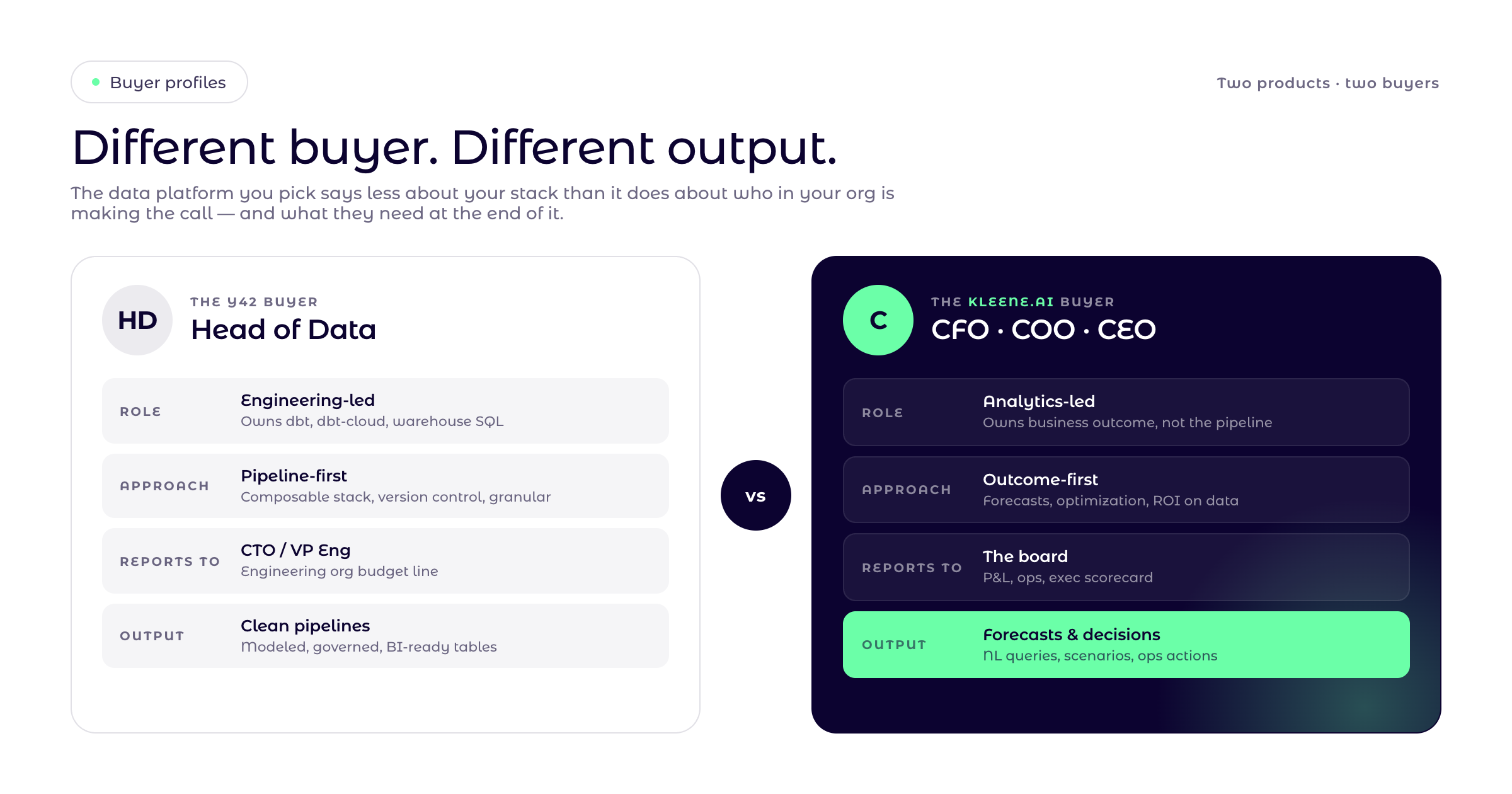
The shorthand version: y42 makes data engineers more productive; Kleene gives analytics and business teams the means to make decisions they couldn't otherwise reach without more headcount.
A few illustrations of what that looks like in practice:
Huel consolidated fragmented marketing, ecommerce, and retail data into a single source of truth, and the analytics team now runs unified attribution and forecasting on top of it. The interesting metric isn't connector count; it's how many analyst hours came back.
Hawkstone (premium beer, three sales channels: DTC, on-trade, off-trade) needed channel-by-channel visibility their previous stack couldn't produce, and got it without hiring a data engineer.
Breast Cancer Now cut significant manual reporting effort, which is work data engineers rarely want to do and analysts shouldn't have to do.
CoinMENA scaled their reporting through a growth period where the alternative was a hiring round they couldn't justify.
None of those are "we shipped a dashboard" stories. They're "we got to a decision faster, with fewer people" stories. That's the bet.
The shape of team that fits y42
The pattern that fits y42 most cleanly looks roughly like this. A data engineering team in place, or one about to be hired. A head of data as the buyer rather than a CFO or COO. A bottleneck that lives in pipeline reliability and engineering throughput. A preference for owning the platform and building on it rather than handing the work to a partner. An intent to build AI applications in-house on top of governed infrastructure.
When that shape is present, y42 is a strong pick. We'd say so on a call.
The shape of team that fits Kleene
The inverse pattern tends to fit Kleene more cleanly. One analyst, two, or none. Revenue somewhere between roughly £20m and £500m. A buyer in finance, ops, marketing, or the corner office, asking for forecasts and decisions rather than infrastructure. A preference to leave the data engineering function unbuilt, or to redirect existing engineers toward harder problems than pipeline plumbing. An interest in AI applied to existing data, rather than a platform on which to build that AI from scratch.
Our pricing includes the partnership component by default, which is a different commercial shape than buying seats on a self-serve tool.
The middle ground most comparison pages skip
These comparisons get written as if the choice were binary. In practice, it mostly isn't. Teams pick y42, use it well, and stay perfectly happy. Teams pick Kleene with a strong data engineering function in place, and use the platform alongside their engineers rather than instead of them. There's real overlap.
The choice gets sharper at the edges. A one-analyst consumer brand often struggles with raw infrastructure for AI applications. A 12-person data engineering org often finds managed-service guardrails frustrating. Most teams sit somewhere in between, and the question they're effectively asking, even when it's not phrased this way, is whether they want to build a data function or get the output of one.
Teams that want to build the function more often land at y42. Teams that want the output of one more often land with us.
A closing observation
For teams in the middle of an evaluation, a 30-minute call usually surfaces which side of that line they're on without much friction.
If the read above doesn't match what you're seeing on the ground, we'd be interested in hearing why.


%201.svg)


%201.svg)
