Kleene.ai vs Weld: a complete data platform comparison
January 26, 2026
- min read
Henry Owen
Product Marketing Manager
Updated June 2026
If you are comparing Kleene.ai and Weld, you have probably already noticed they answer to different people: Weld is the tool a data team reaches for, and Kleene is what a business reaches for when it would rather not build one, or runs a very lean data team.
A quick note for anyone really searching for Weld alternatives: Weld sits in a busy category, and the names that come up alongside it are Matillion, Fivetran with dbt, Boomi, y42, and Databricks. We have written head-to-head comparisons for each of those, linked at the end. This piece is about Weld specifically.
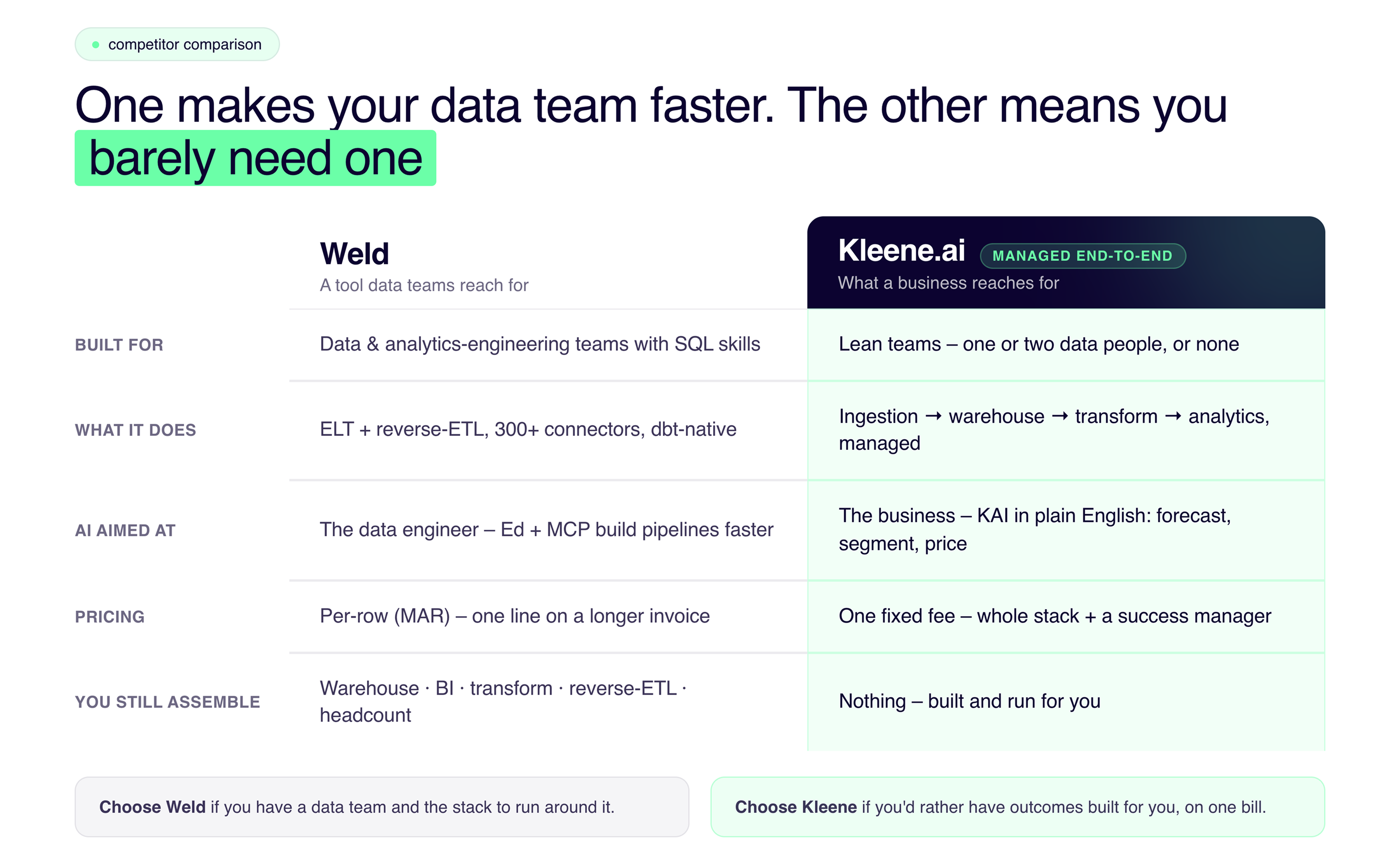
Overview of the key differences between Kleene.ai and Weld, and why you should choose each one
Important disclaimer: Weld is a good product for data engineers
This is the part where most vendor comparisons wave a hand and move on, but we would rather be specific, because generosity only counts when it is informed.
Weld is a Copenhagen-built ELT and reverse-ETL platform with 300+ prebuilt connectors and the option to build your own in Python. It does change data capture, syncs modelled data back into operational tools, and plugs into dbt for teams that already model that way. It is rated 4.8 out of 5 on G2, and it has been shipping quickly: in 2026 alone it has added Ed, its AI agent layer, an MCP server so tools like Claude Code and Cursor can drive your data models, GitHub integration for those models, ShopifyQL reports, and History Tables for versioned, auditable records. If you want fast, reliable data movement run by people who know SQL, Weld is a strong choice.
So where does the difference sit? Weld's own words give it away: it is "loved by data teams." The product, the docs, and the pricing all assume one exists, with the SQL skills and the spare hours to run it.
For a lot of mid-market and consumer businesses, that assumption is the problem. They do not have an analytics-engineering function. Instead, they have one or two data people, or a finance analyst who inherited the dashboards, and a long list of questions the business needs answered this quarter.
The real difference: pipelines versus outcomes
Weld moves and transforms data, and does it well. But after the data lands you still need a warehouse, a BI tool, the transformation logic, the reverse-ETL destinations, and someone to own all of it.
Kleene is the managed end-to-end version: ingestion, a Snowflake-based warehouse (or your own provider), transformation, analytics, and a layer of proprietary AI models (forecasting, segmentation, price elasticity, inventory) in one place, with a consulting team that builds it for you and advises on the opportunities worth chasing. On top sits KAI, a plain-English assistant, so an operator or a finance lead can ask a question and get an answer without writing SQL. You can reach the same models with Claude or Codex over an MCP connection, too.
Pricing: two models that are hard to compare on purpose
Weld's pricing is usage-based, billed on Monthly Active Rows (the rows that change each month), with fixed plans that include a MAR allowance, a 20% discount for paying annually, and 14 days of free usage when you connect a new source (Weld pricing). For what Weld does, that is clear and reasonable.
The catch is that Weld is one line on a longer invoice. Budget separately for the warehouse, the BI tool, the transformation tooling, the reverse-ETL destinations, and the headcount to run the stack. The data-movement bill can look small while the total cost of the stack is not.
Kleene uses a single fixed fee for the whole managed platform, including the warehouse and the AI models, with implementation and a dedicated success manager in the price. You trade per-row variability for one number you can put in a budget. We walk through the full-stack maths in our AI data platform pricing comparison.
The AI question, as it stands in 2026
This is where the two products are diverging fastest, and it is the clearest way to choose.
Weld has aimed its AI at the data team. Ed and the new MCP server let engineers point an AI agent at their pipelines and models and build faster. That is genuinely useful, and if you have engineers, it is a real productivity gain.
Kleene aims its AI at the business. The models are not only there to help you build a pipeline more quickly, but also to forecast demand, segment customers, and test pricing on your own data, with KAI putting the questions and answers into plain English for people who will never open a query editor.
What it looks like in practice
The case studies on both sides tell the story more honestly than any feature table.
Weld's own write-up of Holafly, the eSIM company, is a good one. Their data engineer, Rodrigo Andres Valle, describes building connectors by hand with custom Python scripts and cloud schedulers, roughly two to three days each, then dropping that to a few clicks with Weld and saving about 40 hours a month. Notice the shape of that win: Weld made an existing data engineer dramatically more efficient. There is a data engineer in the story.
Now the other shape. Bremont, the British luxury watchmaker, came to us with a lean data function and legacy reports nobody trusted, right as it was taking on investment and needed numbers that would survive scrutiny. We built a custom connector for its Priority ERP, layered fixes onto the historical data, and shipped dashboards the whole business now works from. The results: 60 hours of manual reporting saved, 100% data alignment across teams, and an AI-ready foundation that scales as the company grows. In their analyst's words, "everybody's working off the same data," and the most valuable part was the Kleene team behind it.
Should you choose Weld?
Yes, in some real situations, and it is worth being plain about them:
You already have a data or analytics-engineering team with the SQL skills and the time to own a stack.
Your bottleneck is data movement and reverse ETL, and you are happy assembling the rest of the stack around it.
You want maximum control over your warehouse and your transformation logic, and you see that control as an asset rather than a cost.
Your BI and analytics already live elsewhere and you do not want them bundled.
If that is you, Weld earns its place.
Should you choose Kleene?
Kleene is the better fit when:
You have one or two data people, or none, and no appetite to hire a platform team.
Your data is scattered across departments and nobody fully trusts the reports.
You need forecasting, segmentation, and pricing intelligence on your own data, on top of clean tables.
You want one predictable fee and a partner who builds it with you, rather than a tool you operate yourself.
That last group, the lean team that has to support and scale the whole business, is the company we built Kleene for.
Still weighing the alternatives?
If Weld is only one name on your shortlist, here is the short version on the others, with a full comparison behind each link.
Matillion earns its keep for big platform teams, but the credit-based pricing climbs fast. See Kleene.ai vs Matillion.
Fivetran + dbt is the default assembled stack; powerful, and two bills plus the team to run both. See Kleene.ai vs Fivetran + dbt.
Boomi is enterprise iPaaS, strong on integration, light on business AI. See Kleene.ai vs Boomi.
y42 is a polished all-in-one for data teams that still want to own the modelling. See Kleene.ai vs y42.
Databricks is a heavyweight lakehouse for engineering-led organisations at scale. See Kleene.ai vs Databricks.
Bring us your current stack, the per-row bill plus the warehouse, the BI, and the data-engineering headcount, and we will walk through it with you.


%201.svg)


%201.svg)
