The 10 essential inventory formulas, explained (2026)
January 1, 2026
- min read
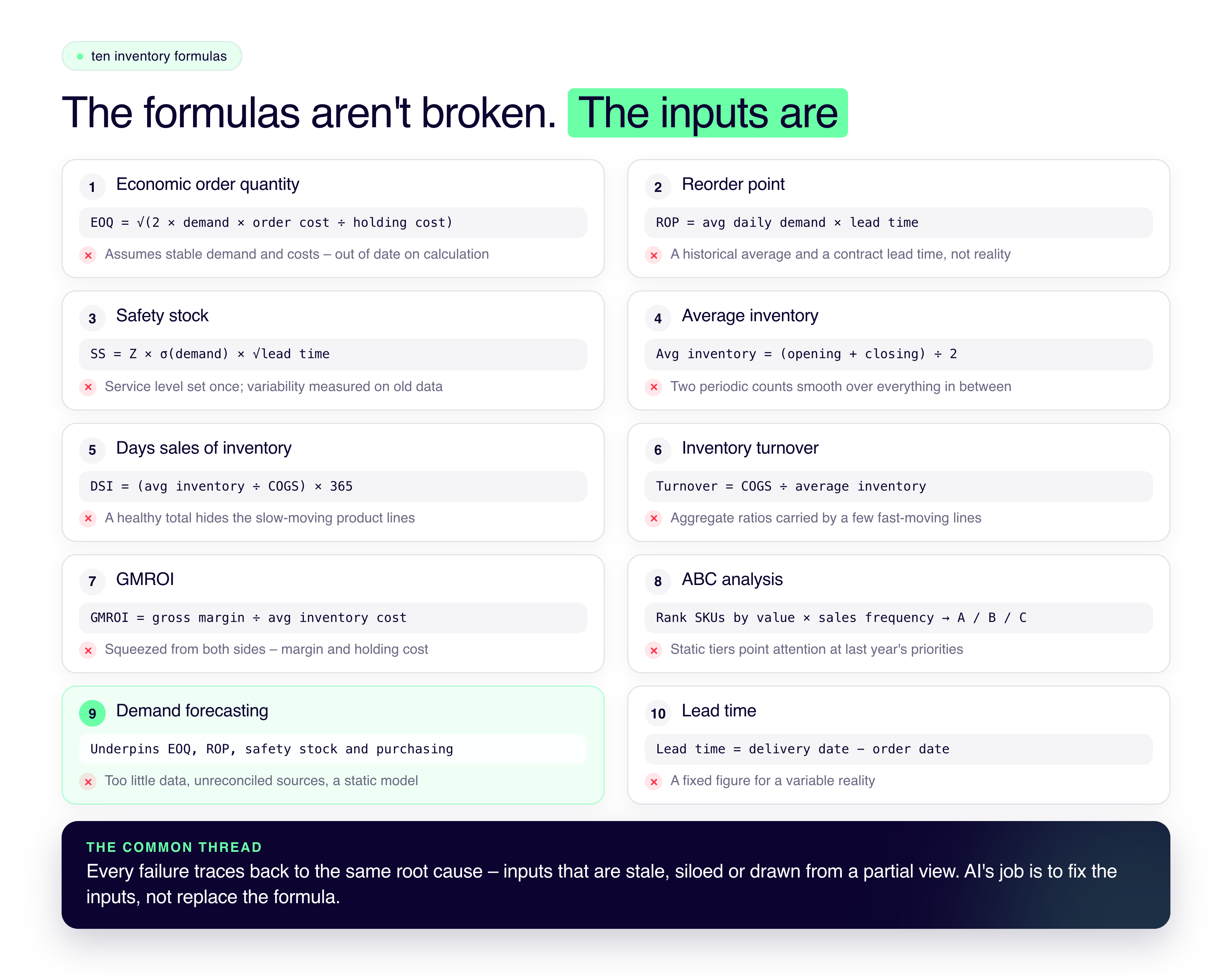
The ten inventory formulas every ops team should know are economic order quantity (EOQ), reorder point (ROP), safety stock, average inventory, days sales of inventory (DSI), inventory turnover, gross margin return on investment (GMROI), ABC analysis, demand forecasting and lead time. The math hasn't changed in decades and doesn't need to what breaks in practice is the data feeding it: stale demand averages, contract lead times that don't match reality, and inventory counts from periodic audits. Get the inputs right and the classic formulas still work; AI's job is to fix the inputs, not replace the formula.
TLDR
Inventory formulas have been around for decades. EOQ, ROP, safety stock, DSI, turnover ratios: the math hasn't changed. What has changed is how well those formulas can actually perform when the inputs feeding them are accurate, dynamic, and drawn from a unified data source rather than a spreadsheet someone updates on Fridays.
Key takeaways:
Every core inventory formula is only as good as the data going into it. Bad inputs produce confident-looking wrong answers.
The most common failure points are demand forecasts based on incomplete data and lead time figures that don't reflect actual supplier performance.
AI doesn't replace inventory formulas. It makes them more accurate by improving the quality and responsiveness of the inputs.
Kleene.ai's KAI Analytics Suite includes pre-built AI demand forecasting and inventory management models that sit on top of unified data from your entire stack, so the formulas you've always relied on are working with the best possible inputs rather than last month's export.
Why inventory formulas still matter in 2026
There's a tendency in conversations about AI and inventory management to imply that machine learning has made the classic formulas obsolete. That's not the right framing.
EOQ is still the right tool for minimizing order and holding costs. Safety stock is still how you buffer against demand variability and supplier unreliability. ABC analysis is still the most practical framework for prioritizing where your management attention goes. These formulas represent decades of operational logic and they work, when they're fed accurate, current data.
The problem most ops teams actually face isn't that the formulas are wrong. It's that the inputs are unreliable. Demand forecasts built on stale or incomplete data. Lead times pulled from a supplier agreement rather than actual delivery history. Safety stock levels set once and never revisited. Average inventory figures calculated from periodic counts rather than real-time tracking.
AI's role in inventory management is to fix the input problem, not to replace the formulas. Better inputs produce better outputs. That's true whether you're running a spreadsheet or a purpose-built analytics platform.
With that framing in place, here's a practical walkthrough of the ten formulas that matter most, what they're for, where they break down, and what better data infrastructure does to each one.
The 10 essential inventory management formulas, and why they fail without AI
1. economic order quantity (EOQ)
What it is: EOQ calculates the order quantity that minimizes the combined cost of placing orders and holding inventory. Too many small orders drives up ordering costs. Too few large orders ties up capital in stock. EOQ finds the point where those two costs are equal.
The formula: EOQ = √(2 × demand rate × ordering cost per order ÷ holding cost per unit per year)
Where it breaks down: EOQ assumes stable demand and stable costs. In practice, demand fluctuates seasonally, ordering costs shift with supplier agreements, and holding costs vary with warehouse utilization. Any of these in flux produces an EOQ figure that's already out of date the moment you calculate it.
What AI changes: A static EOQ calculated quarterly is less useful than a dynamic EOQ that updates as demand patterns shift. When demand forecasting is powered by machine learning models drawing on your full sales history, seasonal patterns, and external signals, the demand rate input becomes significantly more accurate. The result isn't a different formula: it's the same formula running on better data, recalculated more frequently.
2. reorder point (ROP)
What it is: ROP is the inventory level at which you need to trigger a new order to avoid running out before the next delivery arrives.
The formula: ROP = average daily demand × lead time in days
Where it breaks down: This formula is deceptively simple and deceptively fragile. It depends entirely on two figures that are often wrong: average daily demand (which may be based on a historical average that doesn't account for current trends) and lead time (which is often taken from a contract rather than actual delivery performance). When either is off, you either reorder too early and tie up capital, or too late and face a stockout.
What AI changes: AI-powered demand forecasting replaces a static average with a dynamic prediction that accounts for trend, seasonality, and anomalies. Lead time inputs can be drawn from actual delivery history rather than nominal supplier commitments. The combination produces a reorder point that reflects what's actually happening rather than what the spreadsheet was set up to assume.
3. safety stock
What it is: Safety stock is the buffer inventory you hold to absorb variability in either demand or supply. It's insurance against stockouts caused by demand spikes or late deliveries.
The formula: Safety Stock = Z × σ(demand) × √lead time
Where Z is the desired service level in standard deviations and σ(demand) is the standard deviation of demand over the period.
Where it breaks down: The two most common failure modes here are setting the service level once and forgetting to revisit it, and measuring demand variability using historical data that doesn't reflect the current environment. Over-estimated variability leads to excess safety stock tying up cash. Under-estimated variability leads to stockouts.
What AI changes: Dynamic safety stock adjustments, where the model continuously monitors demand variability and lead time fluctuations and recalculates safety stock accordingly, eliminate the "set and forget" problem. For high-SKU operations, this also scales in a way that manual recalculation can't: adjusting safety stock across thousands of SKUs in response to a demand signal is not a practical manual task.
4. average inventory
What it is: Average inventory gives you a baseline figure for how much stock you're typically holding over a period, used as an input into several other formulas including turnover ratio and GMROI.
The formula: Average Inventory = (beginning inventory + ending inventory) ÷ 2
Where it breaks down: This formula is only as accurate as your inventory counts. If beginning and ending figures come from periodic audits rather than continuous tracking, you can have significant intra-period fluctuations that the formula smooths over and ignores. The result is a figure that looks precise but may be materially misleading.
What AI changes: Continuous, automated inventory tracking replaces the snapshot problem with a real-time view. When your inventory data is flowing into a unified warehouse in real time from your e-commerce platform, ERP, and warehouse management system, average inventory becomes a meaningful figure rather than an approximation of two points in time.
5. days sales of inventory (DSI)
What it is: DSI measures how long, on average, your inventory sits before it's sold. A lower DSI means faster-turning stock and more efficient use of working capital. A higher DSI means slower-moving stock and capital tied up on shelves.
The formula: DSI = (average inventory ÷ cost of goods sold) × 365
Where it breaks down: DSI is most useful when tracked at the SKU or category level rather than across the whole business. A healthy overall DSI can mask product lines with seriously slow-moving stock. Without granular visibility, you don't know which products are dragging the figure up.
What AI changes: AI-powered segmentation and demand forecasting can flag slow-moving SKUs proactively, before they've sat long enough to materially damage DSI. Rather than calculating DSI retrospectively and asking "what went wrong?", predictive models can identify at-risk products earlier so action can be taken on pricing, promotion, or purchasing.
6. inventory turnover ratio
What it is: Inventory turnover measures how many times you sell through and replace your inventory over a period. High turnover generally indicates strong demand and efficient stock management. Low turnover indicates overstocking or weak demand.
The formula: Inventory Turnover = cost of goods sold ÷ average inventory
Where it breaks down: Like DSI, aggregate turnover ratios can hide significant variation at the product or category level. A business with a healthy overall turnover can still have product categories with serious overstocking problems if the aggregate figure is carrying a few fast-moving lines.
What AI changes: Category-level and SKU-level turnover analysis, updated continuously rather than calculated quarterly, gives operations teams the granularity to act on problems while they're still manageable. AI demand forecasting also improves the forward-looking version of this analysis: rather than calculating what turnover was, you can model what it's likely to be given current demand trends, and adjust purchasing accordingly.
7. gross margin return on investment (GMROI)
What it is: GMROI connects inventory investment to profitability. It asks: for every dollar tied up in inventory, how much gross margin are you generating? It's the formula that bridges the gap between operations and finance.
The formula: GMROI = gross margin ÷ average inventory cost
Where it breaks down: GMROI is sensitive to both sides of the calculation. Margin pressure from discounting or cost increases reduces it from one direction. Excess inventory holding costs reduce it from the other. Without visibility across both, it's hard to know which lever to pull.
What AI changes: AI price elasticity modeling, available as part of Kleene.ai's KAI Analytics Suite, helps operations and commercial teams understand how price changes affect margin without killing demand. Combined with inventory optimization, GMROI can be actively managed rather than just reported on after the fact.
8. ABC analysis
What it is: ABC analysis segments your inventory into three tiers based on value and sales frequency: A items are high-value, lower-frequency; B items are mid-value, moderate-frequency; C items are lower-value, higher-frequency. The purpose is to direct management attention toward the inventory that matters most.
How it breaks down: Static ABC classifications become stale as sales patterns change. A product classified as C at the start of the year might become A-tier by peak season. If the classification isn't updated, management effort stays pointed at last year's priorities rather than this year's.
What AI changes: Dynamic reclassification, where SKU categorizations update automatically based on real-time sales and value data, keeps ABC analysis current without requiring manual quarterly reviews. For businesses with large SKU counts, this is the difference between a useful prioritization framework and a theoretical exercise that nobody updates.
9. demand forecasting
What it is: Demand forecasting is technically a process rather than a single formula, but it underpins almost every other metric on this list. If your demand forecast is wrong, your EOQ is wrong, your ROP is wrong, your safety stock is wrong, and your purchasing decisions are wrong.
Where it breaks down: The most common failure modes are using too little data (just your own historical sales, without external signals), using data that isn't clean or unified (sales figures from three different systems that don't reconcile), and using a static model that doesn't update as the market changes.
What AI changes: This is where AI delivers its most significant value in inventory management. Machine learning demand forecasting, like the pre-built models in Kleene.ai's KAI Analytics Suite, draws on unified historical data, identifies seasonality and trend patterns that spreadsheet models miss, and produces SKU-level forecasts that update continuously. The difference between a demand forecast built on a three-year average and one built on a machine learning model running on clean, connected data can be substantial, particularly for businesses with complex seasonal patterns or a wide product range.
10. lead time
What it is: Lead time is the gap between placing an order and receiving it. It feeds directly into ROP and safety stock calculations. If your lead time figure is wrong, both of those formulas will be wrong.
The formula: Lead Time = order delivery date − order placement date
Where it breaks down: Most businesses use a nominal lead time from their supplier agreements rather than tracking actual delivery performance. In practice, lead times vary: they stretch during peak periods, shrink when suppliers are overstocked, and fluctuate unpredictably when logistics networks are disrupted. Using a fixed figure for a variable reality produces systematically wrong reorder points.
What AI changes: When your delivery data flows into a unified data warehouse alongside your inventory and sales data, actual lead time performance becomes trackable at the supplier and SKU level. AI can then identify patterns in lead time variability, flag suppliers whose performance is drifting, and feed more accurate lead time inputs into your ROP and safety stock calculations. Proactive supplier performance monitoring shifts lead time from an assumption to a measured variable.
The common thread: data quality determines formula quality
Run through the ten formulas above and a consistent pattern emerges. Every formula has a clear logic. Every formula also has a specific way it can fail, and in almost every case, the failure comes back to the same root cause: inputs that are inaccurate, stale, or drawn from a partial view of the business.
EOQ fails when demand estimates are wrong. ROP fails when lead times don't reflect reality. Safety stock fails when variability is measured on outdated data. DSI and turnover fail when average inventory figures come from periodic snapshots rather than continuous tracking. Demand forecasting fails when the underlying data is siloed across systems that don't talk to each other.
The formulas aren't broken. The data infrastructure underpinning them often is.
This is the problem Kleene.ai is built to fix. By connecting 200+ data sources, including your ERP, e-commerce platform, warehouse management system, and supplier data, into a single governed data warehouse, Kleene.ai ensures that the inputs feeding your inventory calculations are accurate, unified, and current. KAI Analytics' pre-built demand forecasting and inventory management models sit on top of that unified data layer, producing forecasts and recommendations that would take a dedicated data science team months to build from scratch.
The result isn't a replacement for the formulas operations teams have relied on for decades. It's those same formulas running on significantly better data, updated continuously rather than quarterly, and surfaced through an analytics layer that doesn't require SQL skills to use.
If your inventory calculations are only as good as last month's export, it might be worth looking at what a unified data layer actually changes.



%201.svg)
