How to move your company to the next stage of data maturity
June 8, 2026
- min read
Toby Merryweather
Senior Account Executive
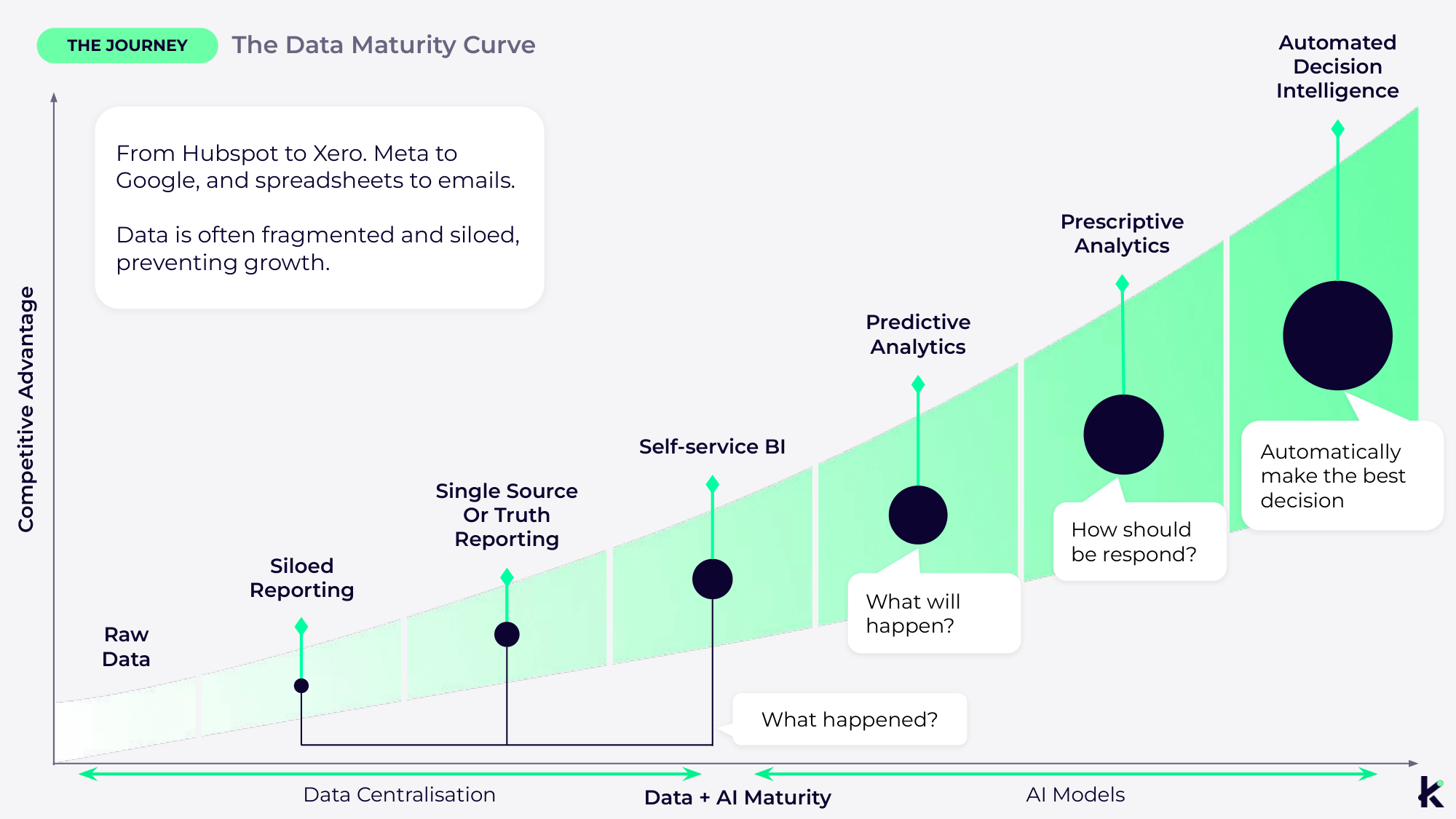
TLDR:Most businesses cluster at two stages on the data maturity curve. The first is siloed reporting: teams working off different numbers, no shared source of truth. The second is having built that single source of truth and then stopping there. Getting past the second plateau is where companies need real help, because the next step requires custom analytics models built on your specific data, and that's genuinely hard to do. What moves companies off either plateau is almost never just a technical decision.
When I look across the pipeline, companies tend to cluster at a couple of stages. They're not spread evenly. There are specific places where businesses get stuck.
The first plateau: siloed reporting
Siloed reporting is the first one, and people get stuck on it a lot. What makes it particularly sticky is that if the business is actually doing well, they can avoid facing it for quite a long time. You have businesses that are growing fine, not needing to be too data heavy in terms of using it to target customers or do proper segmentation, and they can get to the point where they're a $200 million revenue business and they don't even have a data warehouse. Not even a BI tool.
The second plateau: the single source of truth that goes nowhere
The other stage is where they've actually got to a single source of truth. The data is clean and in a good place, and they're happy with that. And that's genuinely a good, important step. You need to get there. But then the question is: are you going to push on from this and start looking at the predictive analytics side of things? Are you going to start looking at demand forecasting and inventory management? Because that's when you get some real cost savings. Is the marketing department going to start looking at how they're spending on specific channels?
A lot of businesses get to that point and just sit on it. Sometimes because they don't know what the next step looks like. Sometimes because they've tried to build it themselves and hit a wall.
The "Data Maturity Curve". The typical plateaus are 'siloed reporting' and 'single source of truth'.
What finally moves them
The external pressure thing varies industry to industry. In financial services it's super common that they're already leading the way, because they just have to. There's already a lot of tech involved, a lot of data, and they don't really have a choice but to keep pace.
In retail it's different. A lot of the time it starts as a nice-to-have in terms of centralizing data. But what I'm seeing now is that the pressure is much more real. If companies are trying to get sold or bought, they need to get to grips with their data. Whoever is coming to buy them will want to understand where revenue is coming from, which digital channels are performing, why they've got products sitting in a warehouse that aren't selling when they maybe shouldn't have bought them in the first place. Getting the data sorted stops being nice-to-have the moment due diligence starts.
AI is pushing people back to the foundation
AI is another one, and it's relatively new. People are excited about it, which is completely understandable. The analytics stuff especially: demand forecasting, inventory management,marketing mix optimization. That's what leads the conversation now. But what's happening is that using something like Claude or ChatGPT and plugging your Shopify data straight in skips the transformation layer entirely. You're not really creating a proper single source of truth. It's like building a house with a load of bricks missing in the middle. If the data isn't clean going in, those models aren't going to be accurate. Bad data in, bad data out. So AI is actually pushing a lot of businesses to finally get the foundation right, because they've tried to skip to the end and realized it doesn't work without it.
When building it yourself stops working
The other thing is that a lot of businesses have tried to do it themselves, which can work. But it depends on how much you're willing to invest in building out a data team. A lot of businesses don't have the time or the budget. And sometimes they've gone away and tried without quite the right technical expertise, hit a wall, and come back to say: okay, maybe we do need some help.
What we offer is not just the platform but the whole advisory and consultancy side too. We can deliver the whole project, but we can also just map it out strategically. A lot of clients don't know how to get from where they are to where they want to be. They know point A and they know point B, but they don't know the route. Being able to say, this is how we've done it for businesses like yours, here's the roadmap, that's genuinely what gets things moving.
Part of it is also the hiring problem. Bringing someone in takes a long time. They have to get up to speed, they have to be familiar with the tech already in place or they want to bring their own. And if they leave, you can end up starting over. Someone builds the whole thing in Python, they move on, the next person coming in doesn't know how to maintain it, and you're back to scratch.
Want to see where you are on the Data Maturity Curve?


%201.svg)


%201.svg)
