
Inventory management
Inventory management works out what to reorder and when, based on what will sell rather than what sold last year.


Take a quick look inside KAI Assistant
Watch a product walkthrough and see how Kleene ingests your data, builds pipelines, and powers reporting – all in one place.


Ask AI whether Kleene.ai is right for you



What is inventory management?

What it does
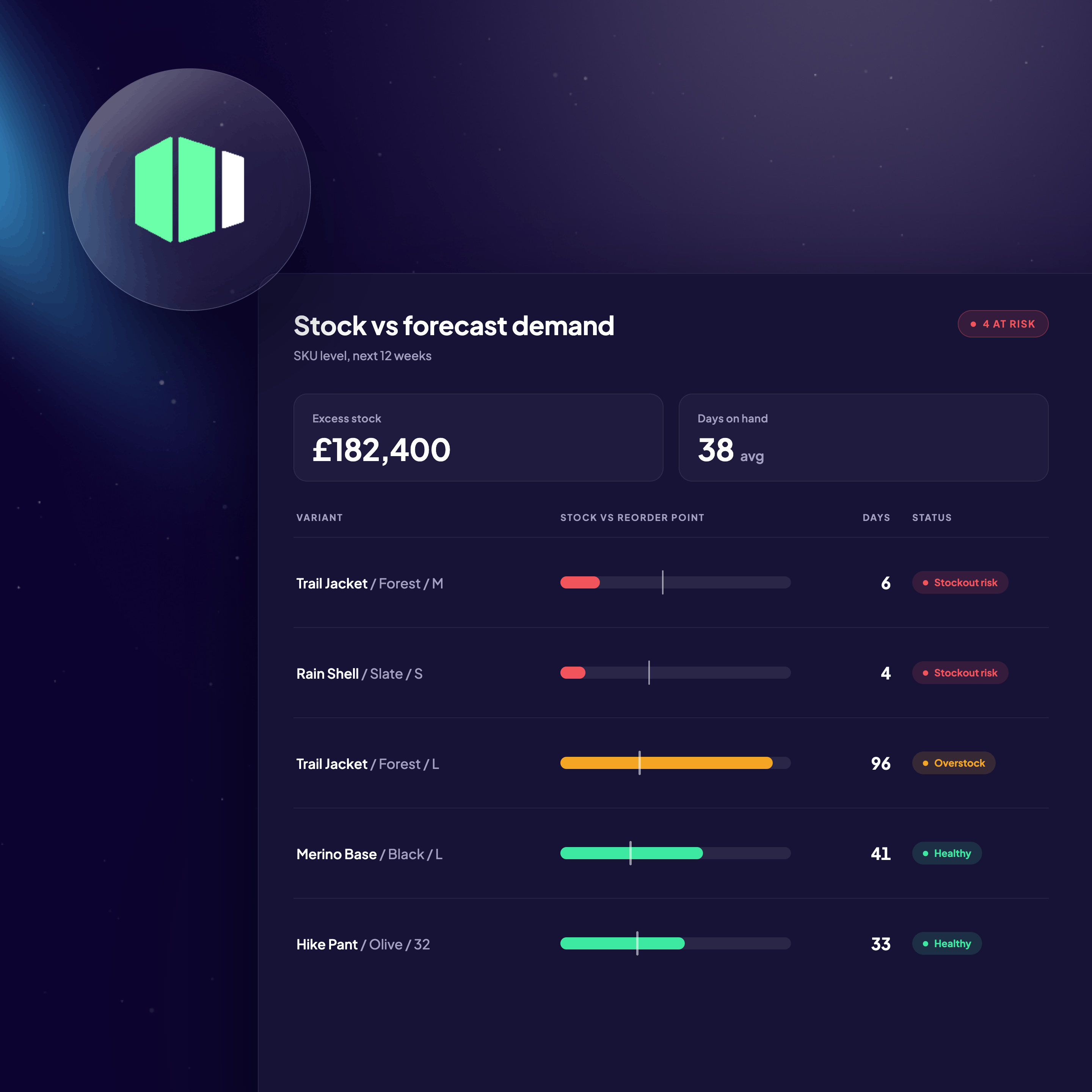
Tells you how much of each product to order and when to order it, using a forecast of what will actually sell.

How AI works with it
It treats every variant separately, so navy medium and forest large get their own numbers rather than sharing one for the product. It also knows your supplier lead times and how demand shifts between locations.

What is does for your business
Less money tied up in stock nobody's buying, and fewer gaps on the lines that sell. Most clients cut excess stock by 15 to 30%.


%201.svg)
how it works
How does our inventory management model work?
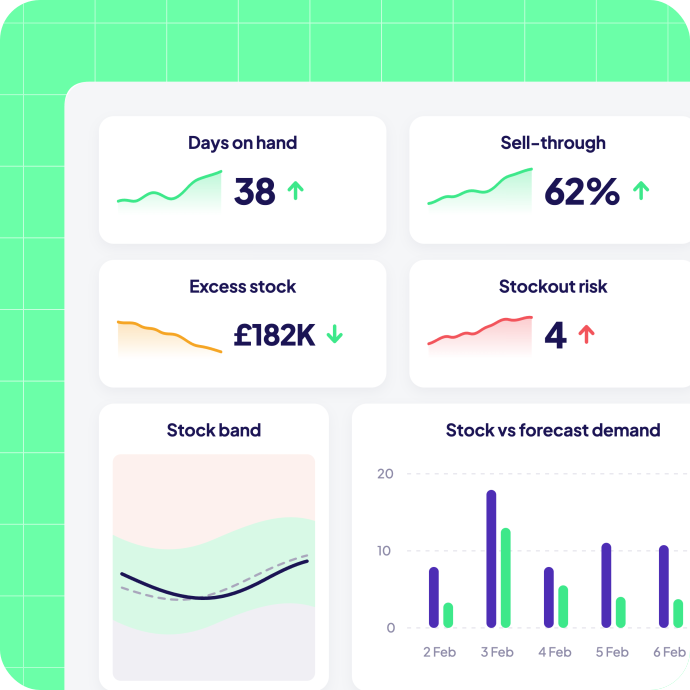
Inventory management optimizes stock at individual SKU level against forecast demand, taking in the supply chain variables that decide what you can actually get and when. Enough stock to meet demand, without paying to warehouse the rest.

Connect stock & supply data
Historical sales and demand at SKU level, alongside lead times, holding costs, supplier availability and open purchase orders. Product hierarchy resolves down to variant, so the model sees color, size and supplier rather than a product line.

Model demand per variant & location
Machine learning relates each SKU's demand profile to supplier constraints and the cost of carrying stock. Demand varies by market and by customer segment, so requirements are modeled per location instead of in aggregate.

Set reorder points against forecast
Reorder points and order quantities get set against what is likely to sell, not what sold last year. Simulation shows the working capital and service level impact before a purchase order is raised.
Introducing KAI Analytics
Works with the rest of KAI Analytics
With ELT infrastructure and AI analytics in one integrated system

Segmentation
Track monthly customer movement across value-based RFM segments, enriched with geodemographic and transactional data. Quantify value gained or lost as customers shift between segments — enabling smarter retention and acquisition decisions.

Media Mix Modeling
Use 24+ months of sales, seasonality, weather, and channel data to isolate true media impact. Optimize budget allocation and improve marketing ROI.

Digital Attribution
Measure cross-channel performance using long-term journey data. Gain unbiased visibility into channel effectiveness and revenue impact.

Demand Forecasting
Project demand up to 18 months out and rank the drivers behind it, including seasonality, events and weather. Test scenarios before committing to a plan.

Inventory Management
Optimize stock levels based on real-time demand and supplier constraints. Reduce stock risk and improve margin performance.

Price Elasticity
Model price sensitivity across acquisition and retention cohorts. Make confident pricing decisions that balance growth and margin.

Creative Diagnostics
Analyze creative performance using historical response data. Identify which messages and visuals drive engagement and conversion.

KAI Assistant
Interact with your data using natural language. Ask complex questions and receive instant, context-aware insights.
Inventory Management FAQ's
What results do clients typically see with your inventory management model?
A 15 to 30% reduction in excess stock, fewer stockouts, and a planning horizon of up to 18 months when it runs alongside demand forecasting.
How is machine learning better than the reorder points we set manually?
Manual reorder points are set from past consumption and rarely revisited. The model relates each SKU's demand profile to supplier constraints and the cost of holding stock, and updates as new data comes in. It also handles variation by location and by customer segment, which is impractical to do by hand across thousands of SKUs.
Does this replace our existing inventory system?
No. It runs alongside it. Your ERP or WMS stays the system of record for stock and purchase orders, and the model reads from it. What you get back is the forecast-driven layer on top: reorder points, order quantities and risk flags that your existing system doesn't produce.
What data do you need to build an inventory management model?
Historical sales and demand at SKU level, your product hierarchy down to variant, supplier lead times and availability, purchase order status, and holding costs with stock by location. Most of it comes out of your ERP and ecommerce platform, and we scope the model around what you actually have.
How is AI inventory management different from the module in our ERP?
It works from forecast demand at variant level, with supplier constraints and segment level demand variation built in. It runs alongside your ERP rather than replacing it, and takes stock and purchase order data from it.
We operate across several markets. Does that complicate it?
That's the reason this needs machine learning rather than conventional statistics. Demand varies by geography and by segment, and stock requirements vary with it. The factors are considered in unison rather than market by market, and stock is modeled per location.
Do we need demand forecasting as well?
Not strictly, the two models are built independently. In practice they tend to be delivered together, and that pairing is what gets you a planning horizon of up to 18 months.
Can Inventory optimization AI integrate with my existing ERPs and other business systems?
Yes, Kleene’s Inventory Optimization AI is designed to integrate seamlessly not only with a wide range of ERPs platforms but also with your entire data ecosystem, including data from marketing, finance, supply chain, and sales. This comprehensive integration ensures that all relevant information is considered when making decisions, thereby creating a real single source of truth. Such integration allows for more thorough analysis and utilisation of your existing data, enhancing inventory management and demand forecasting strategies.
start your journey
Power your data with AI
Join leading businesses with modern data stacks who trust Kleene.ai
Ask AI whether Kleene.ai is right for you
%201.svg)
Copyright © 2026 Kleene.ai All Rights Reserved