Most marketers know the phrase "marketing mix modeling" and almost none of them agree on what it means. Some hear a 1960s statistics exercise. Some hear a vendor pitch. Some hear the thing their agency does once a year that nobody fully trusts. All three are a little bit right, which is the problem. So before any history or methodology, here's the plain version: marketing mix modeling tells you which of your channels are actually working, how to redistribute budget between them, and what happens to sales if you move money around. That's it. Everything else is detail in service of those three jobs.
This guide covers what MMM is, how it got useful again, how it now fuses with digital attribution into something neither does alone, and the honest question most articles skip: whether your business is even at the scale where it pays off.
A short history, because the history explains the present
The "marketing mix" started in the 1950s as the 4 Ps: product, price, place, promotion. Useful for organizing a marketing plan, useless for measuring one, because it told you what your levers were and nothing about which ones moved sales. The 1970s brought the first statistical models that could quantify those relationships, but they needed serious computing power and stayed the preserve of large corporations who could afford it.
Through the 1980s, consumer packaged goods companies made MMM mainstream, using it to find the right balance of advertising and promotion, and their results pulled everyone else in. Sarbanes-Oxley and tighter financial reporting pushed adoption further, especially in industries where marketing is a large line on the P&L, and a small consulting industry grew up to run the models for companies that couldn't.
Then cloud computing and machine learning did to MMM what they did to everything: collapsed the cost and the timeline. Models that once took months and a consulting retainer now run in hours, which is why a technique invented for Procter & Gamble is now within reach of a mid-market brand. The catch, and we'll come back to this, is that "within reach" and "worth running" still aren't the same line.
What MMM does, and the floor you need to clear
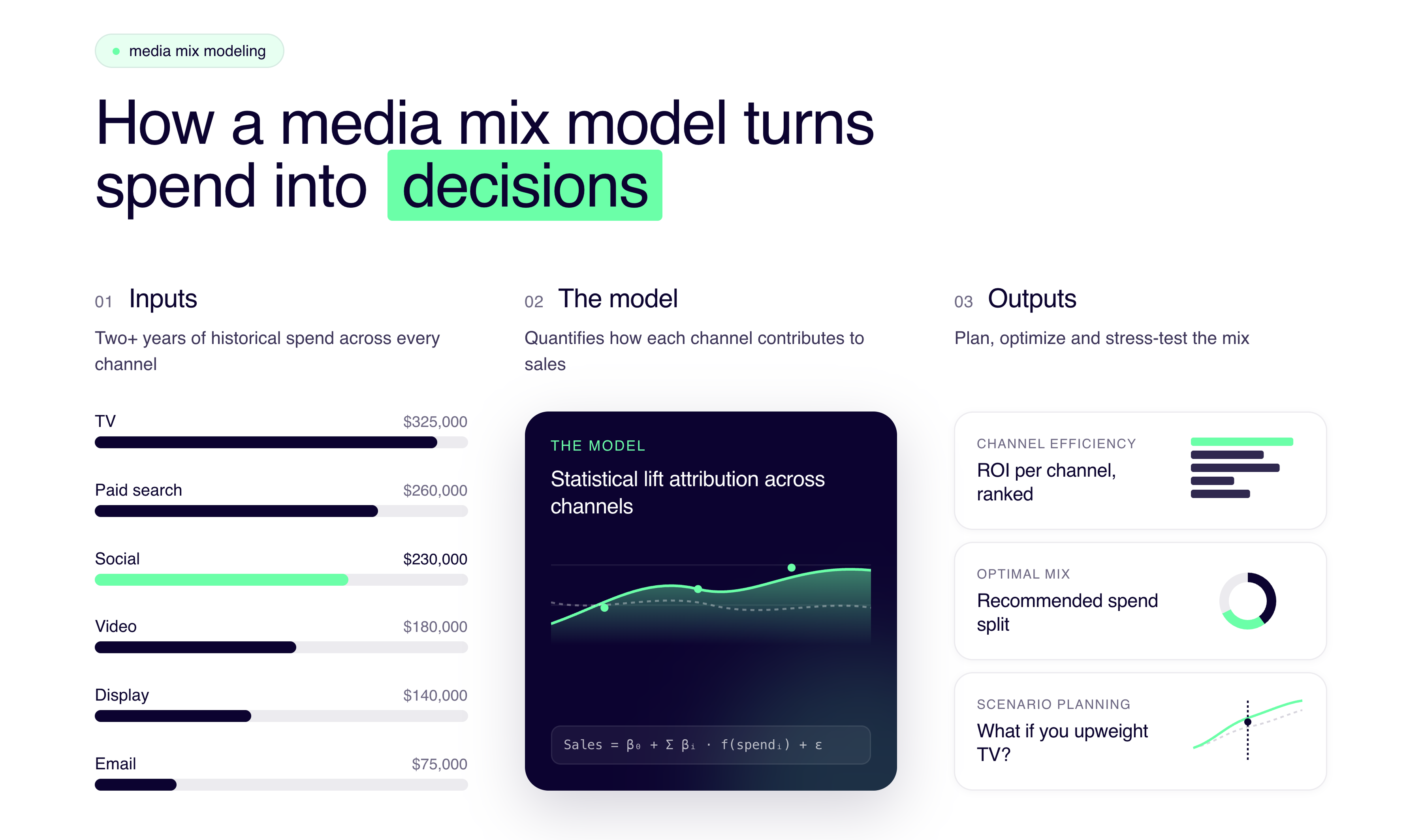
Modern marketing mix modeling looks at two or more years of media spend across every channel and answers three questions in order. First, how efficient is each channel, really. Second, how should the budget be redistributed so the mix is optimized rather than inherited. Third, what happens if you change it: upweight TV, cut PPC, push more into social. A good model lets you scenario-plan those moves against sales, conversion, and the value of sales before you spend the money, which is the difference between a forecast and a guess.
Here's the part the democratization story tends to skip. MMM earns its keep at scale, and the rough floor is somewhere around £750,000 to £1 million in annual media spend across channels. Below that, the spend isn't large enough or varied enough for the model to separate signal from noise, and you're better served by simpler measurement. This isn't gatekeeping, it's the honest answer to "should we do this," and a vendor who tells a brand spending £200k that they need an MMM is selling, not advising. Call it the scale-not-sophistication test: the question is rarely whether the technique is good enough, it's whether your spend is big enough to feed it.
Where MMM and digital attribution stop competing and start fusing
For years these were treated as rival measurement philosophies. They shouldn't be. They measure different things, and the interesting work of the last few years has been putting them together.
Digital attribution looks at the customer's journey at the individual touchpoint level, which is how you get past last-click. Last-click attribution dumps all the credit on the final interaction before a purchase, which everyone knows is wrong and most reporting still does anyway, because it's easy. The real question is which touchpoints actually influenced the buyer and by how much, and answering it means modeling the journey rather than rewarding whatever happened last.
MMM works top-down, telling you how channels perform in aggregate. Attribution works bottom-up, telling you how individual journeys unfold. Fuse them and the media-spend optimization that falls out of the MMM gets informed by what's actually happening at the touchpoint level, and you get a more complete picture than either produces alone. We go deeper on how that fusion works in our piece with our Chief Product Officer, but the short version is that the two models are related, so modeling them together beats modeling them apart.
The thing platform reporting can't do
This is the part worth being direct about, because it's where most brands' measurement quietly breaks. GA4 and platform-level reporting give you a fairly aggregate, high-level view, and they give it to you using only the data the platform can see. Google doesn't have your transactional data. It doesn't know what each customer is actually worth, what they bought before, or how the segments differ. It's modeling a partial picture and presenting it with confidence.
The advantage of bringing modeling in-house, against your own data, is exactly that missing layer. When the model can see the relationship between everything you know about your customers and how they respond to media, the output stops being generic and starts being yours. That's also why segments matter: one customer profile's price sensitivity and channel response is different from another's, and a model that averages across all of them tells you about a customer who doesn't exist. The useful version weights each segment and surfaces what's driving performance for each, rather than flattening them into a single misleading number.
Why this needed machine learning to become practical
If you imagine six models with a hundred factors each, you get a multidimensional picture where factors interrelate differently depending on who the customer is and what time of year it is. No human reconciles that by hand, and no spreadsheet holds it. Machine learning is the only thing that copes with that complexity at the scale real businesses operate at.
The real new development isn't the modeling, though, it's what sits on top of it. A model that produces a brilliant, accurate, multidimensional output that only a data scientist can read hasn't solved a marketing problem, it's relocated it. The shift worth caring about in 2026 is the natural-language layer: a head of marketing or a CMO asking a question in plain English and getting a grounded answer, instead of staring at modeling output trying to reconcile it manually. This is what Kleene's KAI Assistant does on top of the models, and it's the part that turns MMM from a quarterly report someone else interprets into a tool the marketing team actually uses.
How MMM fits into the KAI Analytics Suite
For full disclosure, this is where we describe our own approach. Media Mix Modeling is one model in Kleene's KAI Analytics Suite, and it doesn't run in isolation, which is rather the point of everything above. It sits alongside digital attribution, customer segmentation, price elasticity, demand forecasting, and inventory management, and because they share the same underlying data and orchestration layer, they inform each other rather than contradicting each other the way standalone tools tend to.
That integration is the bit most organizations can't build for themselves. Plenty are still building models independently, one team's attribution model that doesn't know about another team's forecast, and the interrelationships between them go unmodeled. Bringing the transactional data, the integrated models, and the natural-language layer together is hard, which is why working with an AI deployment partner tends to get a mid-market brand somewhere it couldn't reach alone. If you want the fuller technical version, our media mix modeling deep-dive is the place to go.
So, should you run one?
The honest decision tree is short. If you're spending under roughly £750k a year on media, an MMM is probably premature, and simpler measurement will serve you better until you grow into it. If you're above that line and you're still making budget decisions on last-click or platform reporting, you're almost certainly misreading which channels work, because the data those tools can't see is the data that changes the answer. And if you're running models but they're disconnected from each other and from your transactional data, the gap isn't more models, it's integration.
Most of the value in modern MMM comes from three things the old version couldn't offer: fusion with attribution, grounding in your own transactional data, and a natural-language layer that lets non-technical people actually use it. Get those three right and the model stops being a report you commission and becomes a question you can ask.
If you want to work out where your business sits on that decision tree, bring us your setup and we'll give you a straight read, including when the honest answer is that you're not ready for one yet. And if you're earlier in the journey and your data isn't consolidated enough to model anything reliably, our framework for choosing a data stack is the better place to start.


%201.svg)


%201.svg)
