MMM with AI: The 2026 Playbook for Smarter Marketing Spend
April 28, 2026
— min read
Media Mix Modeling is having a genuine renaissance in 2026. AI has cut the time and cost to build a model significantly. Cloud data infrastructure means the 24+ months of historical data a good MMM requires is accessible without a months-long data prep project.
Marketing attribution has been broken for a while, and this guide covers how AI is changing the way MMM works, how it can help SMBs optimise marketing spend more efficiently than ever before, and which tools are already making it happen.
TLDR
Cookie-based attribution is becoming less reliable, and platform-reported ROAS was always more optimistic than accurate. MMM gives you a platform-independent view of what each channel is contributing to revenue, built from data you own. AI has made it significantly faster and cheaper to build than it used to be. Marketing Spend Optimization takes the model output and turns it into concrete budget allocation decisions. Together they give marketing and finance a shared, credible framework for deciding where spend should go and why.
Why MMM is back
Last-click attribution was always a shortcut, but it is getting harder to rely on it. It gives most of the credit to the final click, ignores long-term brand effects, and misses offline channels.
Now that tracking is more restricted and platform numbers are less trustworthy, the gap between dashboards and reality is too big to ignore.
MMM is back because it does not need cookies or pixels. It uses your own spend and sales data over time to estimate what each channel truly contributes, while accounting for things like seasonality and promotions.
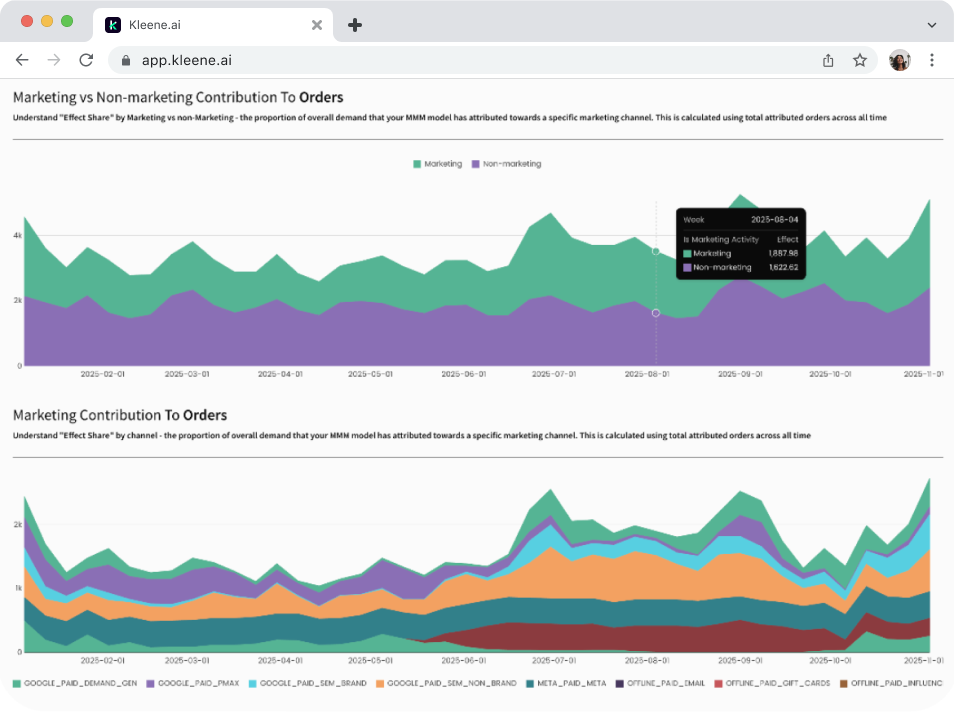
Example of Media Mix Modeling in the Kleene.ai app
How it works
You need historical marketing spend across channels (paid search, paid social, TV, radio, OOH, email, affiliates), alongside sales data and external variables that affect demand independently of marketing, with at least 24 months of data, ideally more. The more variation in spend patterns over that period, the better the model can separate signal from noise.
The modeling technique is econometric, typically Bayesian. The model estimates each channel's contribution to sales, accounts for carryover effects where spend this week drives sales next week or next month, and separates marketing-driven demand from the baseline that would have existed regardless of media activity.
The outputs are sales attribution by channel, optimal budget allocation recommendations, and scenario simulations for different spend configurations. Scenario planning is where it becomes useful in practice. A brand running paid search, paid social, and TV can model what happens to revenue if they cut TV by 20% and shift the budget to social, based not on platform ROAS but on a model of sales response over time.
One thing worth being clear about: MMM is not a real-time tool. It runs on historical data and is typically updated quarterly or annually. It tells you how your channels have been performing and gives you a framework for allocation decisions going forward.
What AI changes
Traditional MMM, the kind Nielsen and Kantar have sold to large enterprises for decades, is expensive, slow and costs six figures. Bayesian machine learning makes model fitting faster and more accurate with less data, so work that used to take a specialist statistician six months now takes weeks. The data infrastructure problem is mostly solved: getting two years of clean spend and sales data into one place used to be most of the project, but on a modern data platform it is a much smaller piece of the work.
Instead of rebuilding the model once a year, AI-native MMM can ingest new data regularly and update as conditions change, which matters significantly for businesses with real seasonality or frequent campaign activity.
Scenario simulation has improved as well. Older models gave you one recommended allocation. AI-native models run thousands of scenarios quickly, giving you a genuine view of the uncertainty range around any allocation decision rather than two or three point estimates that imply false precision.
None of this makes MMM simple, because you still need clean, consistent historical data and people who understand what the model is telling them. But the barriers that kept it enterprise-only for most of the last decade have come down enough that it is now a realistic option for businesses spending well under £10m on marketing.
Marketing Spend Optimization: the point of the whole exercise
Marketing Spend Optimization takes the MMM output and turns it into allocation decisions. Once you have a calibrated model of how each channel responds to spend, you can optimize against a target: maximize revenue within a fixed budget, hit a revenue target at minimum spend, or model the tradeoff between short-term ROAS and longer-term brand investment. That is why Kleene.ai treats MMM and MSO as a single integrated capability.
What it looks like in practice
A mid-market retailer allocating spend across paid search, paid social, TV, and email, with budget decisions based mostly on historical habit and platform ROAS. Paid search looked like the top performer on every dashboard. TV was difficult to measure so it kept getting cut.
After running an MMM across 30 months of spend and sales data, controlling for seasonality and promotional events, the picture looked different. TV was driving a larger share of baseline demand than anyone had credited, particularly in the weeks before peak season. Paid social ROAS was overstated once cross-channel double-counting was removed from the picture. Paid search was still valuable but over-weighted relative to its actual incremental contribution.
The MSO model ran scenarios against the findings. Reallocating around 20% of the paid social budget to TV and pulling back slightly on paid search, while holding total spend flat, was projected to increase revenue in the next peak season, with TV carryover effects building over time.
The point is not that TV always beats paid social. The point is that when all your data sits in one place, and a model sits on top of it, you get a clear view of the true efficiency of each channel. That makes budget decisions materially easier, because you can show the board and other decision makers why a reallocation is justified, using one set of credible, platform-independent numbers rather than competing dashboards.
2026 Market solutions
The MMM market has traditionally been dominated by specialist consultancies and large research firms. Nielsen, Kantar, Gain Theory, Analytic Partners, and Ebiquity all offer MMM as a managed service, typically at enterprise price points with project timelines measured in months. These providers suit large brands with dedicated marketing science teams, budgets above £500k in annual marketing spend, and the internal resource to manage a long consultancy engagement. The outputs are high quality, but the process is slow, expensive, and produces a snapshot rather than a continuously updated model.
For businesses that want to run MMM in-house, tools like Robyn (Meta's open-source MMM library) and Meridian (Google's equivalent) offer a code-first approach that gives data science teams direct control over the model. Both are free, well-documented, and actively maintained. The tradeoff is that they require a data scientist who knows what they are doing, clean historical data that has already been structured correctly, and time to build and maintain the pipeline around the model itself.
Newer SaaS entrants including Northbeam, Triple Whale, and Rockerbox sit closer to the attribution layer than true MMM, offering multi-touch and blended measurement models that work well for eCommerce brands running primarily digital channels. They are faster to set up than a full econometric model and more accessible for smaller teams, but they are less suited to businesses with significant offline spend or those that need to model long-term brand effects alongside short-term conversion activity.
Kleene.ai's MMM and MSO models sit inside the KAI Analytics Suite, running directly on your warehouse data. The data foundation is handled by Kleene's ELT platform: 250+ pre-built connectors pull spend data from Google, Meta, TikTok, TV buying platforms, and any other channel alongside sales data and external variables into a single clean warehouse. The 24+ months of historical data that MMM requires is assembled and maintained automatically rather than being a manual project. The model uses Bayesian econometric techniques and is updated on a regular cycle, so it does not go stale between annual engagements. It is designed for mid-market businesses spending between £1m and £20m on marketing annually who want the output quality of a specialist consultancy engagement without the timeline, cost, or dependency on an external team.
Stay in the loop
Subscribe to the Kleene.ai newsletter and be the first to hear about new guides, data trends, and product updates.



%201.svg)
