Media mix modeling and digital attribution: why your platform reporting isn't giving you the full picture
May 19, 2026
— min read
Ian Liddicoat
Chief Product Officer
TLDR:Media mix modeling looks at two or more years of media spend across all channels to tell you which are working, optimize how your budget is distributed, and let you scenario plan. Digital attribution models the individual touchpoints in a customer's digital journey, moving beyond last-click to understand which interactions actually influenced a purchase. We typically fuse the two together because they're related. The advantage over platform reporting like GA4 is that we bring all of a client's transactional data to the model, which Google simply doesn't have access to. The result is a much more bespoke and complete picture of what's driving performance.
Media mix modeling tends to look at two or more years of media spend, usually for organizations spending at least 750k to a million as a minimum across all channels. The purpose of that model is firstly to understand the efficiency of each media channel, then to optimize the media mix so that the distribution of spend between channels is optimized, and then to provide the client with an optimized media plan going forward and the ability to scenario plan. What happens if I upweight TV or downweight TV? What happens if I increase PPC, search, or social? What is the impact on sales, on conversion, on value of sales, and on a given customer segment?
It's a technique that's been around since the 1960s. What's changed in the last couple of years is the level of sophistication applied to the modeling, and then the ability to fuse that model with digital attribution.
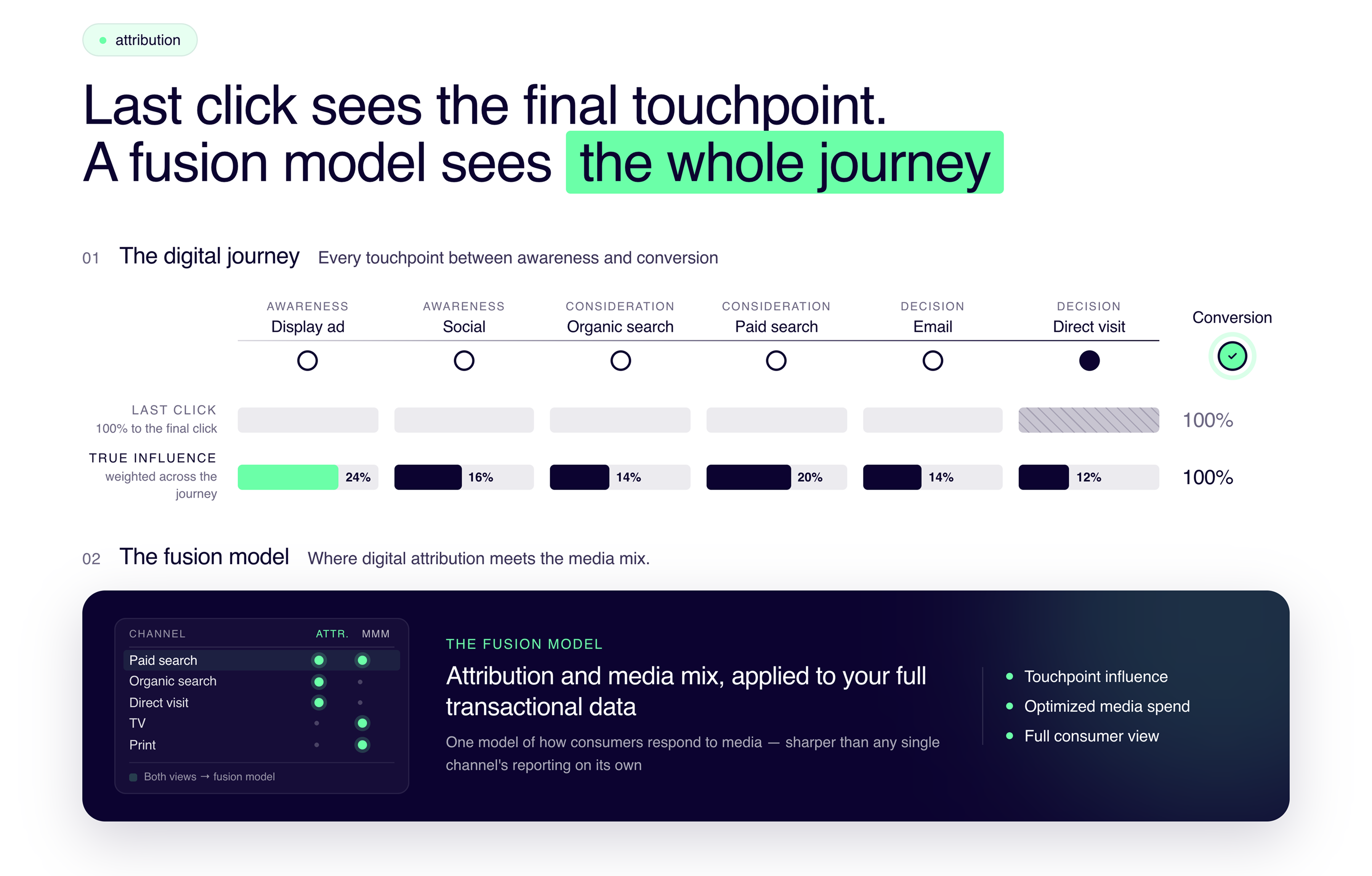
Attribution is about understanding the digital journey at the individual touchpoint level, in order to move beyond last click. Last click places all the value on the final interaction before a conversion, which is clearly not correct. The real question is which touchpoints have significantly influenced the buyer and to what extent. We tend to fuse the digital journey attribution model with the media mix model because the two are related. Media spend optimization comes directly from the media mix model as one of its outputs, but it's a more complete picture when it's informed by what's happening at the touchpoint level too.
The advantage we bring over something like GA4 or platform-level reporting is all the other transactional data we have access to. We understand the relationship between everything the client knows about their customers, and we apply our media mix model, our attribution model, or what we'd call a fusion model combining both, to that complete picture. So you have a full view of how a consumer behaves and responds to media, how that influences their digital journey, and the relative importance of individual touchpoints.
What Google shows you is a fairly aggregate, high-level view. They don't have access to the transactional data we see. Our models are much more bespoke and custom to the client's actual customer journey because of that.
The other thing worth understanding is that different customer segments respond to media differently. One segment profile will be different from other because demographics, behaviors, and needs are different. So profile X price sensitivity and response to a given media channel for a given product or service will be different from profile Y. The orchestration layer understands all of that from a media and pricing perspective at the individual level, applies weighting factors to each one, and surfaces what's actually driving performance for each segment rather than averaging across all of them.
Many organizations are still building models independently and not considering the interrelationships between them. If you imagine six models with a hundred factors each, you end up with a multidimensional picture where different factors interrelate differently depending on who the consumer is and what time of year it is. It's really only machine learning that can cope with that, and that's what generates output that KAI, as a large language model on top, can then interpret. The result is that a non-technical user, a head of marketing, a CMO, can make natural language queries of that data rather than looking at traditional modeling output and trying to reconcile it manually.
That's a really powerful proposition, and it's not where many brands are yet. But because we see transactional data, build models that are integrated, and put natural language capability on top through our KAI assistant, working with Kleene.ai as an AI deployment partner gives you access to something most organizations haven't been able to build on their own.


%201.svg)



%201.svg)
