My view is that Palantir holds ethical and moral positions on a number of issues that sit at the opposite end of the spectrum from the social democratic instincts you find across most of Europe. And right now their technology is embedded into the NHS and into a range of UK governmental organizations. That raises some real questions. Do you want infrastructure owned by a foreign company embedded inside highly sensitive institutions like the NHS? These aren't just my concerns. The same committee called on the government to trigger the 2027 break clause in the £330 million NHS Federated Data Platform contract, citing data security and the risk of locking public bodies into a single supplier they then can't easily move away from. Once that data is in, it's a fair question to ask what could be done with it, and by whom. Palantir, for its part, has rejected the criticism and argued its technology improves NHS operations.
Four reasons why Europe and the UK need to focus on data sovereignty in 2026
From Kleene's perspective, we're doing something that, at a fraction of the scale, looks structurally similar to what Palantir does. We'll take an SMB, take all the data sitting across its various silos, centralize it, and then put intelligence on top of it. The point is to make sense of that data and to surface the underlying relationships and correlations within it. The difference is that we're doing it from a UK perspective. We can't claim complete data sovereignty, because there are very few cloud providers outside the US, and I won't pretend otherwise. But our models are proprietary. They aren't shifting off to the US. And there's nobody who could, on political grounds, simply stop Kleene from operating. So in a sense we're a Palantir light. An ethical Palantir.
There's a human element to this that gets overlooked. We embed our consultants into the businesses we work with, because that's how you build understanding and earn trust. The AI is merely the backbone, the technology that allows us to operate inside these businesses and deliver the results they actually want. This isn't unique to us, either. Even OpenAI and Anthropic are moving in this direction with forward-deployed engineers. Everybody is heading toward this model, because to get trusted outcomes from a business or a government, you have to understand what that organization is actually doing. You have to ask the right questions in the first place, and that needs a human who has gone in, understood the organization, and can then deliver the right services on top of it.
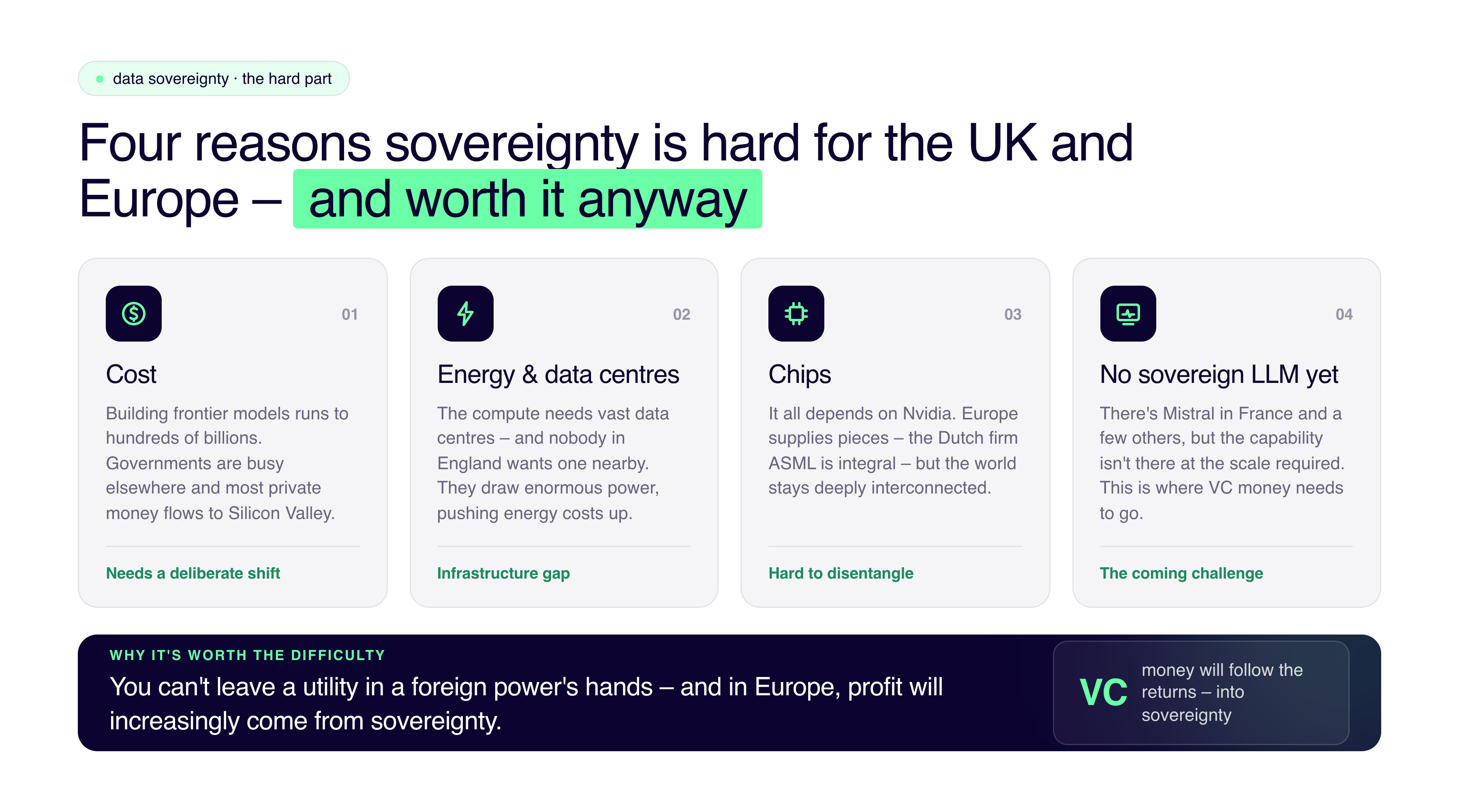
So that's the case for why sovereignty matters and what an alternative can look like. Now the hard part. Data sovereignty is expensive and difficult, for several reasons.
The first is cost. Building out large language models costs hundreds of billions of dollars. At the moment you're not going to get that from governments, because they have plenty of other things to worry about, and most of the private money is flowing to Silicon Valley. For that to change, there has to be a deliberate shift.
The second is energy and data centers. You need enormous data centers to power all of this, and the trouble in England is that nobody wants one in their back garden. They also consume a vast amount of energy, which means energy costs could rise as a result.
The third is chips. Nvidia makes the chips that all of this depends on. But there are European companies that supply components for those chips, and it's worth knowing about a Dutch company called ASML, which provides some of the pieces that are integral to Nvidia's chips. So even here, the world is still interconnected. It's very difficult to completely disentangle it.
And the fourth is that there isn't really a sovereign large language model in Europe or the UK yet. There's Mistral AI in France, and a few others being looked at, but at the moment the capability isn't there at the scale required. That's the challenge I think is coming over the next few years, and it's where a lot of venture capital needs to start going: into creating baseline large language models that are proprietary to Europe, because we don't have enough money in the UK to do it alone.
Unless, of course, the costs start coming down. It may well turn out that the companies spending hundreds of billions don't actually need to. Models can self-improve. There might be an open-source model you can take that then trains itself, at which point you no longer need to spend hundreds of billions to build something sovereign. We'll find out over the next few years.
Here's the part that should interest anyone thinking about where the money goes. VCs are only interested in returns, and that's fine. But in Europe, returns are increasingly going to come from businesses that can prove data sovereignty. So I think VC money will naturally start flowing in that direction. Profit and sovereignty aren't in tension here. Over the next few years in Europe, I think profit will increasingly come from sovereignty.
The reason all of this is worth the difficulty comes back to the principle. You can't have a foreign power holding complete control over a utility, and AI is becoming a utility. We would never allow another country to decide it could turn off our water or shut down our broadband. That might sound like the extreme end of the argument today. It may not sound so extreme in a few years. If you accept that AI is going to become critical infrastructure, then leaving it entirely in the hands of a foreign power that could one day change its mind is not a risk worth taking.


%201.svg)


%201.svg)
