How to unleash and boost customer engagement in retail in 2024
September 4, 2024
- min read
In the fast-paced and ever-evolving retail sector, navigating today's market complexities is more challenging than ever. Retailers confront a range of daunting challenges, from economic hurdles to overwhelming data volumes, alongside the need for specialised skills. Grasping these challenges and identifying viable solutions is crucial for any retail brand aiming to excel in this fiercely competitive landscape.
Recently, economic difficulties have become more pronounced. As consumers grow increasingly selective and budget-conscious, retailers face intensified competition. This competitive environment not only squeezes profit margins but also necessitates innovative strategies to attract and retain customers.
The surge in consumer choices today compels retailers to intensify their efforts to stand out. Success now demands more than just competitive pricing; it also requires excellence in quality, customer service, and distinctive value propositions.
Recent data reflects these market dynamics: Non-food retail sales saw a decline of 2.8% year-over-year in the three months leading to April. Particularly, online and high street sales in non-urgent categories like clothing and footwear have been lacklustre, as shoppers delay updating their summer wardrobes. Furthermore, total UK footfall in April dropped by 7.2% year-over-year, a significant fall from the -1.3% recorded in March, indicating a cautious consumer attitude towards spending. Source: British Retail Consortium
Managing the avalanche of data to enhance customer engagement in retail
A prevalent challenge for retailers today is the fragmentation of data across diverse platforms. From in-store systems to online sales channels, data frequently exists in silos, making comprehensive analysis and strategic decision-making complex. This fragmentation obstructs a holistic view of operations and market trends, complicating effective responses to evolving consumer behaviors. As retailers attempt to navigate the complexities of omnichannel environments, the lack of data integration not only hampers operational efficiency but also diminishes the ability to understand and anticipate market shifts. This disjointed approach to data management leads to missed opportunities, where critical insights are either delayed or entirely overlooked, resulting in strategies that may not fully align with current consumer demands.
Despite the abundance of data, achieving a unified customer view remains a significant hurdle. Retailers often struggle to integrate this data effectively, which impedes their ability to conduct detailed customer segmentation and predictive analytics. Without these critical insights, efforts to personalize the customer experience and enhance customer engagement in retail often rely on less precise methods. This can result in generic marketing strategies that fail to resonate with individual consumers, ultimately weakening brand loyalty and customer retention. In an era where personalized experiences are paramount, the inability to harness and unify data for actionable insights puts retailers at a disadvantage, limiting their capacity to engage customers in meaningful and impactful ways. By overcoming these data challenges, retailers can unlock the potential for deeper customer engagement in retail, more effective targeting, and a stronger, data-driven approach to market strategy.
Where to start? Practical steps to enhance customer engagement in retail
To maximise the impact of your marketing efforts through data-driven insights, it's essential to organise and leverage customer data effectively. Here's a marketing-focused guide to harnessing data to enhance your e-commerce strategy:
Step 1: measuring touchpoints and collecting data
Identify Key Touchpoints: Determine critical touchpoints along the customer journey, from initial awareness through purchase and post-purchase stages. Focus on collecting data that offers insights into customer behaviours and preferences.
Automate Data Capture: Employ automated tools to collect data efficiently from diverse sources such as website interactions, social media engagement, and online transactions. This includes implementing tools like Google Analytics and CRM software that integrate seamlessly to collect real-time data.
Step 2: unifying the journey
Centralize Data Storage: Consolidate all marketing data into a single, accessible database or cloud storage solution. This makes it easier to analyse and draw insights across different data sets.
Ensure Data Quality: Regularly clean and update your data to maintain its accuracy and relevance. This includes removing duplicates, correcting inconsistencies, and verifying the reliability of data sources.
Step 3: analysing marketing data
Utilise Advanced Analytics: Apply statistical tools and data visualisation software to analyse data. Look for trends, patterns, and insights that can guide your marketing strategies.
Segmentation: Segment your customers based on their behaviours, demographics, and purchase history to tailor marketing campaigns effectively.
Predictive Analytics: Use predictive models to forecast future customer behaviours, such as purchasing patterns or potential churn, which can help in crafting proactive marketing strategies.
Step 4: implementing insights
Real-Time Adjustments: Leverage real-time data to make quick adjustments to marketing campaigns, adapting to customer responses and market conditions.
Strategic Decisions: Base strategic marketing decisions on comprehensive data analysis. This includes determining budget allocations, choosing marketing channels, and planning promotional activities.
Feedback Mechanisms: Establish mechanisms to measure the impact of implemented strategies and gather feedback, which is crucial for refining future campaigns.
Step 5: continuous marketing optimization
Performance Review: Regularly review the performance of marketing strategies to understand their effectiveness and ROI.
Iterative Process: Continuously refine your marketing strategies based on data-driven insights and changing market conditions. Experiment with new approaches and tools to stay ahead in a competitive landscape.
By focusing on these steps, your marketing team can better harness the power of data to optimise strategies, enhance customer engagement in retail, and ultimately drive greater success for your e-commerce business.
Retail brands often lack the specific expertise, data insights and effective to implement effective customer engagement in retail strategies
Navigating the complexities of the retail landscape demands a mix of industry knowledge, data proficiency, and operational insight. However, locating individuals or teams equipped with this broad spectrum of skills is a formidable challenge, as such expertise is rare.
Often, business users within retail organisations take it upon themselves to develop independent solutions for specific challenges. While these efforts may provide immediate relief, they typically exacerbate data silo issues and lack the coordinated approach necessary to benefit the organisation as a whole.
Example:
Navigating Complexity in the Customer Journey
The evolving complexity of the customer journey, coupled with measurement challenges at various stages, has created significant hurdles for marketers in effectively coordinating acquisition strategies and budget allocation. Often, these difficulties lead to a disconnect between brand spend and performance measurement. Without a clear and integrated understanding of how each touchpoint influences consumer behaviour, marketers struggle to justify and optimise their spending on brand-building activities. This disconnect not only affects the efficiency of marketing campaigns but also risks undermining long-term brand equity in pursuit of immediate performance gains. It's crucial for marketers to adopt more sophisticated measurement tools and strategies that bridge the gap between brand spend and its impact on overall performance to ensure cohesive and effective marketing efforts.
What data should my retail business collect?
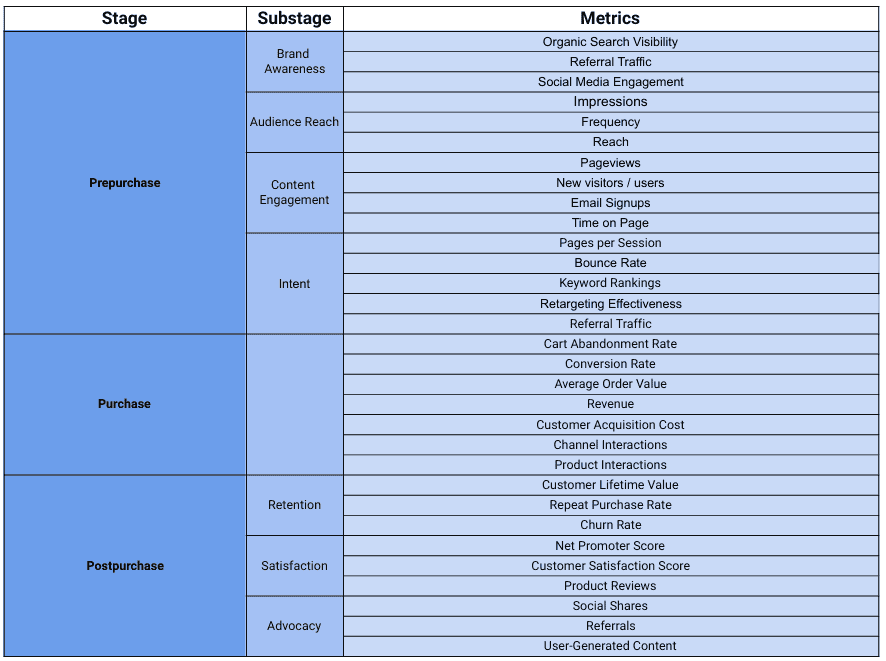
For an e-commerce brand, understanding different stages of the customer journey is crucial to tailor marketing strategies, improve customer experience, and ultimately drive sales and loyalty. Here's a breakdown of the information that an e-commerce brand would typically need at each stage of the customer journey, organised in a table format for clarity:
By gathering and analysing this information, e-commerce brands can create a more personalised shopping experience that aligns with customer expectations and drives engagement at every step of the journey. This strategy not only enhances customer satisfaction but also boosts loyalty and lifetime value.
How customer engagement leads to higher revenue
Effectively capturing and analysing data throughout the customer journey is crucial. By methodically collecting data at each customer touchpoint, retailers obtain a detailed understanding of consumer behaviours, preferences, and challenges. This rich data enables brands to craft highly personalised experiences that resonate with customers, enhancing loyalty and boosting conversion rates. Additionally, these insights help optimise marketing efforts and promotional strategies, ensuring messages reach the right customers at the opportune moment. A disconnected approach can lead to operational inefficiencies, which directly translate into diminished ROI.
Here are five key advantages of capturing data across the customer journey, each contributing to improved customer engagement in retail and higher ROI:
Personalised Marketing and Recommendations: Leveraging customer data allows brands to customise marketing approaches and product suggestions according to individual customer preferences and behaviours. This level of personalization results in more effective marketing, higher conversion rates, and greater customer satisfaction.
Enhanced Customer Insights: Data collected from various touchpoints offers deep insights into customer behaviours and trends, enabling brands to better anticipate customer needs, predict future behaviours, and design products and services that align with changing demands.
Optimised Customer Experience: Continuous data collection helps brands refine the customer experience at every interaction stage, from website navigation to post-purchase follow-up. Tailoring these interactions to meet customer expectations and preferences strengthens customer loyalty and increases lifetime value.
Improved Decision Making: Having access to detailed data equips retailers with the information needed to make informed, quick decisions. Whether adjusting marketing strategies, managing inventory, or personalising customer interactions, data-driven decisions enhance operational efficiency and effectiveness.
Increased Operational Efficiency: Automating data capture streamlines many aspects of customer engagement in retail and business operations, reducing manual efforts, minimising errors, and speeding up service delivery. This not only cuts costs but also elevates the overall customer experience, driving better ROI.
These benefits underscore the transformative impact of data capture for retail and e-commerce brands striving to remain competitive and profitable in a dynamically changing market.
Conclusion
Navigating the complexities of customer data to enhance engagement and drive business growth is no small feat, especially in the fast-paced world of retail. Effective customer engagement in retail requires a deep understanding of not only your customers' behaviors and preferences but also the ability to adapt and respond dynamically through your marketing efforts. By segmenting customers beyond basic demographics, customizing interactions to match the nuanced decision-making processes of different product categories, and continuously adjusting your marketing mix, you can significantly improve the effectiveness of your engagement strategies, leading to stronger customer relationships and increased loyalty.
At Kleene, we specialize in transforming data into actionable insights that propel your marketing initiatives forward and enhance customer engagement in retail. We understand that every business is unique, and so are its data challenges and opportunities. Through our advanced analytics solutions and expertise, we can help you segment your customer base more effectively, tailor your content and interactions precisely to individual preferences, and continually refine your strategies based on real-time customer feedback and behavior. This data-driven approach ensures that your marketing efforts are not only relevant but also impactful, driving sustained growth and success in the competitive retail landscape.
Want to learn more? there are three other ways you can get value from Kleene.ai:





%201.svg)
