Ask most people what the finance team does and they'll describe the rear-view mirror: closing the books, reporting last quarter, explaining variances after the fact. That picture is about a decade out of date. Financial planning and analysis has quietly become one of the most forward-looking functions in the business, and the teams that still treat it as historical reporting are the ones getting blindsided. This guide is about how that shift happened, what modern FP&A actually does, and the part nobody tells you: that a good FP&A function is now mostly a data problem wearing a finance job title.
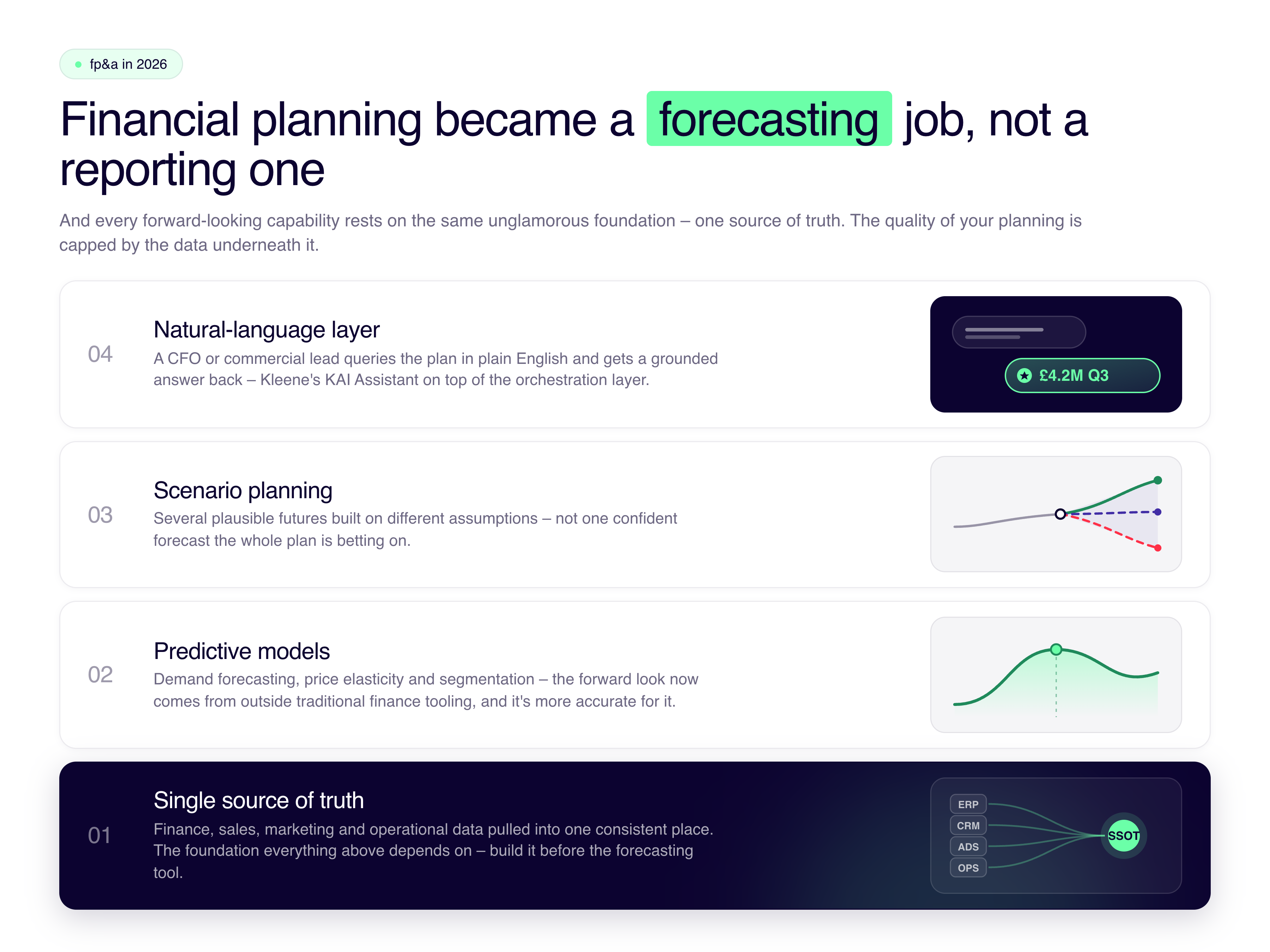
Four ways financial planning is changing from forecasting to predicting in 2026
From spreadsheets to steering the ship
FP&A started as accounting's quieter cousin: manual spreadsheets, basic budgets, historical reporting. It worked for telling you what happened. It was hopeless at telling you what to do next, a bit like steering a cargo ship with a paddle, because spreadsheets don't flex fast enough for a business that needs to react in weeks rather than quarters.
Dedicated financial modeling software changed the job from recording the past to modeling the future, and cloud platforms changed it again by making the underlying data live rather than monthly. The most recent shift is AI and machine learning handling the routine work, the data entry, the reconciliation, the first-draft reporting, which frees the team to do the analysis that actually moves decisions. Each step pushed FP&A further from "what happened" toward "why, and what's coming." The role didn't just get better tools. It changed what the job is for.
What modern FP&A actually does
The clearest sign of the shift is who FP&A talks to. Research suggests around 72% of CFOs now treat FP&A as a strategic asset rather than a reporting cost, and that reframing shows up in the day-to-day. Modern FP&A teams sit with sales to understand how pricing moves margin, with marketing to read the real return on spend, and with operations to cost out process changes before they happen. They're advisors who happen to speak in numbers, not scorekeepers reporting them after the whistle.
That partnering role demands something spreadsheets never did: the ability to explain a complex financial picture to people who don't think in financials, and to do it from data everyone trusts. Which is exactly where most FP&A functions hit a wall, because the analysis is only ever as good as the data feeding it, and in most companies that data is scattered across the ERP, the CRM, the billing system, and a dozen spreadsheets that disagree with each other.
The unglamorous truth: modern FP&A is a data problem
Here's the part the strategy articles skip. Every capability people now expect from FP&A, real-time reporting, accurate forecasting, scenario planning, depends on a foundation that has nothing to do with finance skill and everything to do with data plumbing. You cannot forecast revenue reliably from numbers that arrive late, in inconsistent formats, from systems that don't talk to each other. The most sophisticated forecasting model in the world produces confident nonsense if the inputs are wrong.
This is why a modern FP&A tech stack starts with a single source of truth rather than another planning tool. A data warehouse that pulls finance, sales, marketing, and operational data into one consistent place is the unglamorous prerequisite for everything else, and it's the step most teams skip because it's less exciting than the forecasting dashboard they actually wanted. Call it the foundation-before-forecast rule: the quality of your financial planning is capped by the quality of the data underneath it, and no model recovers from a bad foundation. (If your data isn't there yet, our framework for choosing a data stack is the place to start, because buying an FP&A platform before your data is consolidated is a common and expensive mistake.)
Where forecasting stops being a finance exercise
The interesting development is that the models FP&A leans on for its forward look increasingly come from outside traditional finance tooling, and they're more accurate for it.
Take the revenue line, the single most consequential number in any plan. Forecasting it well means understanding what actually drives demand, and that turns out to involve far more than last year's figures plus a growth assumption. External factors, seasonality, weather, retail events, matter more than most finance teams assume, and modeling them properly is a machine learning job rather than a spreadsheet one. We dug into exactly this in our piece on how demand forecasting works, and the headline is that a demand model grounded in real drivers gives FP&A a revenue forecast worth planning against, not a straight-line guess dressed up as one.
Margin is the same story from the other side. The biggest lever on profitability is usually price, and yet most organizations still set it on instinct or competitor benchmarking rather than on how sensitive their actual customers are. Price elasticity modeling, the technique airlines and insurers have used for decades, now works at the individual-customer level and lets a team scenario-test a price change before committing to it: what happens to conversion and margin if we move this price point for this segment. That's a finance question answered with commercial data, and we covered the mechanics in our piece on price elasticity.
The point isn't that FP&A should run these models itself. It's that the forward-looking finance function now depends on them, and the teams pulling ahead are the ones whose planning is wired into the same predictive models the rest of the business runs on, rather than forecasting in a finance silo.
Scenario planning, which is the whole job now
If there's one capability that separates modern FP&A from the spreadsheet era, it's scenario planning. Instead of betting the plan on a single forecast, good teams build several, each on different assumptions about the economy, demand, competition, and price, so the business can see a range of plausible futures and prepare for more than one. The 2020 lesson landed hard here: a plan built on a single confident forecast is fragile, and fragility is expensive when conditions move.
This is where the data foundation pays off most visibly. When demand, price, inventory, and segmentation models all run against the same trusted data, a finance team can ask real what-if questions and get coherent answers, rather than reconciling four models by hand and hoping. The hard part, and the reason most teams can't do it yet, is that those models have to be integrated rather than built in isolation, because the interesting questions live in how they interrelate. To what extent is price driving demand, and for which customer segment, is a question no single model answers alone.
The natural-language layer is what makes it usable
A forecast only changes a decision if the decision-maker can interrogate it. For years that meant a finance analyst sitting between the model and the executive, translating. The shift worth noticing in 2026 is that a CFO or commercial director can increasingly query this directly, in plain English, and get a grounded answer back. That's what Kleene's KAI Assistant does on top of the orchestration layer that monitors all those models together: it turns integrated financial and commercial data into something a non-technical leader can actually ask questions of, rather than a report they wait for.
For full disclosure, this is the part where we mention that this is what we build. Kleene's finance and FP&A solution exists because the bottleneck in modern financial planning is rarely the planning skill. It's the data underneath it and the integration across models, and that's a deployment problem more than a software-purchase one.
The honest version of where FP&A is heading
Strip away the trend pieces and the future of FP&A is simple to state. The function keeps moving from backward-looking to forward-looking, from reporting what happened to forecasting what will and scenario-planning what might. The tools will keep changing. The core purpose, giving leadership the financial intelligence to navigate uncertainty, doesn't.
What does change is the prerequisite. A decade ago, a strong FP&A team needed Excel skills and business judgment. Today it needs those plus a data foundation that most companies haven't built yet, and the teams that win the next few years will be the ones that treat that foundation as the actual project rather than an afterthought to the dashboard.
If you want to work out where your finance function sits on that path, and whether your data is ready to support the forecasting you want to do, bring us your setup and we'll give you a straight read, including the cases where the honest answer is that you need to consolidate your data before you buy another planning tool.


%201.svg)


%201.svg)
