Personalized pricing in 2026: how AI helps you find the optimal strategy
March 26, 2026
- min read
Henry Owen
Product Marketing Manager
Last Updated: July 2026
Personalized pricing, setting different prices for different customers or segments based on data - has moved from a competitive edge to a mainstream capability in 2026. AI has lowered the barrier significantly: what once required a dedicated data science team can now be deployed by retail and ecommerce teams using modern data platforms.
What is personalized pricing?
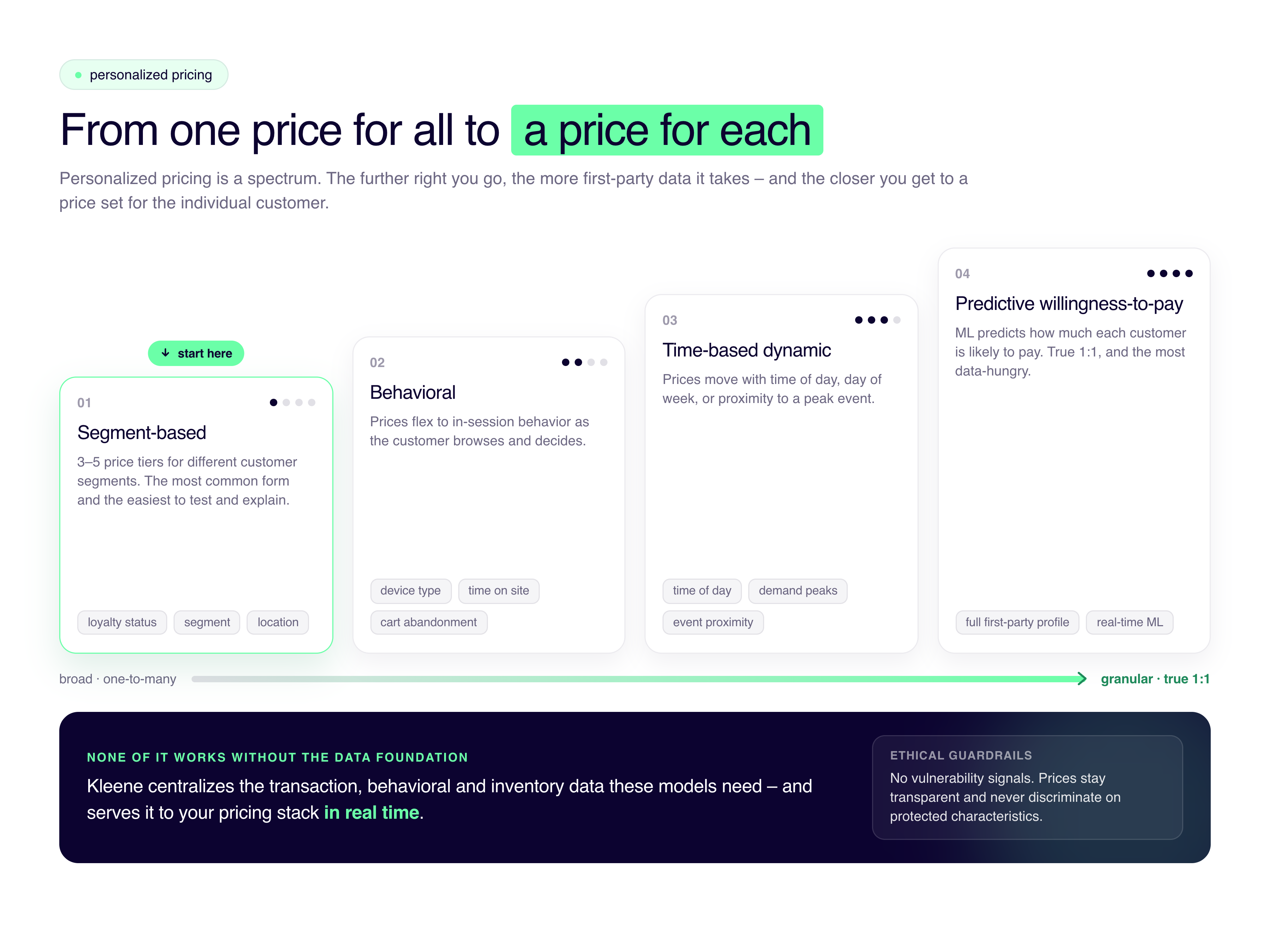
Personalized pricing (also called dynamic or individualized pricing) is the practice of offering different prices to different customers based on data signals such as browsing behavior, purchase history, loyalty status, location, device, and predicted willingness to pay. It sits on a spectrum from broad segment-based pricing to true 1:1 dynamic pricing driven by real-time ML models.
Different ways to implement personalized pricing, and why you need a data foundation to make it work
How AI has changed personalized pricing in 2026
Real-time data infrastructure. Cloud data warehouses can now process and serve pricing signals in milliseconds, enabling prices to update dynamically as customer behavior changes within a session.
First-party data maturity. Brands that invested in first-party data collection after the deprecation of third-party cookies now have rich behavioral profiles that power more accurate willingness-to-pay models.
LLM-augmented pricing logic. In 2026, some pricing platforms use large language models to interpret unstructured signals and factor them into pricing recommendations alongside quantitative signals.
Types of personalized pricing
Segment-based pricing: Different price tiers for different customer segments. The most common and legally straightforward form.
Behavioral pricing: Prices adjusted based on in-session behavior — device type, time spent, cart abandonment.
Predictive willingness-to-pay pricing: ML models predict how much a given customer is likely to pay. The most sophisticated form, requiring robust first-party data.
Time-based dynamic pricing: Prices vary by time of day, day of week, or proximity to an event.
Implementing personalized pricing in 2026: key steps
Audit your first-party data. Assess what you have: transaction history, browsing behavior, loyalty data, CRM profiles.
Define your pricing objective. Revenue per transaction, long-term CLV, market share, or margin? Many teams use a multi-objective approach.
Start with segment-based pricing, not 1:1. 3–5 segments with different price sensitivities is simpler to implement, test, and explain to customers.
Run controlled experiments. Always A/B test pricing changes. Measure impact on both conversion rate and revenue per visitor.
Establish ethical guardrails. Personalized pricing is subject to increasing regulatory scrutiny in the UK and EU in 2026. Don't exploit vulnerability signals, maintain price transparency, and ensure prices don't discriminate on protected characteristics.
Common pitfalls
Optimizing for short-term revenue at the cost of trust. Customers who discover they paid more than others often churn.
Ignoring price elasticity by product category. Staples are typically inelastic; discretionary items are more elastic. Model them separately.
Not connecting pricing to inventory. Integrate your inventory data into your pricing logic.
How Kleene.ai supports personalized pricing
Kleene.ai centralizes the transaction, behavioral, and inventory data that personalized pricing models require, and makes it available in real time to your pricing and ecommerce stack.


%201.svg)


%201.svg)
