What is an attribution model in marketing? Top 5 proven attribution model of 2024
September 3, 2024
- min read
Henry Owen
Product Marketing Manager
In the complex world of digital marketing, understanding what is an attribution model and the impact of various marketing efforts on consumer behaviour is crucial. This is where an attribution model comes into play. An attribution model in marketing is a framework used to assign credit or value to different marketing touchpoints throughout a customer's journey. It helps marketers understand which channels, campaigns, or interactions are driving conversions and contributing to sales. This article explores the concept, importance, types, and challenges of attribution models in marketing.
Despite how overwhelming this appears, we will break it down into manageable steps today. The most popular attribution models and their meanings will be quickly reviewed first. Afterwards, we will quickly review why you wish to use various models instead of others.
What is an attribution model: introduction
The concept of attribution in digital marketing
From doing a product search online to completing a purchase and all the steps in between, attribution modelling helps marketers analyse and credit marketing touchpoints at each phase of the customer journey.
Marketers can use attribution models to find out what aspects of their marketing strategy are generating the most leads for a certain stage of the sales funnel.
Multi-touch modelling allows you to allocate credit across several touchpoints to understand the impact of marketing interactions on the sales funnel.
Why attribution models matter for marketers
Attribution models are vital tools for marketers. With the help of these models, we can see how various marketing channels and strategies perform. The importance of attribution models for marketers can be summarised as follows:
Types of attribution models
In the realm of digital marketing, various types of attribution models are used to understand and credit the impact of different marketing touchpoints on a consumer's decision-making process. Here's an overview of the most commonly used attribution models:
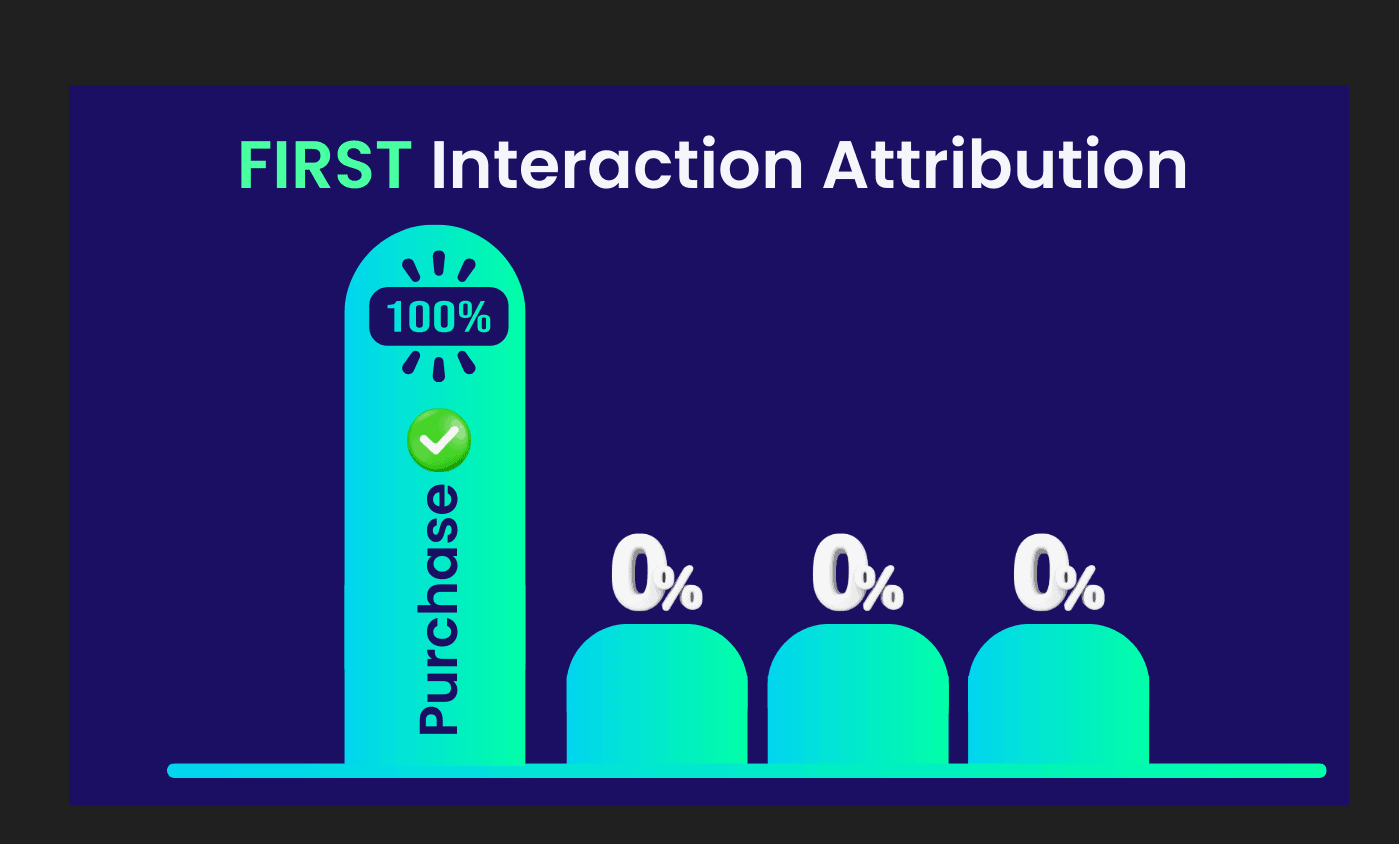
First touch attribution model
According to first-touch attribution modelling, the initial channel or touchpoint that a customer interacts with is given full credit for the conversion.
Best For: Identifying which channels are most effective at generating initial awareness
Last touch attribution model
The inverse of first-touch attribution modelling, last-touch attribution modelling attributes a lead's conversion solely to the last touchpoint they engaged with.
Best For: Understanding which marketing efforts are most effective at sealing the deal.
One form of multi-touch attribution, linear attribution modelling, assigns equal weight to each channel Related Post: Last Click Attribution: What It Is & How To Use Itand touchpoint a consumer interacts with along their buyer's journey.
Best For: Businesses looking for a simple and holistic view of the customer journey.
Time decay attribution model
All touchpoints that led to a conversion are considered in time-decay attribution modelling, which also considers the time of each touchpoint; the touchpoints that occurred most immediately before the conversion are given the greatest weight.
Best For: Emphasizing the importance of interactions that happen near the conversion point.
Position-based attribution model
According to the position-based (U-shaped) method, the two most important encounters in a sales funnel are the one that led to the customer discovering your brand and the one that resulted in a conversion.
Best For: Balancing the importance of initial engagement and closing interactions.
Implementing attribution models in marketing strategies
Choosing the right attribution model for your business is a critical decision that can significantly impact your understanding of marketing effectiveness and where to allocate your budget. Here are steps and considerations to guide you in selecting the most appropriate attribution model:
Understand your customer journey:
Define your business goals:
Consider the resources available:
Evaluate model flexibility and adaptability:
Review and reassess regularly:
Consult with stakeholders:
Learning from marketing attribution failures and successes
You can learn a lot from both your attribution triumphs and mistakes. Improving future marketing campaigns is as simple as figuring out which strategies worked and which didn't. Businesses can gain valuable insights from their marketing attribution experiences by doing the following:
Identifying data issues and analysing attribution failures:
When attribution fails, it's usually because of poor data quality or a lack of integration. Data inaccuracies or gaps can be found and fixed by delving into these failures.
Learn about model limitations:
Understanding the limitations of attribution models is crucial for optimizing your marketing strategy. If an attribution model fails to deliver accurate or meaningful results, it may be due to its inherent design not aligning with the specific nuances of your marketing plan or the complexity of your customer's journey. Attribution models are not one-size-fits-all solutions; each model has its strengths and weaknesses depending on factors such as the length of the sales cycle, the number of touchpoints, and the variety of channels involved.
For instance, a last-click attribution model might overlook the impact of earlier interactions that played a significant role in guiding a customer toward conversion. Similarly, a linear model might evenly distribute credit across all touchpoints, but fail to recognize that some interactions are more influential than others. By identifying these mismatches, you gain valuable insights that help you assess whether the chosen model is truly capturing the key drivers of your marketing efforts.
Armed with this understanding, you can make informed decisions about selecting a more suitable attribution model in the future—one that better reflects the unique dynamics of your customer journey and marketing activities. This proactive approach not only enhances the accuracy of your attribution but also improves your overall marketing performance by ensuring that every touchpoint is evaluated appropriately.
Keeping up with the market:
Attribution mistakes can occur for various reasons, including shifts in customer behaviour or market circumstances. More dynamic strategy adaptation is possible with the recognition of these aspects.
Using Kleene's decision intelligence platform
In today's ultra-competitive business environment, staying competitive requires a steady mix of up-to-date data, cutting-edge tools, and the right mindset. As time progresses, maximising Return on Ad Spend (ROAS) will become increasingly complicated, but utilising the right tools can help you make informed decisions
Kleene.ai help you unify data from many departments into one accurate single source of truth, it offers powerful analytics tools, and facilitates better decision-making with the help of recommendations powered by artificial intelligence.
Kleene enables marketers to measure and prove the incremental impact of every channel, both online and offline, predict budget investment impact and test different allocation scenarios using advanced AI attributions, measure the impact of online and offline campaigns on ROI and get better insights with all data taken into account. We combine Multi-Touch Attribution with Media Mix Modeling to attribute all your marketing activities (online/offline) to the right orders, moving beyond last-click attribution. It helps you gain a holistic perspective of your campaign's performance with a rich, actionable dashboard showing impressions, clicks, CTR, CPC, ROAS, and CAC across all your marketing channels and attribution methods
With Kleene's Decision Intelligence Platform, your organisation can achieve more than survival—it can thrive thanks to smarter, data-informed decision-making.
Is data-driven decision-making something you're prepared to implement in your retail business? Contact a Kleene specialist now to learn more about how our Decision Intelligence Platform can meet your company's specific demands and help you get an edge in the market. Data analysis is only part of the equation; guiding your company to succeed in a volatile market is the real deal.


%201.svg)


%201.svg)
