Agentic AI has moved from a talking point to a hardware category. This edition we look at why Nvidia is redesigning its entire product lineup around agent workloads, what Cursor's data tells us about a developer workforce splitting into two very different tiers, and why the biggest obstacle to getting value from AI in the enterprise may be a data problem that companies have been ignoring for decades.
The trend: Coding agents are helping the average developer produce 8,600 lines of code per week, more than double the rate from a year ago, and lines added per pull request up 2.5x year over year.
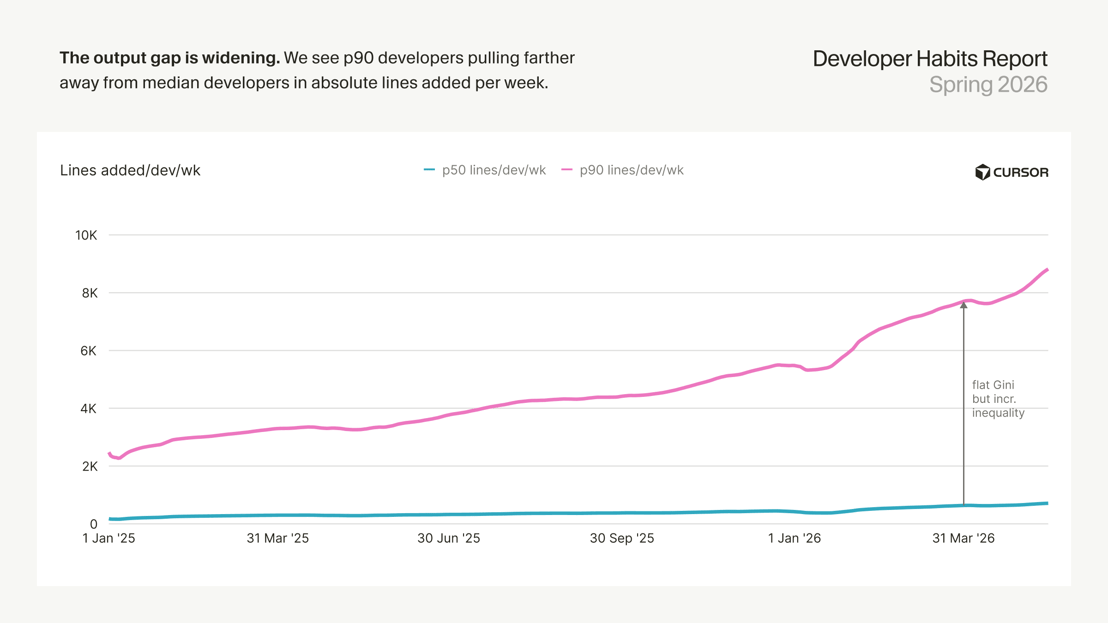
The details: Cursor's Spring 2026 Developer Habits Report found that AI-generated changes are increasingly bypassing manual review entirely, with agent changes accepted without review step rising from 7% in January to 38% by May. Agent sessions are also getting deeper, with average tool calls per session up roughly 30% in just two months as agents take on more complex tasks. The productivity gains are real but highly concentrated: the top 1% of developers produce 46 times more lines than the median active user, and the gap is widening.
Why it matters: As we move from AI assisting developers to running basically autonomously, the question is no longer whether to adopt these tools but how to govern the output, given that more of it is reaching production without a human ever reviewing the diff. If you want a clear pathway to establishing governance in your code and data, read our CTO's recent blog on the topic here.
The trend: Nvidia has unveiled the first laptops designed specifically for running AI agents, powered by a new chip called the RTX Spark, marking a direct bet that agentic computing is replacing the chatbot as the dominant AI workload.
The details:Announced at Computex in Taipei, the new laptops represent a fundamental change in what AI hardware needs to do: chatbot-style inference leans heavily on GPUs, but agentic workloads place most of the load on CPUs, pushing Nvidia to redesign its product lineup accordingly. Ian Buck, Nvidia’s vice president for high-performance computing, said “AI is moving from answering questions to doing real work.”
Why it matters: When the world's dominant chip company starts designing consumer hardware around a specific workload, that workload is no longer experimental. For enterprise teams still treating agents as a pilot project, the hardware industry has already made its call on where this is going.
A World Economic Forum essay argues that the AI race is being fought at the wrong layer. Energy, chips, data centers, and foundation models are largely commoditized or capital-dominated, but the application layer, where AI meets real human workflows, remains fragmented, underbuilt, and impossible to brute-force with funding alone. Europe, often written off for lacking the infrastructure scale of the US or China, may have an edge here: a per-capita concentration of AI experts 30% higher than the US, record AI funding of $21.8 billion in 2025, and deep industrial software expertise in exactly the kind of high-stakes, human-centered environments where application design matters most.
Forrester's latest vision report argues that AI failures in the enterprise trace back to a data problem that predates AI entirely. Most enterprise data still lacks the structure, shared semantics, and governance needed for AI systems to produce accurate, explainable outputs, and fixing it means completing decades of data management work that was never properly finished, not buying a new tool on top of the existing mess.



%201.svg)
