TLDR:For twenty years, software teams have changed live systems safely: isolate the change, review it, test it, deploy it through a gate, roll it back if it breaks, and keep an audit trail. Data pipelines almost never had that. AI data platforms have now brought the same discipline to data, and Kleene.ai delivers it through two things: git integration that puts your pipeline under proper version control, and a sandbox-and-promote flow that KAI, our AI data assistant, writes into directly. The point that matters most: once AI is generating changes, this discipline stops being optional. It is what lets you trust anything the AI produces.
A healthy change process for software looks much the same everywhere. You make your edit, hand it to someone to try out somewhere that can't touch the live product, and only push it live once you know that if it misbehaves, you can wind it straight back to where it started. It is exactly why an engineering team can rewrite the code behind a live product on an ordinary Tuesday afternoon, and nobody reaches for the fire alarm.
Data teams have rarely had the same opportunity. The reason is the environment they were stuck in: the transform you wrote lived inside a database, or behind the buttons of a point-and-click tool – there was nowhere safe to try a change, and no clean way back.
But that has changed and AI data platforms now bring the full, code-style workflow to pipelines. Kleene.ai is one of them: the platform we built so data teams get that workflow without having to assemble it from scratch. Here are the principles and features that make it work.
Six principles worth bringing across
Isolation. Every change starts in a sandbox, a private copy where you can break things without anyone noticing.
Review. Nothing reaches production without a second pair of eyes and a visible diff of exactly what changed.
Testing. You run the change against real data before it goes live.
Gated deployment. Going live is a deliberate, approved step.
Rollback. If a change causes trouble, you return to the previous version in seconds.
Audit. Every change is attributed and timestamped, so "who changed this, and when" is never a mystery.
Two features that make this real
Git integration. Your transforms now sync straight to GitHub or Azure DevOps, with GitLab next. You push from inside Kleene.ai, the commit is structured for you, and the history lives where your engineers already work. That single connection does the heavy lifting. Every change becomes a pull request you review before it merges and can revert in seconds if it goes wrong, with the full attributed history logged the whole time. Your data pipeline stops being the one part of the company nobody version-controls.
Sandbox-and-promote, with KAI inside it. Kleene already runs every change through a sandbox you test against real data, then promote to production with explicit approval. The new part: KAI, our AI data assistant, now writes transforms directly into that same sandbox. It behaves like an AI data engineer that actually follows the rules. Describe what you need in plain English, its text-to-SQL turns the request into a transform (an AI SQL generator with guardrails, not a loose chat window), and the change lands as a diff you approve before anything goes live. It follows the exact review-and-promote path a person does.
Between them they cover the whole list: the sandbox handles isolation and testing, git handles review and rollback and audit, and promotion is the gated deployment step.
SDLC Phase
Software Engineering
Kleene Data Pipeline
Develop
Write code locally
Write transforms in sandbox, or ask KAI to generate them
Run sandbox transforms against a copy of real data without affecting live
Deploy
Merge PR, CI/CD deploys
Raise commit request, review and promote sandbox to production
Monitor
Logs, alerts, dashboards
Pipeline status, job logs, webhook notifications
Rollback
Revert commit
Revert to previous transform version (sandbox or git)
Audit
Git blame, commit history
Audit logs in Kleene + git commit history
Once AI is in the loop, this stops being optional
Here is the part that turns the discipline from nice-to-have into non-negotiable.
AI can generate twenty transforms before lunch, each one capable of quietly changing a number on three dashboards downstream. If those changes can reach production without review, your data gets dirty faster than any human could manage. This is where LLMOps becomes a data problem: the same way LLMOps keeps models accountable in production, AI workflow orchestration has to govern every change an agent makes to your pipelines. The only way to let AI move fast and keep your data clean is to force every AI-made change through the same gate as a human one: sandbox, diff, review, approve, promote.
That is why KAI doesn't get a shortcut. The process isn't a brake on the AI. It is the thing that lets you trust what the AI produces at all.
MCP: the same principles, one layer up
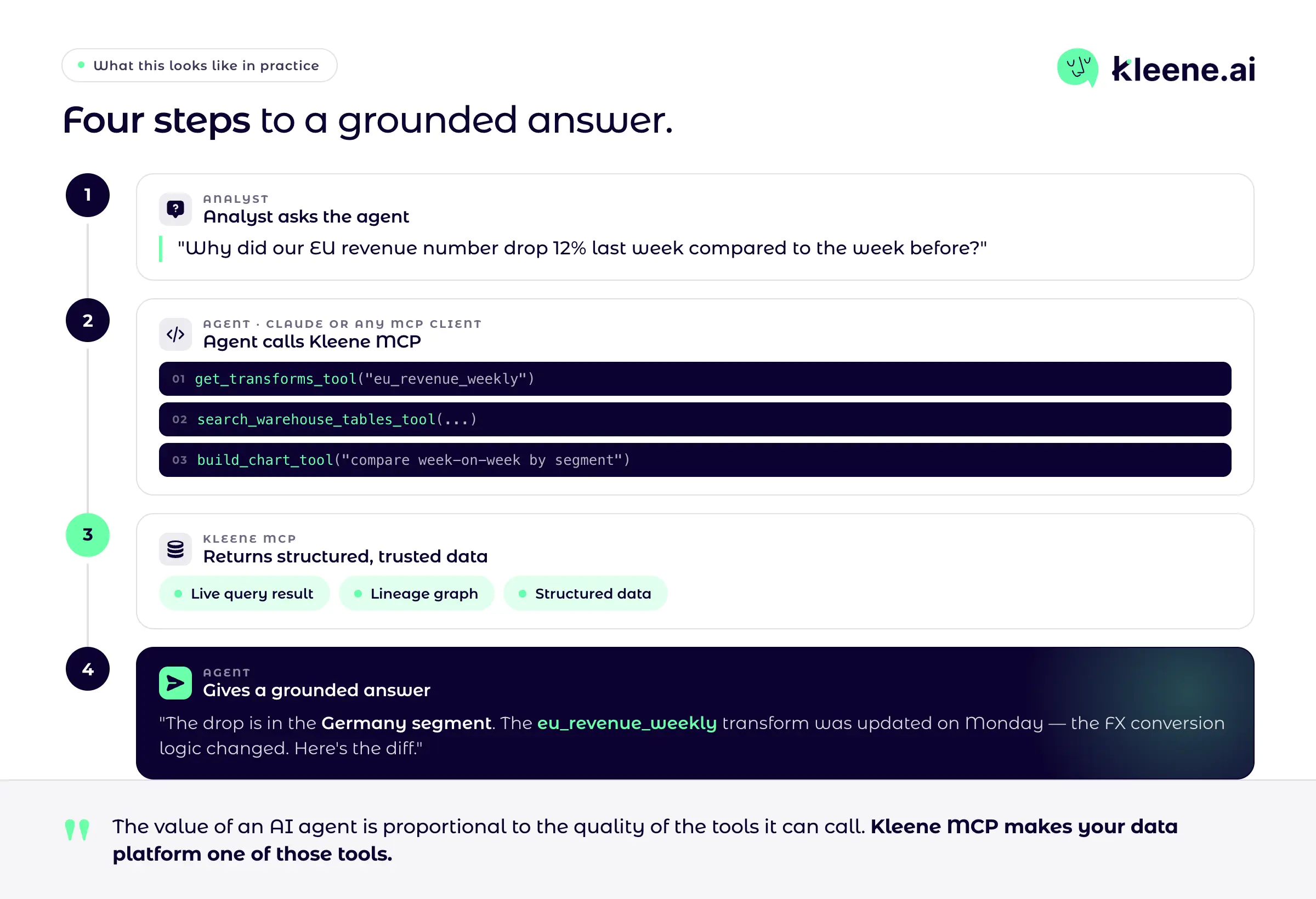
The next shift is agents reaching your data directly through MCP, the open standard that lets tools like Claude and ChatGPT call your systems instead of guessing from a snapshot.
The moment an agent can read and change your pipelines, AI agent orchestration matters for the same reasons, and every principle above applies to the agent too: it should work in isolation, its changes should be reviewable, it should never write to production ungated, and every call it makes should be attributed. An MCP layer that skips those is just a faster way to make confident, untraceable changes that turn out to be wrong, at machine speed.
That is the bar we are building toward with Kleene's own MCP, due early Q3.
The rest of the safety net
Plenty of errors are better caught earlier and lower down. It starts before transforms even run: Kleene's AI data integration pulls from 200+ sources into one place, so you are governing one pipeline instead of twenty brittle exports. From there, a few features worth knowing, all pointed at the same goal of fewer broken numbers:


%201.svg)
.webp)


%201.svg)
