Banks are discovering that their AI ambitions are only as good as the data underneath them. This edition we look at why 80% of banks are blocked by fragmented data rather than a lack of AI tools, how Morgan Stanley is betting that the future of enterprise software is agentic access rather than logging in, and whether Apple’s long-awaited Siri overhaul is actually a leap forward or just catching up to where the rest of the industry was two years ago.
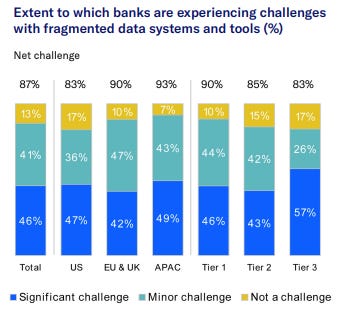
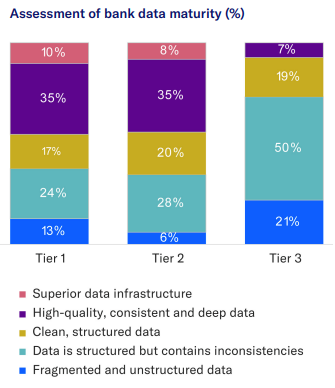
The trend: Over 80% of banks identify fragmented data and legacy infrastructure as a significant challenge, yet only 12% feel confident using their data to act quickly.
The details: Moody’s Intelligence Edge banking study, based on a survey of senior banking leaders, found that 40% of banks have ambitious data and technology plans but remain stuck behind disconnected systems that slow down every decision they try to make. The problem is worse at smaller institutions: 71% of Tier 3 banks report that inconsistent or unstructured data is actively hampering their ability to adopt AI, compared to far lower rates at Tier 1 banks. A UK CFO surveyed put it plainly: “AI is only as good as the data it feeds upon. So it goes back to your legacy infrastructure.”
Why it matters: The banks moving fastest are not the ones with the most advanced AI models. They are the ones that have done the foundational work of unifying their data and building the connective tissue between systems. The same is true across every sector: the gap between AI ambition and outcomes is almost always a data infrastructure problem in disguise. See how CoinMENA tackled exactly that challenge here.
The trend: Morgan Stanley is opening its wealth management platforms directly to AI agents, allowing corporate clients to access its systems agentically rather than logging in through traditional software interfaces, in one of the earliest moves by a major Wall Street bank integrate AI agents.
The details: Morgan Stanley’s stock administration platforms, ShareWorks and Equity Edge, which sit at the center of a wealth management funnel managing $7.35 trillion in client assets, will be accessible to external AI agents from the firm’s 3,400 corporate clients by next year. Mark Mitchell, Morgan Stanley’s chief product officer, was direct about the direction of travel: “The way we see it, in a future state, our corporate clients will not be logging into ShareWorks or Equity Edge.” JPMorgan and Goldman Sachs are currently using agents only internally, making Morgan Stanley one of the first to open its platforms to external agents.
Why it matters: This is the direction enterprise software is heading across the board. At Kleene.ai, we’re moving the same way: through MCP integration, users will be able to access the same capabilities as KAI Assistant directly through Claude, ChatGPT, or whichever AI tool their team already uses, without logging into the platform at all. The companies that will matter in an agentic world are the ones with proprietary data and business logic underneath.
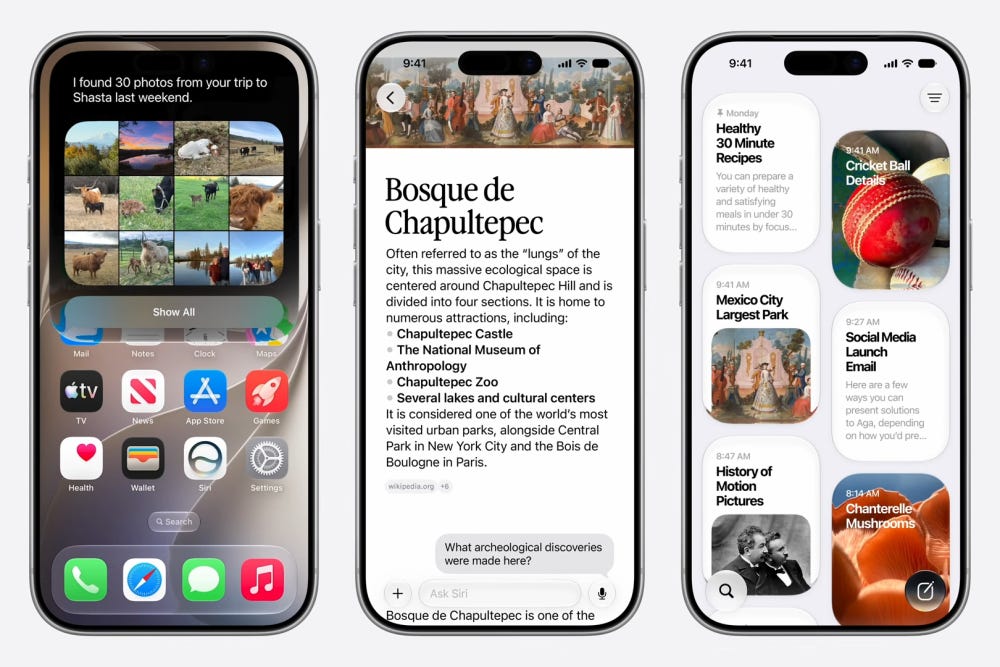
Apple unveiled Siri AI at WWDC 2026, its most significant overhaul of the assistant since its original launch, two years after the first Apple Intelligence rollout overpromised and underdelivered. The new Siri can reason from on-screen content, take actions across apps, and handle multi-step tasks, with a dedicated app serving as a conversational hub that links usage across devices. The update arrives as a free fall release for iPhone 15 Pro or newer, with no access in the EU or China at launch. For a first-time AI user it will feel like a leap forward. For anyone already regularly using newer models, the demos looked a lot like 2024-level capabilities.
A BCG report argues that agentic AI is breaking the data risk structures most companies have spent years building. Privacy, cybersecurity, and governance teams have always operated separately, but a single agent deployment now triggers all of them simultaneously, often before any human can intervene. Agents can act on flawed data in real time, move information across third-party systems, and trigger downstream processes autonomously, and nearly half of enterprise leaders surveyed expect cybersecurity spending to rise directly because of it.
Read This 📚
Argentina’s President Javier Milei is promising tech firms a fully unregulated AI environment, including “non-human corporations” run entirely by AI agents, and an open invitation to make Buenos Aires the global hub for AI development
AI coding tools may cost Anthropic & OpenAI more than $1,000 for every $100 a subscriber pays, raising serious questions about whether the current pricing model survives upcoming IPOs



%201.svg)
