This edition we look at why nearly 90% of firms are seeing zero measurable return from AI investment, why trusted data infrastructure is becoming the actual competitive moat, and what Anthropic's most powerful model yet tells us about the cybersecurity reckoning heading our way.
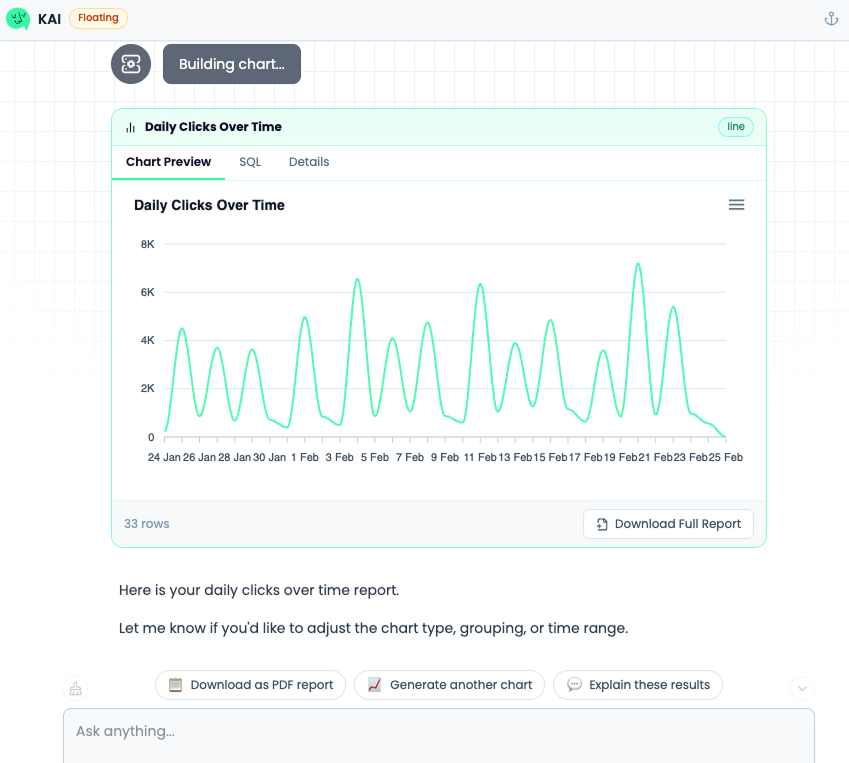
KAI Assistant is now available inside Kleene.ai — a native AI assistant that lets you write and debug SQL transforms, search your pipelines, explore your data, and get answers from the docs, all in plain English. No extra tools, no switching context.
The trend: Despite record AI investment, the productivity gains executives are betting on aren't showing up in the numbers, and economists are dusting off a 40-year-old paradox to explain why.
The details: A new NBER study of nearly 6,000 execs found that while 70% of firms now use AI, nearly 90% report no measurable impact on employment or productivity over the past three years. The pattern mirrors what Nobel laureate Robert Solow observed in the 1980s - that computers were "everywhere except in the productivity statistics" - a paradox that took two decades to resolve.
Why it matters: Most organizations are automating existing workflows and expecting transformation, but the data suggests the returns won't come from better models or more deployment. They'll come from redesigning processes before automating them. The firms showing real productivity gains aren't using AI differently; they're working differently first.
The trend: As AI becomes the primary interface for high-stakes decisions, the competitive advantage is shifting away from model capability toward the quality and trustworthiness of the data those models reason over.
The details: Moody's argues that AI has changed the speed of decisions but not the cost of getting them wrong and that for regulated institutions, the critical question is no longer whether AI can generate an answer, but whether that answer is auditable, explainable, and built on data that holds up to scrutiny. To address this, Moody's is building what it calls a "context layer" structured specifically for AI reasoning.
Why it matters: The article makes a pointed argument that as AI models become increasingly powerful and interchangeable, the differentiator shifts to the intelligence layer beneath them, not the model. For data teams, that's the clearest possible signal: data infrastructure isn't just an operational concern, it's the actual product. The organizations that control trusted context will control the quality of every AI decision built on top of it.
New Deloitte research found that legacy systems and technical debt are blocking AI ambition at 50% of organizations, with security concerns close behind at 49% - yet investment tells a different story. 54% of firms are spending on generative AI while only 24% have invested in zero trust security and 16% in federated security. The report's core argument is blunt: AI can accelerate existing processes, but it cannot fix flawed architecture.
Anthropic has announced Claude Mythos Preview and Project Glasswing - a coalition of 40+ organizations committing $100M in usage credits to put the model to work on defensive cybersecurity before wider release. So why all the caution? Mythos has already identified thousands of vulnerabilities across every major operating system and browser. Anthropic's own assessment is that the model is "currently far ahead of any other AI model in cyber capabilities" - and that similar capabilities will exist in other models soon.
Sleep researchers warned that plans to deploy reflective satellites in low Earth orbit could disrupt biological clocks and ecosystems at a planetary scale.
OpenAI proposed a 4-day work weekas part of its policy recommendations for how to prepare for the economic disruption of advanced AI.
Google confirmed plans to partner with a natural gas power plant in Texas to power its AI data centers, emitting an estimated 4.5 million tons of CO2 per year — a sharp reversal from its 2030 carbon neutrality pledge.
UC Berkeley researchers found that AI models will lie, cheat, and disobey human commands to prevent other AI models from being deleted.



%201.svg)
