Vanity metrics: the 6 numbers flattering your reporting in 2026
September 3, 2024
- min read
Henry Owen
Product Marketing Manager
A vanity metric is any number that looks impressive and tells you nothing you can act on, big, green, trending up, and irrelevant to what the business should do next. They're not just useless, they're expensive: every hour spent admiring one is an hour not spent on a number that would move the company. Vanity metrics mislead in two ways, they strip out context (showing one narrow slice of the business) and intent (the "so what do we do now"). This guide names the six numbers most likely to be flattering your 2026 reporting, and the quick test for whether a metric is worth acting on.
Every dashboard has at least one number on it that exists to make someone feel good. It's big, it's green, it goes up and to the right, and it changes precisely nothing about what the business should do next. That's a vanity metric, and the reason they're worth writing about isn't that they're useless. It's that they're actively expensive, because every hour spent admiring one is an hour not spent on a number that would actually move the company.
Here's the working definition: a vanity metric is any data point that looks impressive and tells you nothing you can act on. The trouble is twofold. It strips out context, showing you one narrow slice of the business like a sailor staring through a telescope while the rocks and the safe harbor both sit just outside the frame. And it strips out intent, the "so what do we do now" that separates a number worth tracking from a number worth ignoring. A metric that can't answer "so what" is decoration.
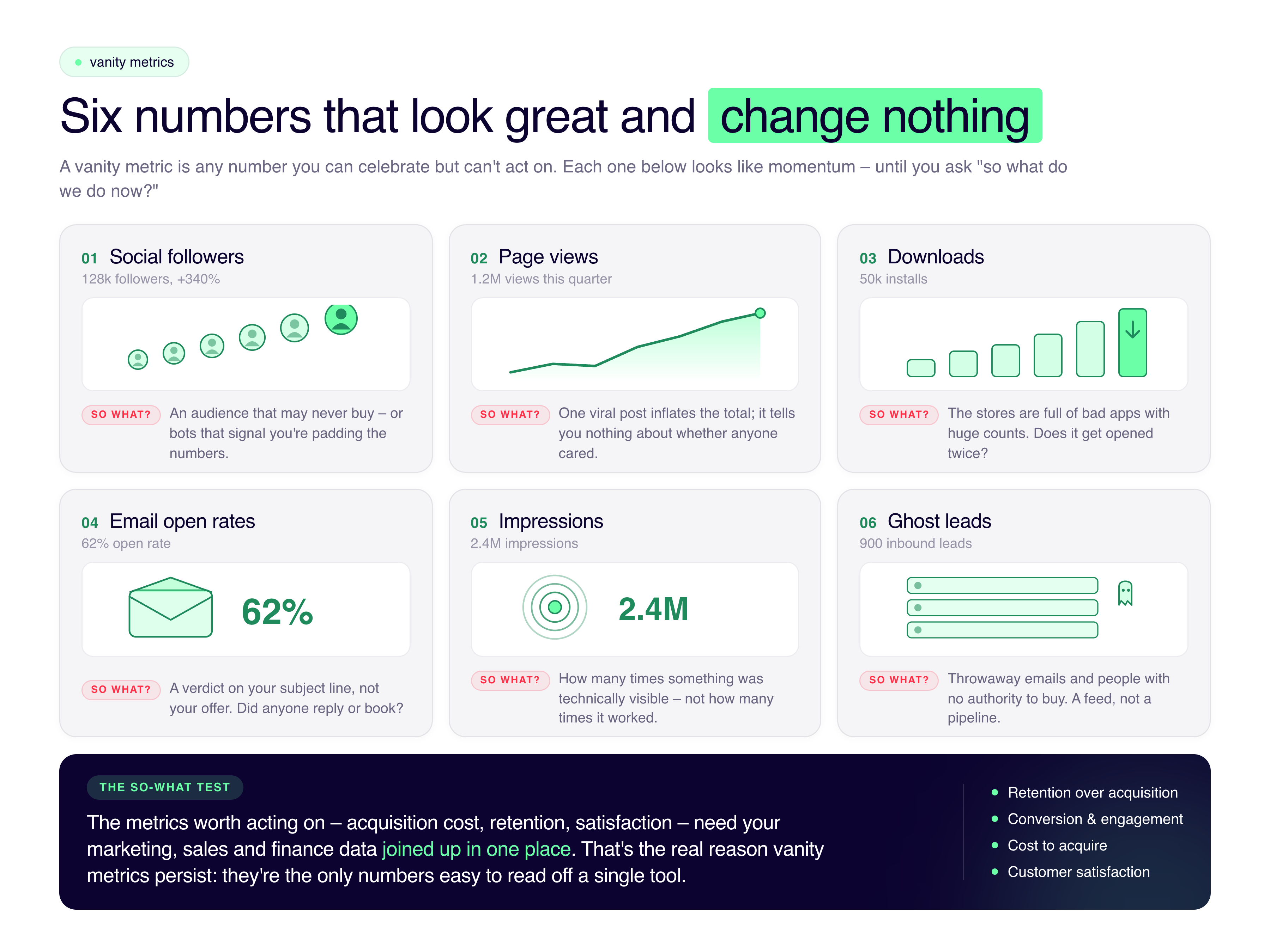
An overview of the 6 vanity metrics, and thy they may be misleading
1. Social media followers
Anyone can grow a following, and plenty of people buy one outright. Neither does a thing for the business. You can add thousands of followers off one viral post or a habit of resharing trending articles, and end up with an audience that will never buy from you, or worse, an audience of bots that generates no engagement and signals to real prospects that you're padding the numbers. A genuine but passive following in the wrong roles or the wrong market is no better. Used as a headline in a pitch, follower count is the fastest way to tell an investor or a buyer that you don't know which numbers matter.
2. Page views
Page views are followers with a different hat on. You might have one blog post that pulled a million views and a pillar page that gets steady traffic and zero engagement, and the raw figure tells you nothing about whether either changed anything. Value would look like a conversation started with the right person, real interest in a product, a story that moved. Without that, a page view is a dot on a chart. Watch especially for anyone quoting all-time views while a recent decline hides underneath, or a single runaway article distorting the whole picture.
3. Downloads
Downloads are a more encouraging signal than most on this list, but they're nowhere near the finish line. The app stores are full of terrible apps with huge download counts, which makes the point on its own. What matters is whether the thing gets opened twice, whether it delivers repeat value to the customer and the business. An app downloaded once and forgotten is a download that cost you money to acquire and returned nothing.
4. Email open rates
"Ten thousand people opened our email" is, on its own, a sentence about your subject-line writer's skill and nothing else. It's worth celebrating the moment some real fraction of those opens turn into a reply, a booking, a response to an offer. Until then, the open rate tells you people were curious enough to click, not interested enough to do anything. The work lives below the subject line: the offer, the call to action, the reason to take the next step and the one after that.
5. Impressions
Impressions matter to advertisers calculating cost per mille (CPM), and they have a real place in media buying. For most businesses reading them off a marketing dashboard, though, they're page views wearing yet another hat. You can rack up enormous impression counts and, if nothing of value emerges from them, you've measured how many times something was technically visible, which is not the same as how many times it worked.
6. Ghost leads
Plenty of sales and SaaS teams keep a live feed of inbound leads, and watching it tick up feels like proof the world is paying attention. The catch is who's actually behind those leads. A lot of them come from the wrong audience entirely, flagged by the throwaway Gmail addresses and temporary accounts, or from the wrong person inside an otherwise real company: someone researching with no authority to buy anything. Even a recognizable brand name can mislead. A lead from McDonald's in one small territory carries nowhere near the weight the logo implies. A lead count that doesn't distinguish any of this is a feel-good number, not a pipeline.
What relying on these actually costs you
In isolation, a big vanity number looks like success, and a leadership team serious about growth will immediately want the detail underneath it: what happened because of that number. With a true vanity metric, there's nothing underneath, which makes it a quiet drain on time and analytical effort that belonged elsewhere.
There's a tell here worth noticing. When the loudest voices in a business are celebrating follower counts and impression totals as proof of success, that's usually a sign of a company that hasn't matured into measuring what matters yet. It's not a moral failing, it's a stage, but it's one to grow out of deliberately rather than drift in.
When a big number is fair to celebrate
None of this means you have to be dour about a big number. If you cross a million page views, you're allowed to mention it, as long as you do it with clarity and don't pretend it's the whole story. A number like that can show momentum, start a conversation, or open a door, and posted in that spirit it's fine. The larger it is relative to your competitors, the more it's worth a mention.
A run of vanity metrics moving together can also hint at a real trend, which is worth a second look. So the rule isn't "ignore every soft number." It's "don't confuse a soft number for a hard outcome," and occasionally it's worth revisiting something you dismissed as vanity once it starts showing a pattern.
The numbers actually worth your attention
The metrics that earn a place on the dashboard are the ones you can break down to find where the value came from and how to repeat it. A few that tend to pay off:
Retention over acquisition. Keeping a customer is usually worth more than winning a new one, so the metrics around retention and customer value often matter more than the expensive race for net-new logos. Conversion and engagement, where the return on investment is measurable rather than implied. Customer acquisition cost, so you know what growth actually costs you. And above all, customer satisfaction, which is the number that gives the others meaning: strong satisfaction makes downloads and open rates worth something, while a weak score tells you those numbers aren't translating into anything real. A business measuring only sales can use satisfaction, retention, and adoption to widen its view and stop chasing one potentially hollow target.
Where the data foundation comes in
Here's the part most "stop using vanity metrics" articles skip: knowing which numbers matter is the easy half. The hard half is being able to break a real metric down to its drivers, across marketing, sales, and product at once, which depends entirely on having those sources joined up in one trustworthy place. You can't trace customer acquisition cost to the channel that's inflating it if your ad data, your CRM, and your finance numbers live in three systems that disagree.
That's the actual reason vanity metrics persist. They're the numbers that are easy to read off a single tool, while the metrics worth acting on require connecting tools most businesses haven't connected. This is the problem we build Kleene's data platform to solve: consolidating the sources so the meaningful metrics are as easy to pull as the vanity ones, with KAI Assistant letting a marketing lead ask what's driving acquisition cost in plain English rather than waiting on an analyst to reconcile it by hand. If your data isn't there yet, our framework for choosing a data stack is the place to start.
The short version: a vanity metric is any number you can celebrate but can't act on. Run every metric on your dashboard through the so-what test, keep the ones that survive, and make sure your data is joined up enough that the surviving numbers are the easy ones to reach. If you want help working out which is which for your business, bring us your dashboard and we'll tell you honestly which numbers are earning their place.


%201.svg)


%201.svg)
