Return on ad spend in 2026: how modern teams optimize ROAS with AI and unified data
August 19, 2024
- min read
Henry Owen
Product Marketing Manager
TLDR: Reporting ROAS accurately is largely a solved problem. Improving it is not, because a blended ROAS figure is produced from data the ad platforms cannot see: your margin, returns, repeat purchase rates and inventory position. Platform-reported ROAS and last-click both optimize toward the conversion event they can observe. Media mix modeling establishes channel efficiency across years of spend, digital attribution establishes touchpoint influence, and the two are strongest fused rather than run separately. Fusion needs roughly 750k a year in media spend to work. Below that, cleaner tracking and margin visibility return more than any model.
Return on ad spend remains one of the most scrutinized metrics inside modern marketing organizations. In 2026, however, the challenge is no longer reporting ROAS accurately. The real challenge is turning ROAS into a reliable input for planning, forecasting, and decision-making across marketing, finance, and operations.
Most teams can report ROAS at a channel or campaign level. Far fewer can improve it consistently over time. The difference is not creative quality or bid management. It is data maturity, measurement design, and whether marketing decisions are informed by predictive intelligence rather than backward-looking dashboards.
This guide explains how leading organizations approach ROAS optimization today, why traditional ETL, BI, and black-box attribution tools stall progress, and how platforms like Kleene.ai enable marketing teams to operationalize ROAS as part of a broader decision intelligence framework.
How modern teams optimize ROAS in 2026, using AI and unified data
Why optimizing return on ad spend is harder than it looks
ROAS optimization breaks down when marketing data is fragmented across systems that were never designed to work together.
Paid media data sits in advertising platforms. Revenue, orders, and customer behavior live in ecommerce systems and CRMs. Margin, cost, and inventory data live in finance and operational systems. Each tool answers a narrow question well, but none provide a complete view of how marketing spend affects growth, risk, and profitability.
This fragmentation creates predictable failure modes:
Marketing, finance, and leadership see different ROAS numbers for the same period
Teams default to last-click or platform-reported attribution because it is readily available
Budget decisions are made without understanding downstream inventory or margin impact
Optimization focuses on short-term efficiency rather than long-term value
Kleene.ai addresses this by unifying marketing, sales, finance, and inventory data into a single governed data layer. This allows ROAS to be evaluated in the context of the entire business, rather than as an isolated marketing metric.
Why black-box attribution models stall return on ad spend improvement
Many organizations rely on automated attribution and optimization tools embedded directly within advertising platforms. These tools are convenient and often performant at a tactical level, but they introduce structural limitations that prevent sustained ROAS improvement.
Black-box attribution models typically:
Favor short-term conversions over customer lifetime value
Struggle to account for offline, delayed, or cross-channel effects
Provide limited transparency into how credit is assigned
Cannot be reconciled cleanly with finance, margin, or inventory data
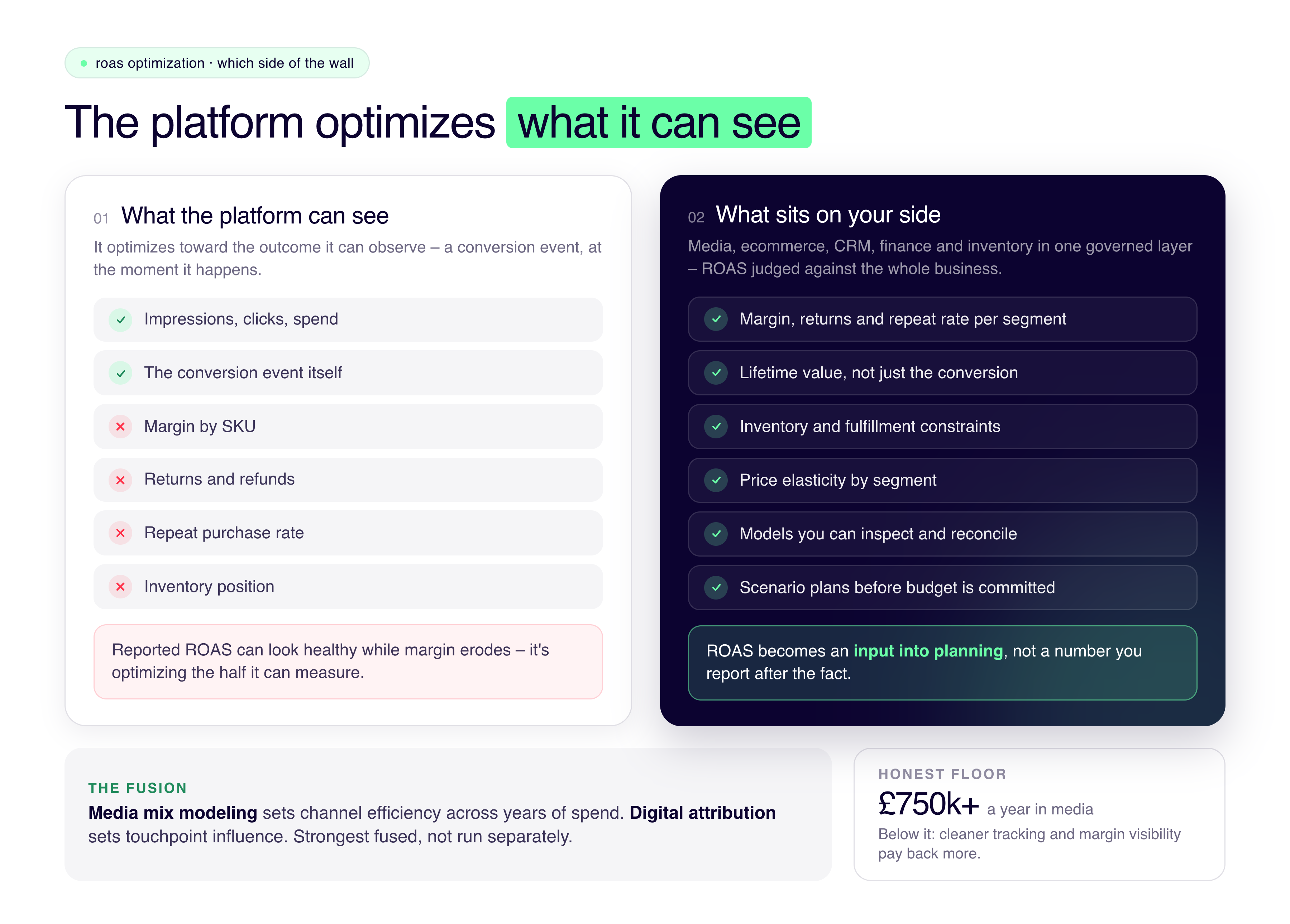
The constraint is not the quality of the engineering inside those platforms. It is what data sits on which side of the wall. As Ian Liddicoat, CPO at Kleene.ai, puts it: "What Google shows you is a fairly aggregate, high-level view. They don't have access to the transactional data we see."
Your margin by SKU, your repeat purchase rates, your returns and your inventory position are not available to the ad platform. So it optimizes toward the outcome it can observe, which is a conversion event, at the moment it can observe it.
For C-suite leaders, this creates a trust gap. For Heads of Data, it creates a validation and governance problem. Over time, marketing performance becomes disconnected from broader business outcomes, even if reported ROAS appears healthy.
Kleene.ai avoids this trap by grounding attribution and optimization in transparent, governed data models. These models can be inspected, tested, and aligned directly with financial outcomes, enabling ROAS optimization that leadership can trust.
From attribution to decision intelligence for marketing
In 2026, high-performing organizations are moving beyond attribution-centric reporting toward decision intelligence.
Rather than asking only what happened, marketing and leadership teams are asking:
How will reallocating budget across channels affect ROAS next quarter?
Which customer segments drive sustainable lifetime value versus short-term revenue?
Where does incremental spend create inventory or fulfillment risk?
How do pricing changes and elasticity affect campaign efficiency?
Answering these questions requires more than dashboards or static models. It requires predictive analytics that operate on unified data and allow teams to simulate outcomes before committing budget.
Kleene.ai is built specifically for this shift. By combining unified data, predictive modeling, and AI-driven applications, Kleene enables marketing leaders to evaluate scenarios across channels, customers, pricing, and inventory, rather than optimizing ROAS in isolation.
The role of AI ETL tools in return on ad spend optimization
ROAS optimization starts with reliable data pipelines. Without clean, consistent, and timely data, even the most sophisticated models produce misleading results.
AI ETL tools play a foundational role by:
Ingesting data from paid media, ecommerce platforms, CRMs, finance systems, and inventory tools
Standardizing definitions of revenue, spend, conversions, margin, and returns
Maintaining historical consistency as platforms and schemas change
Making data available for analytics, forecasting, and AI-driven decisioning
Kleene.ai combines ETL, transformation, analytics, and AI within a single managed platform. This reduces tool sprawl, minimizes manual reconciliation, and ensures that ROAS calculations are consistent across teams, time periods, and use cases.
Core capabilities required to optimize return on ad spend in 2026
Customer segmentation with business context
Effective ROAS optimization depends on understanding which customers create long-term value, not just which campaigns drive conversions.
Kleene.ai's AI-powered customer segmentation groups customers based on behavior, lifetime value, and responsiveness to marketing spend. This allows teams to invest more aggressively in high-value segments while avoiding overspend on customers who convert but churn or erode margin.
Predictive sales and revenue forecasting
Historical ROAS explains past performance. Predictive forecasting explains what is likely to happen next.
Kleene.ai enables teams to model how changes in marketing spend affect revenue, customer acquisition cost, and lifetime value over time. This supports more confident budget planning and reduces reliance on lagging indicators or intuition.
Media optimization and digital attribution
Modern attribution must account for cross-channel interactions, diminishing returns, and time-based effects.
The two techniques doing most of the work here answer different questions, and they are often used interchangeably when they should not be. Media mix modeling looks across two or more years of spend on every channel to establish how efficient each one is. From there it optimizes how budget is distributed between them, and lets you scenario plan: what happens to sales and conversion if you upweight TV, or increase search and social? Digital attribution operates at the level of the individual touchpoint, moving past the assumption that the final interaction deserves the credit. On that point Ian Liddicoat is direct: "Last click places all the value on the final interaction before a conversion, which is clearly not correct."
Media mix modeling itself is not new, having been in use since the 1960s. What has changed recently is narrower than most vendor claims suggest. In Liddicoat's words: "What's changed in the last couple of years is the level of sophistication applied to the modeling, and then the ability to fuse that model with digital attribution."
That fusion is the part worth understanding. Budget allocation comes out of the media mix model as one of its outputs, but the allocation improves when the model also knows what is happening at the touchpoint level. Kleene.ai's approach to fusing MMM with digital attribution sets out how the two feed each other, and our guide to media mix modeling and marketing attribution explainer go deeper on each technique separately. and why access to transactional data produces a more bespoke picture than platform-level reporting can.
One honest qualifier belongs here, because it determines whether this applies to your business at all. Media mix modeling needs scale to work. Liddicoat puts the practical floor at organizations "spending at least 750k to a million as a minimum across all channels." Below that threshold there is not enough variation for the model to learn from, and the better investment is cleaner tracking and margin visibility rather than an econometric model you cannot feed.
Creative performance you can explain
Creative is one of the largest levers on return on ad spend and one of the least measured, because standard testing identifies a winner without explaining the win.
Liddicoat frames the gap plainly: "If you take a traditional A/B test, what you know is that Creative A does better than Creative B in the north of England versus the south of England. That's interesting. What you don't know is what the difference between Creative A and Creative B is that's actually driven that difference."
Creative diagnostics closes that gap using computer vision, which decomposes an ad into its physical attributes: where the call to action sits, which objects and people appear, how sound is used, which colors recur. The model then tests which of those attributes moved performance, and where there is access to the ad server, the optimized version can be rebuilt and re-served during a live campaign.
The gains compound rather than arriving all at once. As Liddicoat notes: "The differences in any individual element may be small. But when you add up the performance over time, the difference in terms of cost and performance can be significant."
Inventory-aware marketing decisions
Marketing efficiency does not exist independently of operations.
By connecting marketing performance with inventory and supply data, Kleene.ai helps teams understand where increased demand may lead to stockouts, overstocks, or fulfillment bottlenecks. This ensures that ROAS improvements translate into operationally sustainable growth rather than downstream risk.
Price elasticity and margin awareness
Improving ROAS without understanding pricing effects can reduce profitability.
Kleene.ai's price elasticity models allow teams to evaluate how pricing changes affect demand and marketing efficiency, ensuring that ROAS optimization aligns with margin, revenue, and inventory objectives.
ROAS strategies that scale beyond tactical optimization
At scale, ROAS optimization becomes a systems problem rather than a campaign problem.
Organizations that consistently improve ROAS:
Measure performance across all channels, not just paid media
Use predictive models to guide budget allocation decisions
Segment customers based on lifetime value rather than clicks or conversions
Align marketing decisions with inventory, supply, and pricing constraints
Treat ROAS as an input into planning and forecasting, not just reporting
Kleene.ai supports this approach by embedding predictive intelligence directly into marketing workflows, enabling teams to act on ROAS insights rather than simply observe them. You can see how this comes together on our data platform for marketing teams.
Comparing approaches to ROAS optimization
Five ways to measure return on ad spend, compared
Approach
What it does well
Where it breaks
Use it when
Platform-reported ROAS
Fast feedback, free, already in the interface
Channel bias, no margin or inventory context, short-term bias
In-flight tactical decisions inside one channel
Last-click attribution
Simple logic, updates daily, easy to explain
Credits the final interaction for the whole journey
A stopgap only, while better measurement is built
Traditional MMM (standalone)
Cross-channel view, scenario planning, strategic
Slow to refresh, hard to operationalize, blind to touchpoint detail
Annual and quarterly budget setting at scale
Fused MMM and attribution
Channel efficiency and touchpoint influence in one view
Needs two or more years of data and meaningful spend
Media spend from roughly £750k a year upward
Kleene.ai decision intelligence
Unified data foundation, predictive and scenario-based, tied to margin
Requires commitment to unifying the underlying data first
ROAS needs to inform planning, not just reporting
The spend threshold for media mix modeling reflects the point at which there is enough variation in the data for the model to learn from, per Kleene.ai CPO Ian Liddicoat. Below it, cleaner tracking and margin visibility deliver more than an econometric model.
How Kleene.ai enables ROAS optimization end to end
Kleene.ai is designed to support ROAS optimization across marketing, finance, and operations rather than treating it as a standalone marketing metric.
By unifying data and applying AI-driven analytics, Kleene enables:
Transparent, explainable attribution grounded in business reality
Predictive budget, demand, and revenue forecasting
Customer segmentation tied directly to lifetime value
Inventory-aware campaign and spend planning
Pricing and margin-informed optimization decisions
For executives, this provides clarity, confidence, and accountability. For Heads of Data, it reduces manual pipelines, ad hoc analyses, and reconciliation work while increasing trust in the outputs.
Conclusion: ROAS as a signal of marketing and data maturity
In 2026, return on ad spend is no longer just a marketing metric. It is a signal of how well an organization connects marketing investment to real business outcomes.
Teams relying on fragmented tools, opaque attribution models, and retrospective reporting will continue to optimize locally and underperform globally. Teams that unify data, apply predictive intelligence, and align marketing decisions with finance and operations will consistently outperform their peers.
Kleene.ai supports this shift by making ROAS optimization transparent, predictive, and operational across the organization, turning marketing performance into a durable competitive advantage.


%201.svg)


%201.svg)
