Price elasticity: what airlines figured out decades ago, and what most businesses haven't
May 19, 2026
— min read
Ian Liddicoat
Chief Product Officer
TLDR:Price elasticity modeling has been around for decades, pioneered by airlines and insurers to understand how sensitive customers are to price changes. What's changed is the sophistication: it now works at the individual customer level, not just in aggregate, and connects directly to segmentation, demand forecasting, and inventory. Price comparison sites are essentially the consumer-facing byproduct of this kind of modeling done at scale. The KAI orchestration layer brings it together with other models so you can understand not just what price to charge, but which customers to charge it to and when.
Price elasticity was invented by the insurance industry and has been around a long time. Originally it was literally slide rules and spreadsheets. Now it's Python-based machine learning models looking at price for new business, price for existing customers, price testing, and understanding how price sensitive consumers are, and then relating that price sensitivity to product availability.
That's why it's heavily used by airlines, hotels, and big restaurant chains. Anywhere where capacity is a major factor. Airlines and insurance companies are very sophisticated at the use of price. And sophisticated price elasticity is what spawned price comparison sites. We're all heavy users of price comparison sites now, for everything from insurance to broadband to utilities. That's the consumer-facing result of this kind of modeling being applied at scale.
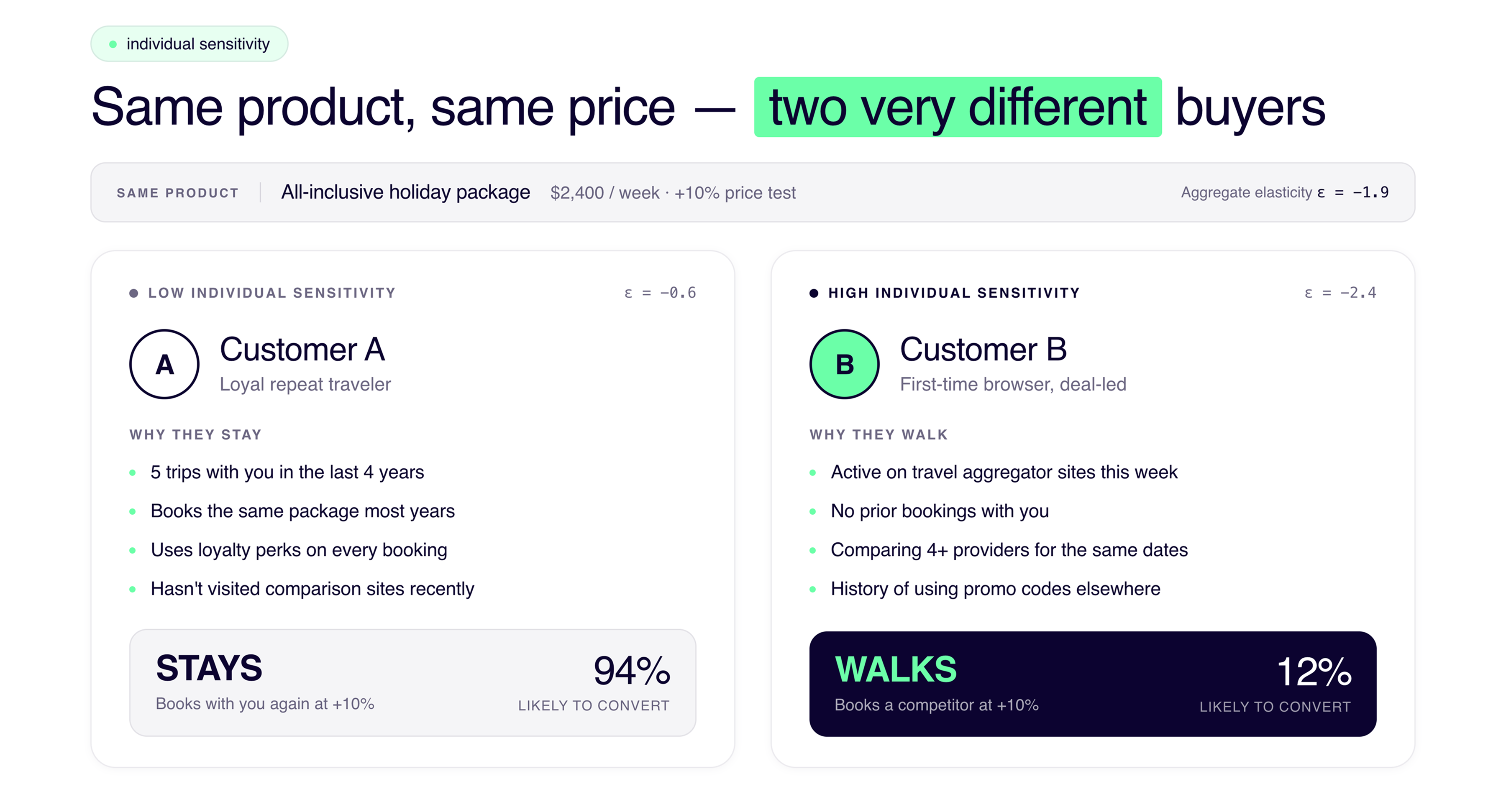
The ability to understand price sensitivity at the individual level is now very sophisticated. And that's where the shift has happened. It's not just about understanding price sensitivity in aggregate across your customer base. It's about understanding it for each individual customer, because your segment profile will be different from mine. You might be young, I might be older. Our needs and behaviors are different. So my price sensitivity for a given product or service will be different from yours, even for the same product at the same moment.
What our orchestration layer is doing is understanding all of that from a pricing perspective at the individual level, but also the relationship between your price elasticity and mine. It applies weighting factors and says: for this particular service, this customer is not really price sensitive, but that customer is very price sensitive, because their profile is different and they have different needs and behaviors.
Price elasticity also connects directly to other models in the stack. If we have demand forecasting, price elasticity, and inventory management running for a client, the orchestration layer is monitoring the interrelationships between all of them. To what extent is price influencing demand? And to what extent is price influencing demand for a given segment? Those are questions you can't answer cleanly by looking at a price elasticity model in isolation. You need to see it alongside the demand model and the segmentation model at the same time.
The models include scenario testing capability, so a client can run granular price tests and understand the revenue implications before committing. What happens to conversion if I move this price point up for this segment? What's the impact on margin if I introduce a promotional price for lapsing customers but hold price for my most loyal ones? These are the kinds of questions the model is built to answer.
For a CEO or a board, the question they're really asking is what are the actual drivers of profitability, and how do I influence them? Price is almost always one of the most significant levers, but most organizations are still managing it on instinct or broad competitive benchmarking rather than on individual-level data. The combination of price elasticity modeling, the KAI orchestration layer, and the KAI assistant as an AI deployment partner is what closes that gap. You end up with the ability to optimize one of the most important levers in your business in a way that was, until recently, only accessible to the airlines and insurers that built it from scratch decades ago.


%201.svg)



%201.svg)
