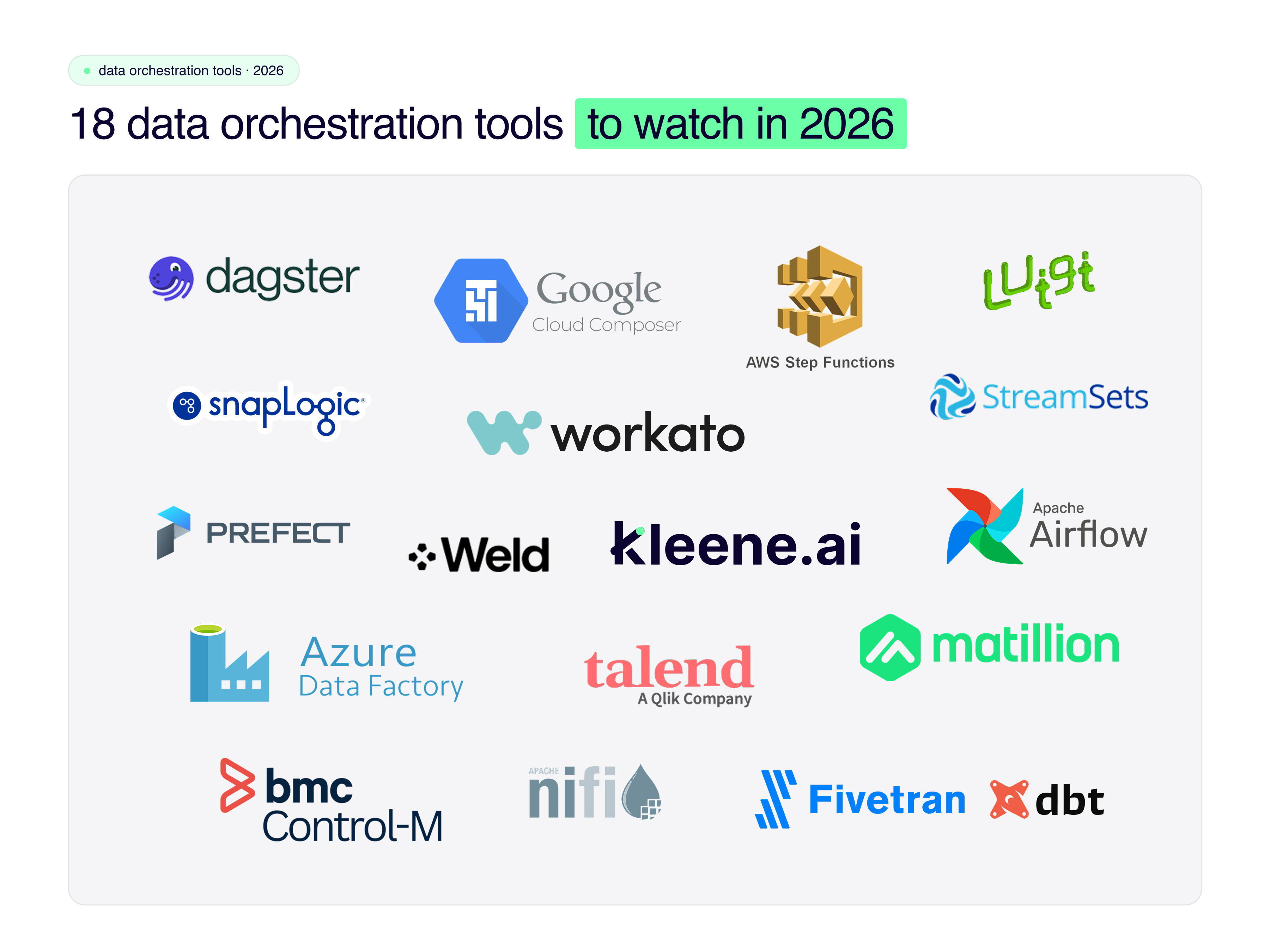
The best data orchestration tools in 2026 range from open-source frameworks like Apache Airflow, Prefect, Dagster and Luigi, to cloud-native services like AWS Step Functions, Azure Data Factory and Google Cloud Composer, to unified platforms like Kleene.ai that build orchestration in by default. Which one fits depends on whether you want maximum engineering control or fewer tools and faster outcomes. Most data problems in 2026 aren't caused by missing dashboards or weak SQL, they're caused by poor orchestration: pipelines that break silently, data that arrives late, and dependencies nobody can see.
Data orchestration tools coordinate how data moves, transforms, and becomes usable across an organization. In 2026, most data problems are not caused by missing dashboards or weak SQL skills. They are caused by poor orchestration. Pipelines break silently. Data arrives late. Dependencies are unclear. Teams spend more time debugging than deciding.
This guide explains what data orchestration tools are, how data orchestration processes actually work in practice, and which data orchestration software platforms are worth watching in 2026. It is written for organizations dealing with siloed data, legacy systems, and tools built before AI.
Why do data orchestration tools matter in 2026?
In 2026, most organizations already have data pipelines. The problem is that those pipelines are fragile, opaque, and difficult to operate at scale.
As data volumes grow and AI-driven use cases move into production, the cost of poor orchestration increases dramatically. Late data breaks forecasts. Silent failures undermine trust. Inconsistent dependencies produce conflicting answers across teams. What used to be an engineering inconvenience becomes a business risk.
Modern data orchestration processes do more than schedule jobs. They coordinate dependencies across ingestion, transformation, analytics, and AI workflows. They provide visibility into what ran, what failed, why it failed, and what downstream decisions are impacted. They enable automation testing frameworks and data orchestration testing that validate outputs before they reach executives, models, or operational systems.
For organizations dealing with siloed data and legacy software built before AI, orchestration is often the missing layer. Without it, data integration tools create complexity rather than clarity. With it, teams can move faster, trust their outputs, and support real application testing for analytics and AI use cases that matter to the business.
In short, data orchestration tools are no longer optional infrastructure. They are what separates data systems that merely move information from systems that reliably support decision-making at scale.
Category: Unified data orchestration and AI platform Best for: Business-led teams that want outcomes, not tooling
Kleene.ai embeds data orchestration directly into a unified data and intelligence platform. Orchestration is not a separate layer. Pipelines, dependencies, testing, monitoring, analytics, and AI applications are managed together. This reduces complexity and removes the need for stitching together multiple tools.
Pros
Built-in orchestration without separate frameworks
Automated testing and monitoring across pipelines
AI data applications for forecasting, segmentation, attribution, inventory, and pricing
Natural language querying through KAI for non-technical users
Fixed-fee pricing simplifies forecasting and scaling
Cons
Less flexibility for teams that want to build everything from scratch
Opinionated platform approach may not suit extreme customization needs
Category: Open-source data orchestration framework Best for: Engineering-first organizations
Apache Airflow remains one of the most widely used data orchestration tools. It uses DAGs to define dependencies and scheduling logic, typically in Python. It is powerful but infrastructure-heavy.
No native/built in AI-powered analytics layer, Maia focuses on helping data engineering teams automate routine workflows and accelerate pipeline delivery currently
Requires additional tools for orchestration completeness
Category: Lightweight orchestration Best for: Small engineering teams
Pros
Simple dependency management
Lightweight
Cons
Minimal UI
No built-in testing or monitoring
Final takeaway
In 2026, data orchestration tools are the foundation of reliable analytics, AI, and decision-making. The key question is no longer which tool moves data fastest. It is which tool reduces complexity, improves trust, and actually enables better decisions.
For many organizations, the future of data orchestration is not another framework. It is fewer tools, tighter integration, and outcomes built on top of orchestration by default.


%201.svg)


%201.svg)
