AI data integration: what it means, and how it works
July 7, 2026
— min read
Henry Owen
Product Marketing Manger
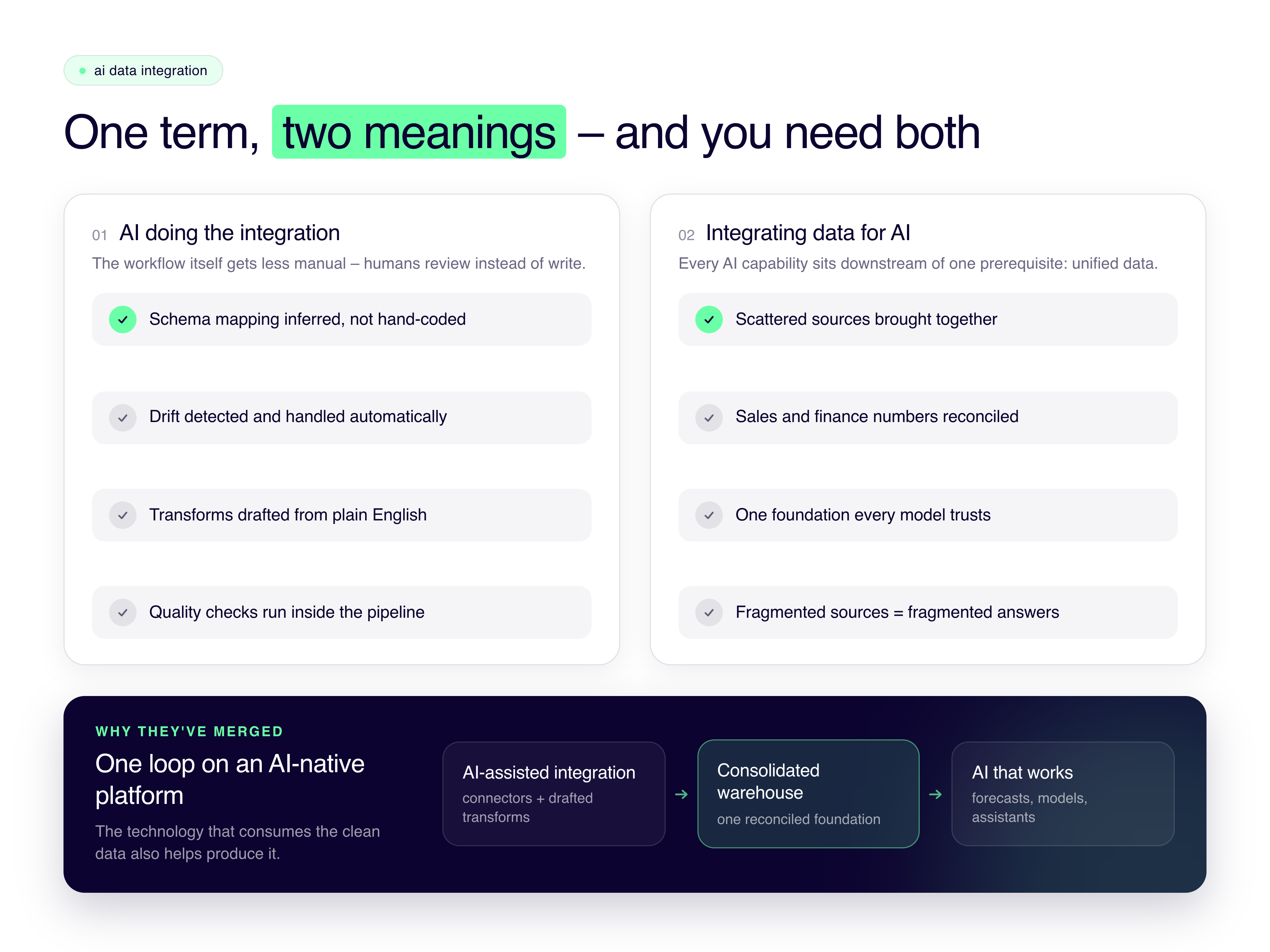
"AI data integration" is a term that gets used to refer to two different things, and which one we’re talking about changes what you're buying, if you’re in the market for some software. The first meaning is using AI to do the integration directly: pipelines that map schemas automatically, connectors that automatically fix themselves when a source API changes, natural language assistants that write transformation logic from a plain-English request. The second meaning is integrating data for AI: consolidating your scattered sources into the clean, unified foundation that any model, forecast, or AI assistant needs before it can produce anything trustworthy.
In practice the two meanings have collapsed into one big problem. You need integrated data to make AI useful, and AI has become the best way to do that integrating. Most businesses looking for "AI data integration" actually need both halves and don't yet know it, so let's take them in turn and then deal with how you evaluate the whole thing.
The two different meanings of AI data integration, and why both are important in 2026
Meaning one: AI doing the integration
Traditional data integration was a mostly manual craft. Data engineers wrote connector code, mapped source fields to warehouse schemas by hand, and rewrote it all whenever a source changed. The maintenance burden was the biggest, hidden cost, and it's why integration projects used to take way more resources than were budgeted for.
AI changes the economics at specific points in that workflow. Schema mapping can now be inferred rather than hand-coded. Schema drift can be detected and handled automatically. Transformation logic can be drafted from a plain-English description and reviewed by a human instead of written from a blank editor. And data quality checks can run inside the pipeline continuously rather than as a quarterly audit. We've gone deeper on this shift in our piece on AI ETL versus traditional ETL; the short version is that AI doesn't eliminate integration work so much as move the human role from writing to reviewing.
This is the meaning most vendors lead with, because "our copilot writes your pipelines" demos well.
Meaning two: integrating data for AI
The larger half is the less trendy one. Every AI capability a business wants, forecasting, segmentation or a natural-language assistant that answers questions about the business, sits downstream of one prerequisite: data from many systems, brought together and reconciled. A demand forecast built on sales data that disagrees with the finance system produces confidently wrong numbers. An AI assistant connected to fragmented sources gives fragmented answers.
This is the version of AI data integration that decides whether your investment produces anything of value. The pattern is consistent: a business buys an AI tool, points it at data that was never consolidated, gets outputs they can’t trust, and concludes AI doesn't work for them.
Why the two halves belong together
Now that you’ve got both halves, hopefully the reason they've merged becomes clear. The businesses that need data integrated for AI are overwhelmingly the ones without large data engineering teams, which means they also need the integration itself to be less labor-intensive, which is exactly what AI-assisted integration provides. The technology that consumes the clean data is also the technology that helps produce it.
That loop is what an AI-native data platform actually is, and it's the best answer to the search that probably brought you here. On full stack solutions like Kleene, the pipeline/ETL layer uses AI where it earns its place: managed connectors that handle drift, KAI Assistant drafting and debugging transformations in plain English with a human approving every change. And the output of that layer, the consolidated warehouse, is what the KAI Analytics models then run on.
How to evaluate AI data integration honestly
Ask what happens when a source schema changes, because automated drift handling is where AI integration earns its keep, and where the weakest tools just rely on you noticing the breakage. Ask who reviews AI-generated transformations before they touch production, because a tool that auto-commits its own SQL is a liability; the right pattern is draft, diff, human approval. Ask whether the tool stops at moving data or carries through to the analytics the data is for, because a stack assembled from an ingestion tool, a transformation tool, a warehouse, and a separate AI layer has real costs we've priced line by line, and the meters all run at once. And ask what happens to the sources the connector library doesn't cover, because every business has at least one system nobody supports, and "build it yourself" is a very different answer from "we build it for you in a couple of weeks."
Where this fits in the bigger picture
If you're trying to work out which meaning of AI data integration your business actually needs, the answer is usually both, and the order is always the same: foundation first. Bring us your sources and we'll give you a straight read on what integrating them properly looks like, including the timeline and the honest version of what it costs.


%201.svg)


%201.svg)
