What is a data warehouse & does your retail business need one?
December 17, 2023
- min read
Henry Owen
Product Marketing Manger
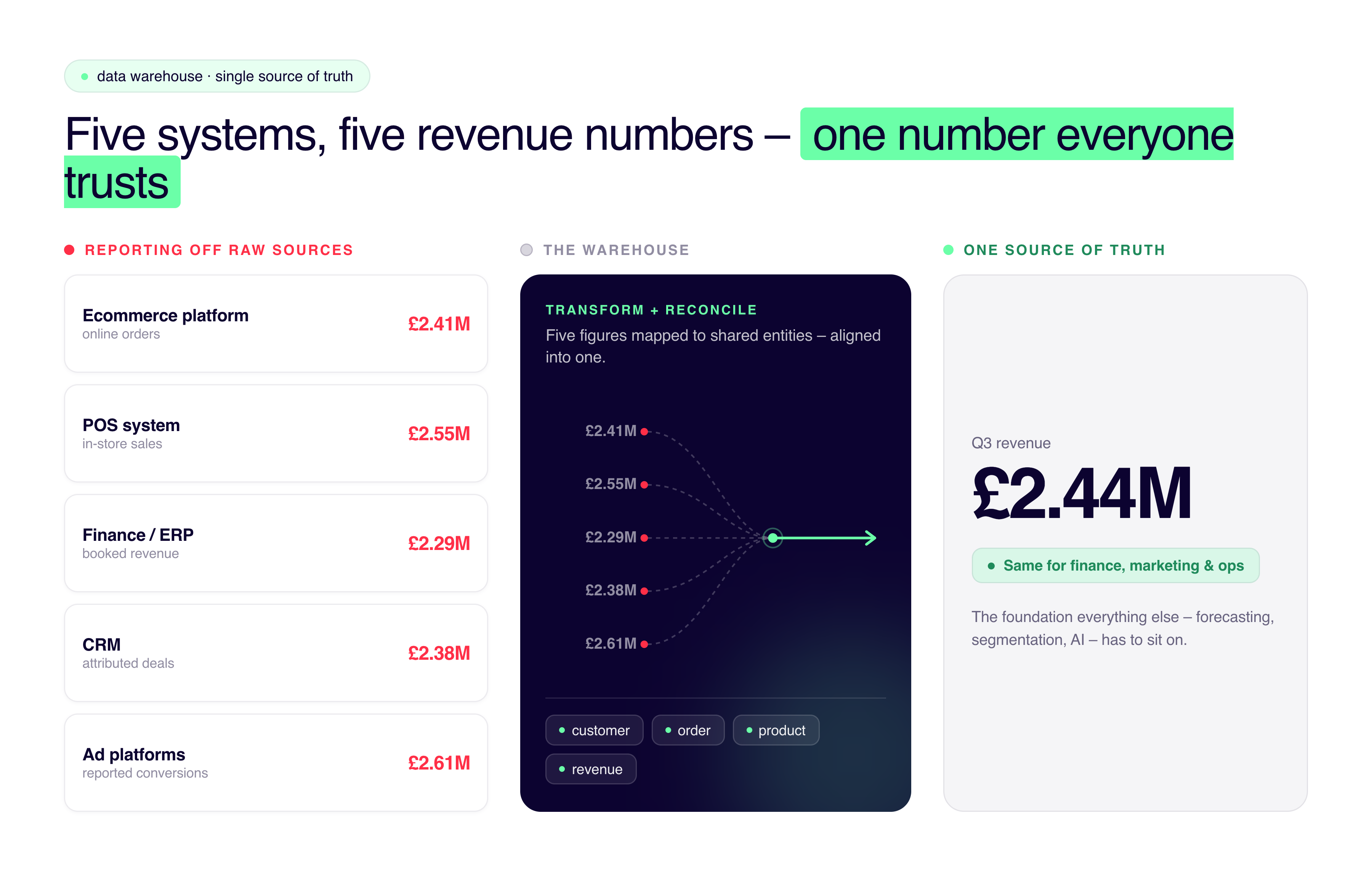
Most retail businesses don't discover they need a data warehouse. They discover, usually in a meeting, that the marketing team's revenue number and the finance team's revenue number don't match, and nobody in the room can say which one is right. That argument, repeated across enough meetings, is what a data warehouse solves. But the term gets thrown around like everyone already knows what it means, so let's start there and then get to the more useful question: whether your business is actually at the point of needing one, or whether you'd be buying infrastructure ahead of the problem.
Why retail has this problem worse than most
A retail business generates data from more places than almost any other kind of company. Transactions, the ecommerce platform, the POS system, the CRM, email and social, ad platforms, the warehouse and inventory system, returns, customer service. Each one holds a piece of the truth about your customers and your performance, and each one holds it in its own format, on its own schedule, using its own definition of things.
That last part is the killer. The reflex is to point a BI tool at all of it and start building dashboards, and BI tools will happily connect to raw sources and draw charts. What they can't do is reconcile the sources against each other, so the dashboard looks authoritative while reporting from data that disagrees with itself. You end up with beautiful charts built on numbers three systems can't agree on, which is worse than no chart, because now the wrong number has a design department behind it.
The thing you're actually building: a single source of truth
Underneath all the technical language, a data warehouse exists to create one thing: a single source of truth. A unified, consistent, reliable version of your data that every team works from, so the marketing revenue number and the finance revenue number are the same number because they come from the same place.
Without that, you get exactly the mess most growing retailers live in: disparate sources, inconsistent formats, quality problems nobody owns, and reporting that generates confusion instead of clearing it. The warehouse is where you store data specifically to end that, and it's the foundation everything else, forecasting, segmentation, any kind of AI, has to sit on. Skip it and you're building on sand, however good the tool on top.
How a data warehouse helps retail businesses that have outgrown reporting from raw data
So what is a data warehouse, actually?
A data warehouse aggregates large volumes of data from many sources, your CRM, your ERP, your ecommerce platform, your ad accounts, and brings them together in one place, structured and prepared for analysis.
The distinction worth understanding is against the databases you already run. A transactional database, the one behind your ecommerce site, is built for day-to-day operations: recording an order, updating stock, doing it fast and reliably thousands of times an hour. A data warehouse is built for the opposite job, analysis rather than operations, storing data in a structured, query-friendly format designed for the complex questions and reporting that transactional systems choke on. One runs your business. The other tells you how your business is running.
How it turns chaos into something you can question
The clever part is what happens between raw data landing and you asking it a question. A transforming layer breaks each part of your business, customers, orders, products, into fundamental building blocks called entities, and it's entities that make the data interpretable.
The customer entity is the example that makes it click. Your customers touch multiple systems across their journey: they're a record in the ecommerce platform, a contact in the CRM, an email subscriber, a returns case, a loyalty member. A BI tool can pull each of those in separately and report on them, but it has no way of knowing they're all the same person. A customer entity in the warehouse is the bridge, reconciling every system's idea of "a customer" into one consistent definition. Once that exists, you can ask a question of any dataset and trust that "customer" means the same thing every time. That reconciliation is the whole game, and it's the part a BI tool alone cannot do.
The six signs you've outgrown reporting off raw data
Businesses tend to reach for a warehouse at recognizable moments rather than on a schedule. If several of these are true, you're probably there.
Six signs you've outgrown reporting off raw data
The signal
What it means
Fragmented data silos
Teams can't get a unified view because data lives in isolated systems that don't connect.
Inconsistent reporting
Different tools produce conflicting numbers, and meetings turn into arguments about whose figure is right.
Rising data volume
Growth means more sources generating more data than spreadsheets or single tools can integrate.
Advanced analytics needs
Forecasting, segmentation, or any AI use case requires a centralized, reliable, reconciled data source to work at all.
Regulatory or audit pressure
You need a structured, auditable record of your data, which fragmented sources can't provide.
Slow query performance
Legacy systems bog down on the complex queries that reporting increasingly demands as data grows.
The honest read on this list: one or two of these and you might still be fine with simpler tooling for a while. Four or more, and you're already paying the cost of not having a warehouse, just in wasted hours and bad decisions rather than a line item. That cost is the one nobody puts in a budget, which is why the decision so often gets deferred past the point it should.
Where this sits on the data maturity curve
It helps to see the warehouse as a step on a path rather than a purchase. Picture data maturity as a curve. On the left, companies look backwards: historical reporting, siloed between departments, built on inconsistent data that's hard to trust and harder to act on. Further right, the systems get more proactive, more automated, more trusted, until data is actually driving decisions rather than justifying them after the fact.
A warehouse is the step that moves a retailer off the left of that curve, because almost nothing to the right is possible without a single source of truth underneath it. Demand forecasting, customer segmentation, price elasticity, the AI capabilities every retailer now wants, all of them assume clean, reconciled, centralized data as a starting condition. Try to bolt predictive analytics onto fragmented sources and you get confident predictions built on numbers that don't agree, which is the vanity-metric problem wearing a more expensive suit. (We wrote about how demand forecasting works once that foundation is in place, and external factors like weather and seasonal events turn out to drive more of retail demand than most teams expect.)
The payoff for getting up the curve is real and measurable. McKinsey's research has found data-driven companies are considerably more likely to outperform on customer acquisition, profitability, and retention. We'd treat the exact multipliers with the usual caution you'd apply to any headline stat, but the direction is not seriously in dispute: the retailers who can trust their data make better decisions than the ones who can't, and they compound that advantage over time.
The part most articles skip: you might not need one yet
Here's the honest boundary, because a data warehouse is not a universal answer. If you're a small retailer running on one or two systems, with data volumes a spreadsheet still handles and no immediate need for forecasting or advanced analytics, a full warehouse can be premature. The reconciliation problem it solves has to actually exist for the solution to earn its cost.
The tell is whether your teams are already arguing about whose numbers are right, already waiting days for reports, already unable to answer a question because the answer lives in four systems. If that's happening, you've outgrown reporting off raw data and the warehouse is overdue. If it isn't yet, you have some runway, and the smarter move is to plan for the warehouse before the pain rather than scramble for it during. Either way, the decision belongs inside a broader look at your whole stack, which is what our framework for choosing a data stack walks through before you commit to any tool.
Turning retail data into decisions
The through-line here is simple. Retail runs on data scattered across more systems than most industries, that scatter creates disagreement, and disagreement is expensive. A data warehouse ends the disagreement by building a single source of truth, and that foundation is what makes everything more valuable, from clean reporting to AI, possible at all.
Building and running one is the part that stops most retailers, because a warehouse on its own is infrastructure that still needs connecting, transforming, and maintaining. That's the problem Kleene's platform for retail is built to solve: the managed warehouse, the connectors, the transformation layer, and the reconciliation all handled together, with KAI Assistant on top so a merchandiser or a head of ecommerce can ask a question in plain English and get a consistent answer, rather than waiting on a report built from sources that don't agree.
If you want to work out whether your retail business is at the point of needing a warehouse, or whether you've been paying for the lack of one already without realizing it, bring us your setup and we'll give you a straight read.


%201.svg)


%201.svg)
